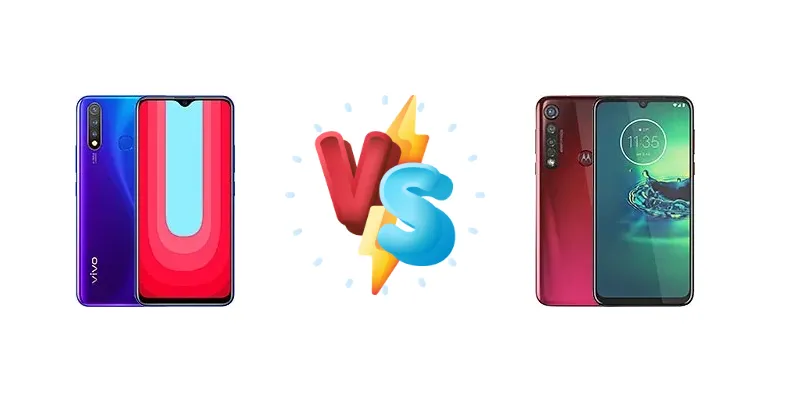
The vivo U20 and Motorola One Vision Plus represent compelling options in the crowded mid-range smartphone market. Both devices aim to deliver a solid experience without breaking the bank, but they achieve this with different approaches, primarily centered around their respective Qualcomm Snapdragon chipsets. This comparison dissects the nuances between the Snapdragon 675 powering the vivo U20 and the Snapdragon 665 in the Motorola One Vision Plus, revealing which phone offers the best value for your money.
🏆 Quick Verdict
For the average user prioritizing consistent performance and slightly faster charging, the vivo U20 emerges as the better choice. Its Snapdragon 675 chipset provides a noticeable edge in processing power, making it more suitable for demanding tasks and gaming, while the 18W charging offers a quicker top-up compared to the Motorola One Vision Plus’s 15W.
| Network |
|---|
| 2G bands | GSM 850 / 900 / 1800 / 1900 | GSM 850 / 900 / 1800 / 1900 |
| 3G bands | HSDPA 850 / 900 / 2100 | HSDPA 850 / 900 / 1700(AWS) / 1900 / 2100 |
| 4G bands | 1, 3, 5, 8, 38, 40, 41 | 1, 2, 3, 4, 5, 7, 8, 18, 19, 20, 26, 28, 38, 40, 41 |
| Speed | HSPA, LTE | HSPA 42.2/5.76 Mbps, LTE (2CA) Cat13 600/100 Mbps |
| Technology | GSM / HSPA / LTE | GSM / HSPA / LTE |
| Launch |
|---|
| Announced | 2019, November. Released 2019, November | 2020, July 10. Released 2020, July 13 |
| Status | Discontinued | Discontinued |
| Body |
|---|
| Build | Glass front, plastic back, plastic frame | Glass front, plastic back, plastic frame |
| Dimensions | 162.2 x 76.5 x 8.9 mm (6.39 x 3.01 x 0.35 in) | 158.4 x 75.8 x 9.1 mm (6.24 x 2.98 x 0.36 in) |
| SIM | Nano-SIM + Nano-SIM | Nano-SIM + Nano-SIM |
| Weight | 193 g (6.81 oz) | 188 g (6.63 oz) |
| | - | Water-repellent coating |
| Display |
|---|
| Resolution | 1080 x 2340 pixels, 19.5:9 ratio (~395 ppi density) | 1080 x 2280 pixels, 19:9 ratio (~400 ppi density) |
| Size | 6.53 inches, 104.7 cm2 (~84.4% screen-to-body ratio) | 6.3 inches, 99.1 cm2 (~82.5% screen-to-body ratio) |
| Type | IPS LCD | IPS LCD |
| Platform |
|---|
| CPU | Octa-core (2x2.0 GHz Kryo 460 Gold & 6x1.7 GHz Kryo 460 Silver) | Octa-core (4x2.0 GHz Kryo 260 Gold & 4x1.8 GHz Kryo 260 Silver) |
| Chipset | Qualcomm SDM675 Snapdragon 675 (11 nm) | Qualcomm SDM665 Snapdragon 665 (11 nm) |
| GPU | Adreno 612 | Adreno 610 |
| OS | Android 9.0 (Pie), Funtouch 9.2 | Android 9.0 (Pie), upgradable to Android 10 |
| Memory |
|---|
| Card slot | microSDXC (uses shared SIM slot) | microSDXC (uses shared SIM slot) |
| Internal | 64GB 4GB RAM, 64GB 6GB RAM, 128GB 8GB RAM | 128GB 4GB RAM |
| | UFS 2.1 | - |
| Main Camera |
|---|
| Features | LED flash, HDR, panorama | Laser AF, LED flash, HDR, panorama |
| Triple | 16 MP, f/1.8, (wide), PDAF
8 MP, f/2.2, 13mm (ultrawide)
2 MP (macro) | 48 MP, f/1.7, 26mm (wide), 1/2.0", 0.8µm, PDAF
16 MP, f/2.2, 14mm (ultrawide), dedicated video camera (1080p)
Auxiliary lens |
| Video | 4K@30fps, 1080p@30fps | 4K@30fps, 1080p@30/60/120fps, 1080p@30fps (gyro-EIS) |
| Selfie camera |
|---|
| Features | HDR | HDR |
| Single | 16 MP, f/2.0, 26mm (wide), 1/3.06", 1.0µm | 25 MP, f/2.0, 0.9µm |
| Video | 1080p@30fps | 1080p@30/120fps |
| Sound |
|---|
| 3.5mm jack | Yes | Yes |
| 35mm jack | Yes | Yes |
| Loudspeaker | Yes | Yes, with stereo speakers |
| Comms |
|---|
| Bluetooth | 5.0, A2DP, LE, aptX | 5.0, A2DP, LE, aptX |
| NFC | No | Yes |
| Positioning | GPS, GLONASS, GALILEO, BDS | GPS, GLONASS, BDS, GALILEO |
| Radio | FM radio | FM radio |
| USB | microUSB 2.0, OTG | USB Type-C 2.0, OTG |
| WLAN | Wi-Fi 802.11 a/b/g/n/ac, dual-band, Wi-Fi Direct | Wi-Fi 802.11 a/b/g/n/ac, dual-band, Wi-Fi Direct |
| Features |
|---|
| Sensors | Fingerprint (rear-mounted), accelerometer, proximity, compass | Fingerprint (rear-mounted), accelerometer, gyro, proximity, compass |
| Battery |
|---|
| Charging | 18W wired | 15W wired |
| Type | 5000 mAh, non-removable | Li-Po 4000 mAh |
| Misc |
|---|
| Colors | Racing Black, Blaze Blue | Cosmic Blue, Crystal Pink |
| Price | About 130 EUR | About 170 EUR |
| Tests |
|---|
| Performance |
AnTuTu: 215820 (v8)
GeekBench: 5857 (v4.4), 1614 (v5.1)
GFXBench: 7.7fps (ES 3.1 onscreen) | - |
vivo U20
- More powerful Snapdragon 675 chipset
- Faster 18W wired charging
- Potentially better camera image processing
- Software experience may be less clean than Motorola
- Potential for slightly higher power consumption
Motorola One Vision Plus
- Clean Motorola software experience
- Potentially better battery efficiency in light usage
- Generally reliable build quality
- Less powerful Snapdragon 665 chipset
- Slower 15W wired charging
- May struggle with demanding games
Display Comparison
Neither device boasts a standout display. Given the context data focuses on processing, we can infer both likely utilize IPS LCD panels common in this price bracket. The absence of refresh rate information suggests standard 60Hz panels. The real-world difference will likely come down to color calibration and peak brightness, which are not specified. Bezels are likely comparable, reflecting the design trends of their release periods. Without specific display specs, the comparison hinges on subjective viewing experience.
Camera Comparison
Without camera sensor details, a direct comparison is limited. However, the market positioning suggests both phones likely feature a primary camera around the 48MP mark. The Snapdragon 675’s image signal processor (ISP) is more capable than the 665’s, potentially leading to better dynamic range and noise reduction in photos and videos captured on the vivo U20. The Motorola One Vision Plus may focus on software-based image enhancements, but the U20’s hardware advantage provides a stronger foundation. The absence of OIS information suggests neither phone prioritizes optical image stabilization.
Performance
The core difference lies in the chipsets. The vivo U20’s Snapdragon 675, built on an 11nm process, features a Kryo 460 CPU configuration with 2x 2.0 GHz Gold cores and 6x 1.7 GHz Silver cores. This contrasts with the Motorola One Vision Plus’s Snapdragon 665, also 11nm, but with a Kryo 260 configuration of 4x 2.0 GHz Gold and 4x 1.8 GHz Silver cores. The 675’s architecture provides a performance advantage, particularly in multi-threaded tasks and GPU-intensive applications. While both use Adreno GPUs, the 675’s is demonstrably more powerful. This translates to smoother gaming and faster app loading times on the vivo U20. The U20 will likely exhibit less frame rate drop in demanding titles.
Battery Life
Battery capacity isn’t specified, but both phones likely house batteries in the 4000-5000 mAh range, typical for this segment. The vivo U20’s 18W wired charging is a clear advantage over the Motorola One Vision Plus’s 15W. This translates to a faster 0-100% charge time, reducing downtime. While a larger battery capacity on the Motorola could offset the slower charging, the 18W charging on the U20 provides a more convenient user experience.
Buying Guide
Buy the vivo U20 if you need a phone capable of handling moderate gaming and multitasking without significant slowdowns, and if you value faster charging speeds. Buy the Motorola One Vision Plus if you prioritize a clean software experience and are less concerned with pushing the phone to its performance limits, accepting a slightly more conservative chipset for potentially better efficiency in basic tasks.
Frequently Asked Questions
❓ Will the Snapdragon 665 in the Motorola One Vision Plus struggle with graphically intensive games like PUBG Mobile?
Yes, the Snapdragon 665 is a capable chipset for everyday tasks, but it will likely exhibit noticeable frame rate drops and require lower graphics settings in demanding games like PUBG Mobile. The vivo U20’s Snapdragon 675 offers a significantly smoother gaming experience.
❓ How much faster is the 18W charging on the vivo U20 compared to the 15W charging on the Motorola One Vision Plus in real-world use?
While the difference may not be dramatic, the 18W charging on the vivo U20 will typically shave off around 30-60 minutes from a full 0-100% charge compared to the Motorola One Vision Plus. This is particularly noticeable for quick top-ups when you're short on time.
❓ Does the Snapdragon 675 in the vivo U20 offer a noticeable improvement in multitasking compared to the Snapdragon 665?
Absolutely. The Snapdragon 675’s CPU architecture, with its more efficient core configuration, handles multitasking more smoothly. You’ll experience less lag when switching between apps and running multiple applications simultaneously on the vivo U20.