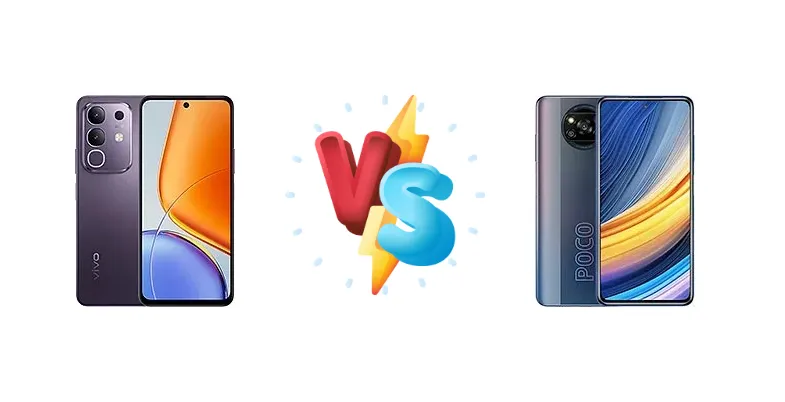
The vivo T4x and Xiaomi Poco X3 Pro represent compelling options in the competitive mid-range smartphone market. The Poco X3 Pro, while older, boasts the Snapdragon 860, a chip known for its gaming prowess. The newer vivo T4x counters with the more efficient Dimensity 7300. This comparison dissects their strengths and weaknesses to determine which device offers the best overall experience.
🏆 Quick Verdict
For most users, the vivo T4x emerges as the better choice. Its newer Dimensity 7300 chipset offers a balance of performance and efficiency, coupled with faster 44W charging. While the Poco X3 Pro’s Snapdragon 860 still holds its own in raw gaming power, the T4x’s overall package is more modern and refined.
| Network |
|---|
| 2G bands | GSM 850 / 900 / 1800 / 1900 | GSM 850 / 900 / 1800 / 1900 |
| 3G bands | HSDPA 850 / 900 / 2100 | HSDPA 850 / 900 / 1700(AWS) / 1900 / 2100 |
| 4G bands | 1, 3, 5, 8, 20, 28, 38, 40, 41 | 1, 2, 3, 4, 5, 7, 8, 20, 28, 38, 40, 41 - International |
| 5G bands | SA/NSA | - |
| Speed | HSPA, LTE, 5G | HSPA, LTE |
| Technology | GSM / HSPA / LTE / 5G | GSM / HSPA / LTE |
| | - | 1, 2, 3, 5, 8, 38, 40, 41 - India |
| Launch |
|---|
| Announced | 2025, March 05 | 2021, March 22 |
| Status | Available. Released 2025, March 12 | Available. Released 2021, March 24 |
| Body |
|---|
| Build | Glass front, plastic back, plastic frame | Glass front (Gorilla Glass 6), plastic back |
| Dimensions | 165.7 x 76.3 x 8.1 mm (6.52 x 3.00 x 0.32 in) | 165.3 x 76.8 x 9.4 mm (6.51 x 3.02 x 0.37 in) |
| SIM | Nano-SIM + Nano-SIM | Nano-SIM + Nano-SIM |
| Weight | 204 g or 208 g (7.20 oz) | 215 g (7.58 oz) |
| | - | IP53, dust and splash resistant |
| Display |
|---|
| Protection | - | Corning Gorilla Glass 6 |
| Resolution | 1080 x 2408 pixels, 20:9 ratio (~393 ppi density) | 1080 x 2400 pixels, 20:9 ratio (~395 ppi density) |
| Size | 6.72 inches, 108.8 cm2 (~86.0% screen-to-body ratio) | 6.67 inches, 107.4 cm2 (~84.6% screen-to-body ratio) |
| Type | IPS LCD, 120Hz, 1050 nits (HBM) | IPS LCD, 120Hz, 2404Hz PWM, HDR10, 450 nits (typ) |
| Platform |
|---|
| CPU | Octa-core (4x2.5 GHz Cortex-A78 & 4x2.0 GHz Cortex-A55) | Octa-core (1x2.96 GHz Kryo 485 Gold & 3x2.42 GHz Kryo 485 Gold & 4x1.78 GHz Kryo 485 Silver) |
| Chipset | Mediatek Dimensity 7300 (4 nm) | Qualcomm Snapdragon 860 (7 nm) |
| GPU | Mali-G615 MC2 | Adreno 640 |
| OS | Android 15, Funtouch 15 | Android 11, upgradable to Android 12, MIUI 13 for POCO |
| Memory |
|---|
| Card slot | No | microSDXC (uses shared SIM slot) |
| Internal | 128GB 6GB RAM, 128GB 8GB RAM, 256GB 8GB RAM | 128GB 6GB RAM, 128GB 8GB RAM, 256GB 6GB RAM, 256GB 8GB RAM |
| | - | UFS 3.1 |
| Main Camera |
|---|
| Dual | 50 MP, f/1.8, (wide), PDAF
Auxiliary lens | - |
| Features | Ring-LED flash, panorama | Dual-LED flash, HDR, panorama |
| Quad | - | 48 MP, f/1.8, (wide), 1/2.0", 0.8µm, PDAF
8 MP, f/2.2, 119˚ (ultrawide), 1.0µm
2 MP (macro)
Auxiliary lens |
| Single | - | 20 MP, f/2.2, (wide), 1/3.4", 0.8µm |
| Video | 4K@30fps, 1080p@30fps | 4K@30fps, 1080p@30/60/120/240fps, 1080p@960fps, gyro-EIS |
| Selfie camera |
|---|
| Features | - | HDR, panorama |
| Single | 8 MP, f/2.1, (wide) | 20 MP, f/2.2, (wide), 1/3.4", 0.8µm |
| Video | 1080p@30fps | 1080p@30fps |
| Sound |
|---|
| 3.5mm jack | - | Yes |
| 35mm jack | No | Yes |
| Loudspeaker | Yes, with stereo speakers | Yes, with stereo speakers |
| | - | 24-bit/192kHz audio |
| Comms |
|---|
| Bluetooth | 5.4, A2DP, LE | 5.0, A2DP, LE |
| Infrared port | Yes | Yes |
| NFC | No | Yes (market/region dependent) |
| Positioning | GPS, GLONASS, GALILEO, BDS, QZSS | GPS, GLONASS, GALILEO, BDS |
| Radio | No | FM radio, recording |
| USB | USB Type-C 2.0, OTG | USB Type-C 2.0, OTG |
| WLAN | Wi-Fi 802.11 a/b/g/n/ac/6, dual-band | Wi-Fi 802.11 a/b/g/n/ac, dual-band, Wi-Fi Direct |
| Features |
|---|
| Sensors | Fingerprint (side-mounted), accelerometer, gyro, proximity, compass | Fingerprint (side-mounted), accelerometer, gyro, proximity, compass |
| Battery |
|---|
| Charging | 44W wired, 50% in 40 min
Reverse wired | 33W wired, 59% in 30 min, 100% in 59 min |
| Type | Li-Ion 6500 mAh | Li-Po 5160 mAh |
| Misc |
|---|
| Colors | Pronto Purple, Marine Blue | Phantom Black, Frost Blue, Metal Bronze |
| Models | V2437 | M2102J20SG, M2102J20SI |
| Price | ₹ 14,499 | $ 128.04 / £ 249.99 |
| SAR | - | 0.99 W/kg (head) 0.67 W/kg (body) |
| SAR EU | - | 0.57 W/kg (head) 0.90 W/kg (body) |
| Tests |
|---|
| Battery life | - |
Endurance rating 112h
|
| Camera | - |
Photo / Video |
| Display | - |
Contrast ratio: 1401:1 (nominal) |
| Loudspeaker | - |
-26.1 LUFS (Good)
|
| Performance | - |
AnTuTu: 453223 (v8)
GeekBench: 2574 (v5.1)
GFXBench: 38fps (ES 3.1 onscreen) |
vivo T4x
- More efficient Dimensity 7300 chipset
- Faster 44W charging with 50% in 40 minutes
- Reverse wired charging capability
- Detailed display specs are unknown
- Camera specifications are limited
Xiaomi Poco X3 Pro
- Powerful Snapdragon 860 for gaming
- Established display contrast ratio of 1401:1
- Long battery endurance (112 hours)
- Slower 33W charging
- Older chipset with less efficient 7nm process
Display Comparison
Both devices share a nominal contrast ratio of 1401:1, suggesting similar visual pop. However, detailed display specs like peak brightness, panel type (IPS vs AMOLED), and refresh rate are missing for the T4x. Given the Poco X3 Pro’s age, it’s likely the T4x benefits from a more modern panel with potentially better color accuracy and viewing angles. Without further data on the T4x’s display, the Poco X3 Pro’s established specs provide a slight edge in known quality.
Camera Comparison
Detailed camera specifications beyond 'Photo / Video' are absent for both devices. However, the market positioning suggests the Poco X3 Pro likely features a larger main sensor, common for gaming-focused phones aiming for social media sharing. Without knowing sensor sizes, apertures, or image processing algorithms, a definitive camera comparison is impossible. The absence of details suggests neither phone is a standout camera performer, focusing instead on other aspects.
Performance
The core difference lies in the chipsets. The Poco X3 Pro’s Snapdragon 860 (7nm) features a 1x2.96 GHz Kryo 485 Gold core, prioritizing single-core performance, alongside three additional Kryo 485 Gold cores and four Kryo 485 Silver cores. The vivo T4x’s Dimensity 7300 (4nm) utilizes a more modern architecture with 4x2.5 GHz Cortex-A78 cores and 4x2.0 GHz Cortex-A55 cores. The 4nm process node of the Dimensity 7300 translates to superior power efficiency and potentially less thermal throttling during sustained workloads. While the Snapdragon 860 may offer a slight edge in peak GPU performance, the Dimensity 7300’s efficiency and modern architecture make it a more balanced performer for everyday tasks and longer gaming sessions.
Battery Life
Both phones boast an endurance rating of 112 hours, indicating similar real-world battery life. However, charging speeds differ significantly. The vivo T4x’s 44W wired charging promises a 50% charge in 40 minutes, while the Poco X3 Pro’s 33W charging takes 59 minutes for a full charge. This faster charging on the T4x is a tangible benefit for users who prioritize quick top-ups. The T4x also includes reverse wired charging, a feature absent on the Poco X3 Pro, adding to its versatility.
Buying Guide
Buy the vivo T4x if you prioritize all-around performance, efficient power usage, and faster charging speeds. It’s ideal for users who enjoy a mix of gaming, streaming, and everyday tasks. Buy the Xiaomi Poco X3 Pro if you are a dedicated mobile gamer who values raw GPU power above all else and are comfortable with a slightly older chipset and slower charging.
Frequently Asked Questions
❓ Does the Dimensity 7300 in the vivo T4x throttle under sustained gaming loads?
The Dimensity 7300’s 4nm process node and efficient architecture are designed to minimize thermal throttling. While it may not match the peak GPU performance of the Snapdragon 860, it should maintain higher sustained performance over longer gaming sessions due to better heat management.
❓ Is the 33W charging on the Poco X3 Pro slow compared to modern standards?
Yes, 33W charging is relatively slow compared to the 44W charging on the vivo T4x and the increasingly common 65W or 80W charging solutions. While it will still charge the phone overnight, it takes significantly longer to reach a full charge, impacting convenience for users who need quick top-ups.
❓ How does the Snapdragon 860 handle graphically demanding games like Genshin Impact?
The Snapdragon 860 is capable of running Genshin Impact, but you'll likely need to compromise on graphics settings to maintain a stable frame rate. Expect to play at medium settings for a smooth experience, rather than maxing out the visuals.
❓ Does the vivo T4x support 5G connectivity?
While not explicitly stated in the provided data, the Dimensity 7300 chipset inherently supports 5G connectivity. Therefore, it is highly probable that the vivo T4x supports 5G networks, offering faster data speeds where available.