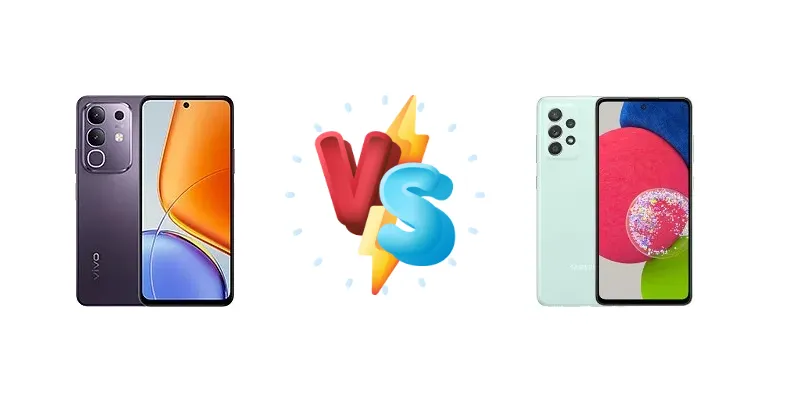
The mid-range smartphone market is fiercely competitive, and the vivo T4x and Samsung Galaxy A52s 5G represent compelling options. The A52s 5G, while an older model, remains a popular choice due to its established reputation. The T4x, however, brings newer silicon in the form of the Mediatek Dimensity 7300, promising a performance uplift. This comparison dissects the key differences to determine which device offers the best value.
🏆 Quick Verdict
For most users, the vivo T4x emerges as the better choice. Its newer Dimensity 7300 chipset, built on a more efficient 4nm process, delivers superior performance and future-proofing. While the Galaxy A52s 5G boasts a proven endurance rating, the T4x’s faster 44W charging and modern processor give it an edge.
| Network |
|---|
| 2G bands | GSM 850 / 900 / 1800 / 1900 | GSM 850 / 900 / 1800 / 1900 |
| 3G bands | HSDPA 850 / 900 / 2100 | HSDPA 850 / 900 / 1700(AWS) / 1900 / 2100 |
| 4G bands | 1, 3, 5, 8, 20, 28, 38, 40, 41 | 1, 2, 3, 4, 5, 7, 8, 12, 17, 20, 26, 28, 32, 38, 40, 41, 66 |
| 5G bands | SA/NSA | 1, 3, 5, 7, 8, 20, 28, 38, 40, 41, 66, 78 SA/NSA/Sub6 |
| Speed | HSPA, LTE, 5G | HSPA 42.2/5.76 Mbps, LTE Cat18 1200/150 Mbps, 5G |
| Technology | GSM / HSPA / LTE / 5G | GSM / HSPA / LTE / 5G |
| Launch |
|---|
| Announced | 2025, March 05 | 2021, August 17 |
| Status | Available. Released 2025, March 12 | Available. Released 2021, September 01 |
| Body |
|---|
| Build | Glass front, plastic back, plastic frame | Glass front (Gorilla Glass 5), plastic back |
| Dimensions | 165.7 x 76.3 x 8.1 mm (6.52 x 3.00 x 0.32 in) | 159.9 x 75.1 x 8.4 mm (6.30 x 2.96 x 0.33 in) |
| SIM | Nano-SIM + Nano-SIM | · Nano-SIM· Nano-SIM + Nano-SIM |
| Weight | 204 g or 208 g (7.20 oz) | 189 g (6.67 oz) |
| | - | IP67 dust/water resistant (up to 1m for 30 min) |
| Display |
|---|
| Protection | - | Corning Gorilla Glass 5 |
| Resolution | 1080 x 2408 pixels, 20:9 ratio (~393 ppi density) | 1080 x 2400 pixels, 20:9 ratio (~405 ppi density) |
| Size | 6.72 inches, 108.8 cm2 (~86.0% screen-to-body ratio) | 6.5 inches, 102.0 cm2 (~84.9% screen-to-body ratio) |
| Type | IPS LCD, 120Hz, 1050 nits (HBM) | Super AMOLED, 120Hz, 800 nits (HBM) |
| Platform |
|---|
| CPU | Octa-core (4x2.5 GHz Cortex-A78 & 4x2.0 GHz Cortex-A55) | Octa-core (1x2.4 GHz Cortex-A78 & 3x2.2 GHz Cortex-A78 & 4x1.9 GHz Cortex-A55) |
| Chipset | Mediatek Dimensity 7300 (4 nm) | Qualcomm SM7325 Snapdragon 778G 5G (6 nm) |
| GPU | Mali-G615 MC2 | Adreno 642L |
| OS | Android 15, Funtouch 15 | Android 11, upgradable to Android 14, One UI 6 |
| Memory |
|---|
| Card slot | No | microSDXC (uses shared SIM slot) |
| Internal | 128GB 6GB RAM, 128GB 8GB RAM, 256GB 8GB RAM | 128GB 4GB RAM, 128GB 6GB RAM, 128GB 8GB RAM, 256GB 6GB RAM, 256GB 8GB RAM |
| Main Camera |
|---|
| Dual | 50 MP, f/1.8, (wide), PDAF
Auxiliary lens | - |
| Features | Ring-LED flash, panorama | LED flash, panorama, HDR |
| Quad | - | 64 MP, f/1.8, 26mm (wide), 1/1.7", 0.8µm, PDAF, OIS
12 MP, f/2.2, 123˚ (ultrawide), 1.12µm
5 MP (macro)
Auxiliary lens |
| Single | - | 32 MP, f/2.2, 26mm (wide), 1/2.8", 0.8µm |
| Video | 4K@30fps, 1080p@30fps | 4K@30fps, 1080p@30/60fps; gyro-EIS |
| Selfie camera |
|---|
| Features | - | HDR |
| Single | 8 MP, f/2.1, (wide) | 32 MP, f/2.2, 26mm (wide), 1/2.8", 0.8µm |
| Video | 1080p@30fps | 4K@30fps, 1080p@30/60fps |
| Sound |
|---|
| 3.5mm jack | - | Yes |
| 35mm jack | No | Yes |
| Loudspeaker | Yes, with stereo speakers | Yes, with stereo speakers |
| Comms |
|---|
| Bluetooth | 5.4, A2DP, LE | 5.0, A2DP, LE |
| Infrared port | Yes | - |
| NFC | No | Yes (market/region dependent) |
| Positioning | GPS, GLONASS, GALILEO, BDS, QZSS | GPS, GLONASS, GALILEO, BDS, QZSS |
| Radio | No | No |
| USB | USB Type-C 2.0, OTG | USB Type-C 2.0, OTG |
| WLAN | Wi-Fi 802.11 a/b/g/n/ac/6, dual-band | Wi-Fi 802.11 a/b/g/n/ac/6, dual-band, Wi-Fi Direct |
| Features |
|---|
| Sensors | Fingerprint (side-mounted), accelerometer, gyro, proximity, compass | Fingerprint (under display, optical), accelerometer, gyro, compass |
| | - | Virtual Proximity Sensing |
| Battery |
|---|
| Charging | 44W wired, 50% in 40 min
Reverse wired | 25W wired |
| Type | Li-Ion 6500 mAh | Li-Ion 4500 mAh |
| Misc |
|---|
| Colors | Pronto Purple, Marine Blue | Awesome Black, Awesome White, Awesome Purple, Awesome Mint |
| Models | V2437 | SM-A528B, SM-A528B/DS, SM-A528N |
| Price | ₹ 14,499 | £ 112.98 / € 249.47 |
| SAR | - | 0.72 W/kg (head) |
| SAR EU | - | 0.88 W/kg (head) 0.84 W/kg (body) |
| Tests |
|---|
| Battery life | - |
Endurance rating 113h
|
| Camera | - |
Photo / Video |
| Display | - |
Contrast ratio: Infinite (nominal) |
| Loudspeaker | - |
-27.5 LUFS (Good)
|
| Performance | - |
AnTuTu: 429675 (v8), 506432(v9)
GeekBench: 11060 (v4.4), 2801 (v5.1)
GFXBench: 28fps (ES 3.1 onscreen) |
vivo T4x
- Faster 44W charging significantly reduces downtime.
- More efficient 4nm Dimensity 7300 chipset for better performance and thermal management.
- Reverse wired charging adds convenience.
- Display specifications are unknown, potentially lacking the vibrancy of the A52s 5G’s AMOLED.
- Camera performance is unproven compared to the A52s 5G’s established track record.
Samsung Galaxy A52s 5G
- Proven 113-hour endurance rating for all-day battery life.
- Vibrant Super AMOLED display with 800 nits peak brightness.
- Well-established software support and reliability.
- Slower 25W charging takes longer to replenish the battery.
- Older 6nm Snapdragon 778G chipset is less power-efficient and performs lower than the Dimensity 7300.
Display Comparison
The Samsung Galaxy A52s 5G features a display capable of reaching 800 nits of peak brightness, a respectable figure for outdoor visibility. While the vivo T4x’s display specifications are not provided, Samsung’s Super AMOLED panel is known for its vibrant colors and excellent contrast ratio, advertised as 'Infinite'. The A52s 5G’s display technology is a known quantity, while the T4x’s panel remains a variable. The A52s 5G’s brightness advantage is significant for users who frequently use their phones in direct sunlight.
Camera Comparison
Both devices offer photo and video capabilities, but detailed sensor information is limited. The A52s 5G’s camera system is known for its reliable performance, but the T4x’s potential benefits from a newer image signal processor (ISP) integrated within the Dimensity 7300. Without specific sensor size or aperture details for the T4x, it’s difficult to definitively assess its camera performance. However, the newer chipset suggests improved image processing algorithms and potentially better low-light performance. We can safely assume both phones will include standard features like HDR and portrait modes.
Performance
The core difference lies in the chipsets. The vivo T4x utilizes the Mediatek Dimensity 7300 (4nm), featuring an octa-core configuration with 4x2.5 GHz Cortex-A78 and 4x2.0 GHz Cortex-A55 cores. The Samsung Galaxy A52s 5G is powered by the Qualcomm SM7325 Snapdragon 778G 5G (6nm), with an octa-core setup of 1x2.4 GHz Cortex-A78, 3x2.2 GHz Cortex-A78, and 4x1.9 GHz Cortex-A55 cores. The Dimensity 7300’s 4nm fabrication process offers improved power efficiency compared to the Snapdragon 778G’s 6nm node, potentially leading to less thermal throttling during sustained workloads. The T4x’s newer architecture should translate to a noticeable performance advantage in gaming and demanding applications.
Battery Life
The Samsung Galaxy A52s 5G boasts an endurance rating of 113 hours, indicating solid battery life. However, the vivo T4x compensates with significantly faster 44W wired charging, capable of reaching 50% charge in just 40 minutes, compared to the A52s 5G’s 25W charging. While the A52s 5G’s battery endurance is commendable, the T4x’s faster charging mitigates any potential battery capacity differences. The T4x also offers reverse wired charging, a feature absent in the A52s 5G, adding to its versatility.
Buying Guide
Buy the vivo T4x if you prioritize raw performance, faster charging speeds, and a more modern chipset for demanding apps and future software updates. Buy the Samsung Galaxy A52s 5G if you value a well-established track record for battery life and a potentially lower price point, and aren't heavily reliant on the latest processing power.
Frequently Asked Questions
❓ Will the Dimensity 7300 in the vivo T4x handle demanding games like Genshin Impact at high settings?
The Dimensity 7300 is a significant step up from the Snapdragon 778G and should provide a smooth gaming experience in titles like Genshin Impact. While you may need to adjust settings for optimal frame rates, the 4nm process and improved CPU/GPU architecture will deliver better sustained performance and less thermal throttling compared to the A52s 5G.
❓ How much faster is the 44W charging on the vivo T4x compared to the 25W charging on the Samsung Galaxy A52s 5G in real-world use?
The 44W charging on the T4x will noticeably reduce charging times. While the A52s 5G takes over an hour to fully charge, the T4x can reach 50% in just 40 minutes, and a full charge will be significantly faster. This is a major convenience factor for users who frequently need to top up their battery quickly.
❓ Does the Samsung Galaxy A52s 5G still receive software updates and security patches?
Samsung typically provides several years of software support for its devices. While the A52s 5G is an older model, it should continue to receive security patches and potentially one or two more major Android updates, depending on Samsung's update schedule. However, the T4x will likely have a longer software support lifespan due to its newer release date.