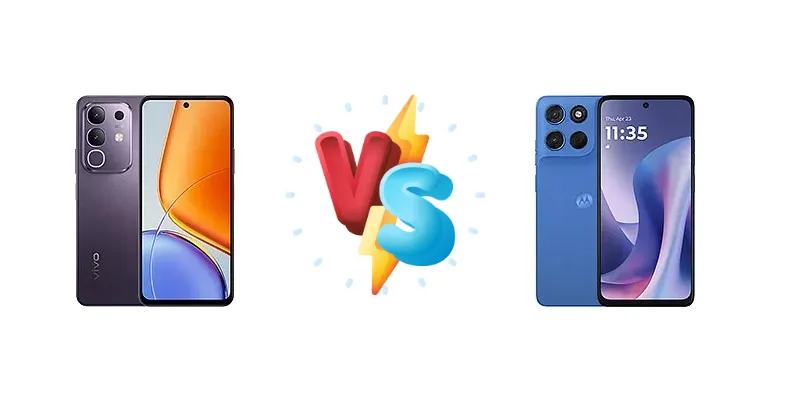
The mid-range smartphone market is fiercely competitive, and the vivo T4x and Motorola Moto G100S represent compelling options for budget-conscious buyers. Both devices leverage 4nm chipsets, promising efficiency, but differ significantly in their CPU architecture and charging capabilities. This comparison dissects these differences to determine which phone offers the best overall value.
🏆 Quick Verdict
For most users, the vivo T4x emerges as the stronger contender. Its Mediatek Dimensity 7300 chipset, with its faster Cortex-A78 cores, provides a noticeable performance edge in demanding tasks. While the Moto G100S offers a respectable experience, the T4x’s superior processing power and faster 44W charging make it the better choice.
| Network |
|---|
| 2G bands | GSM 850 / 900 / 1800 / 1900 | GSM 850 / 900 / 1800 / 1900 |
| 3G bands | HSDPA 850 / 900 / 2100 | HSDPA 850 / 900 / 1900 / 2100 |
| 4G bands | 1, 3, 5, 8, 20, 28, 38, 40, 41 | LTE |
| 5G bands | SA/NSA | SA/NSA |
| Speed | HSPA, LTE, 5G | HSPA, LTE, 5G |
| Technology | GSM / HSPA / LTE / 5G | GSM / HSPA / LTE / 5G |
| Launch |
|---|
| Announced | 2025, March 05 | 2025, November 03 |
| Status | Available. Released 2025, March 12 | Available. Released 2025, November 03 |
| Body |
|---|
| Build | Glass front, plastic back, plastic frame | Glass front, plastic frame, silicone polymer (eco leather) back |
| Dimensions | 165.7 x 76.3 x 8.1 mm (6.52 x 3.00 x 0.32 in) | 166.2 x 76.5 x 8.6 mm (6.54 x 3.01 x 0.34 in) |
| SIM | Nano-SIM + Nano-SIM | Nano-SIM + Nano-SIM |
| Weight | 204 g or 208 g (7.20 oz) | 210 g (7.41 oz) |
| Display |
|---|
| Resolution | 1080 x 2408 pixels, 20:9 ratio (~393 ppi density) | 1080 x 2400 pixels, 20:9 ratio (~392 ppi density) |
| Size | 6.72 inches, 108.8 cm2 (~86.0% screen-to-body ratio) | 6.72 inches, 109.0 cm2 (~85.8% screen-to-body ratio) |
| Type | IPS LCD, 120Hz, 1050 nits (HBM) | IPS LCD, 120Hz, 1050 nits (peak) |
| Platform |
|---|
| CPU | Octa-core (4x2.5 GHz Cortex-A78 & 4x2.0 GHz Cortex-A55) | Octa-core (4x2.4 GHz Cortex-A78 & 4x1.8 GHz Cortex-A55) |
| Chipset | Mediatek Dimensity 7300 (4 nm) | Qualcomm SM6435-AA Snapdragon 6s Gen 4 (4 nm) |
| GPU | Mali-G615 MC2 | Adreno |
| OS | Android 15, Funtouch 15 | Android 15 |
| Memory |
|---|
| Card slot | No | No |
| Internal | 128GB 6GB RAM, 128GB 8GB RAM, 256GB 8GB RAM | 128GB 8GB RAM, 256GB 8GB RAM |
| Main Camera |
|---|
| Dual | 50 MP, f/1.8, (wide), PDAF
Auxiliary lens | 50 MP, f/1.9 (wide), 1/1.95", 0.8µm, PDAF
8 MP, f/2.2, 118˚ (ultrawide), 1/4.0", 1.12µm |
| Features | Ring-LED flash, panorama | LED flash, HDR, panorama |
| Video | 4K@30fps, 1080p@30fps | 1440p@30fps, 1080p@30fps |
| Selfie camera |
|---|
| Features | - | HDR |
| Single | 8 MP, f/2.1, (wide) | 8 MP, f/2.2, (wide), 1/4.0", 1.12µm |
| Video | 1080p@30fps | 1440p@30fps, 1080p@30fps |
| Sound |
|---|
| 35mm jack | No | Yes |
| Loudspeaker | Yes, with stereo speakers | Yes, with stereo speakers |
| Comms |
|---|
| Bluetooth | 5.4, A2DP, LE | 5.1, A2DP, LE |
| Infrared port | Yes | - |
| NFC | No | Yes |
| Positioning | GPS, GLONASS, GALILEO, BDS, QZSS | GPS, GALILEO, GLONASS, BDS, QZSS |
| Radio | No | No |
| USB | USB Type-C 2.0, OTG | USB Type-C 2.0, OTG |
| WLAN | Wi-Fi 802.11 a/b/g/n/ac/6, dual-band | Wi-Fi 802.11 a/b/g/n/ac, dual-band |
| Features |
|---|
| Sensors | Fingerprint (side-mounted), accelerometer, gyro, proximity, compass | Fingerprint (side-mounted), accelerometer, gyro, proximity, compass |
| Battery |
|---|
| Charging | 44W wired, 50% in 40 min
Reverse wired | 30W wired |
| Type | Li-Ion 6500 mAh | Si/C Li-Ion 7000 mAh |
| Misc |
|---|
| Colors | Pronto Purple, Marine Blue | Black, Blue |
| Models | V2437 | - |
| Price | ₹ 14,499 | About 120 EUR |
vivo T4x
- Faster CPU clock speeds for improved performance
- 44W fast charging for quicker top-ups
- Potentially better multitasking capabilities
- Software experience may vary (vivo’s Funtouch OS)
- Camera details are unknown, potential for lower quality
Motorola Moto G100S
- Potentially better thermal management due to Snapdragon’s efficiency
- Motorola’s near-stock Android experience (depending on skin)
- Competitive price point
- Slower CPU clock speeds compared to the T4x
- 30W charging is slower than the T4x
- Performance may be limited in demanding applications
Display Comparison
Display specifications are absent from the provided data, making a direct comparison impossible. However, given the price bracket, both devices likely feature LCD panels with FHD+ resolution. The absence of LTPO technology suggests standard refresh rates (60Hz or 90Hz). The user experience will likely hinge on color calibration and peak brightness, areas where Motorola historically performs well, but without specific data, it's speculative.
Camera Comparison
Camera details are missing, but we can infer some points. Both phones likely feature multi-camera setups, but the quality will depend heavily on sensor size and image processing. Without sensor specifications, it’s difficult to assess image quality. Motorola often emphasizes software-based image enhancement, while vivo tends to focus on hardware capabilities. The absence of any mention of OIS suggests neither phone prioritizes optical image stabilization.
Performance
The core difference lies in the chipsets. The vivo T4x’s Mediatek Dimensity 7300 features four Cortex-A78 cores clocked at 2.5 GHz, while the Motorola Moto G100S utilizes the Snapdragon 6s Gen 4 with Cortex-A78 cores at 2.4 GHz. While both are 4nm chips, the higher clock speed of the Dimensity 7300 suggests a performance advantage in CPU-bound tasks. The Snapdragon 6s Gen 4 aims for efficiency, potentially offering better sustained performance under load due to thermal management. Both utilize Cortex-A55 cores for efficiency, clocked at 2.0 GHz and 1.8 GHz respectively. The T4x’s CPU architecture is likely to translate to faster app loading and smoother multitasking.
Battery Life
Battery capacity is not specified, but the charging wattage is a key differentiator. The vivo T4x supports 44W wired charging, claiming a 50% charge in 40 minutes. The Motorola Moto G100S is limited to 30W wired charging. This means the T4x will significantly reduce charging times, a crucial benefit for users who frequently need to top up their battery. The actual battery life will depend on the battery capacity and software optimization, but the faster charging of the T4x provides a tangible advantage.
Buying Guide
Buy the vivo T4x if you prioritize raw performance for gaming or multitasking and value faster charging speeds. This phone is ideal for users who frequently push their devices. Buy the Motorola Moto G100S if you prefer a potentially more refined software experience (depending on Motorola’s skin) and are less concerned with achieving peak performance. It’s a solid all-rounder for everyday tasks.
Frequently Asked Questions
❓ Will the Dimensity 7300 in the vivo T4x overheat during prolonged gaming sessions?
While the Dimensity 7300 is a powerful chip, its 4nm process and the T4x’s likely thermal design should mitigate overheating. However, sustained high loads will inevitably generate heat. The Snapdragon 6s Gen 4 in the Moto G100S may exhibit slightly better thermal efficiency, but the T4x’s performance advantage may be worth the potential for slightly warmer temperatures.
❓ Does the Motorola Moto G100S support 5G connectivity?
The Snapdragon 6s Gen 4 typically includes an integrated 5G modem. Therefore, the Motorola Moto G100S likely supports 5G connectivity, but the specific 5G bands supported will vary by region and carrier. Check the phone’s specifications for compatibility with your network.
❓ How does the software experience differ between the vivo T4x and the Motorola Moto G100S?
vivo’s Funtouch OS is heavily customized and includes numerous features, but can be perceived as bloated by some users. Motorola, on the other hand, generally offers a near-stock Android experience with minimal bloatware, appealing to those who prefer a cleaner interface. Software updates may also be more frequent and timely on the Motorola device.