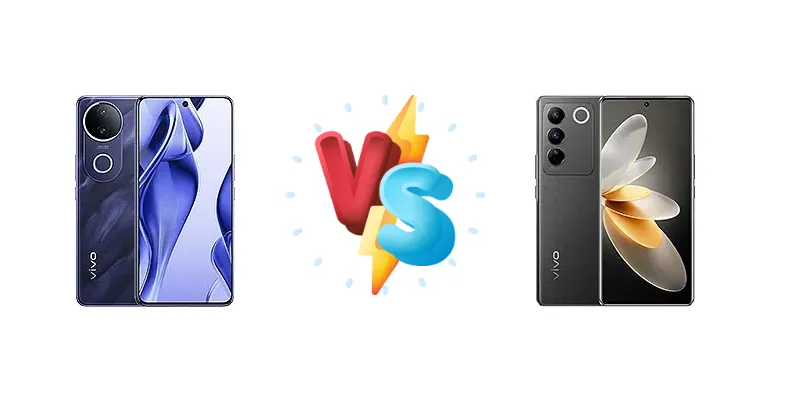
vivo's T and V series represent distinct approaches to the mid-range market. The T4R focuses on delivering strong performance at a competitive price, while the V27 Pro aims for a more premium experience with a brighter display and faster charging. This comparison dissects the key differences between these two devices to help you determine which best suits your needs.
🏆 Quick Verdict
For the average user prioritizing a smoother experience and faster charging, the vivo V27 Pro is the better choice. Its Dimensity 8200 chipset and 66W charging offer a noticeable upgrade over the T4R's Dimensity 7400 and 44W charging, justifying the price difference for many.
| Network |
|---|
| 2G bands | GSM 850 / 900 / 1800 / 1900 | GSM 850 / 900 / 1800 / 1900 |
| 3G bands | HSDPA 850 / 900 / 1700(AWS) / 2100 | HSDPA 850 / 900 / 1700(AWS) / 2100 |
| 4G bands | 1, 3, 5, 8, 19, 28, 38, 40, 41, 42 | 1, 3, 4, 5, 8, 28, 38, 40, 41 |
| 5G bands | 1, 3, 5, 8, 28, 40, 77, 78 SA/NSA | 1, 3, 5, 8, 28, 77, 78 SA/NSA |
| Speed | HSPA, LTE, 5G | HSPA, LTE, 5G |
| Technology | GSM / HSPA / LTE / 5G | GSM / HSPA / LTE / 5G |
| Launch |
|---|
| Announced | 2025, July 31 | 2023, March 01 |
| Status | Available. Released 2025, August 05 | Available. Released 2023, March 01 |
| Body |
|---|
| Build | - | Glass front, plastic frame, glass back |
| Dimensions | 163.3 x 76.7 x 7.4 mm (6.43 x 3.02 x 0.29 in) | 164.1 x 74.8 x 7.4 mm (6.46 x 2.94 x 0.29 in) |
| SIM | Nano-SIM + Nano-SIM | Nano-SIM + Nano-SIM |
| Weight | 183.5 g (6.49 oz) | 182 g (6.42 oz) |
| | - | Color changing back panel color |
| Display |
|---|
| Protection | Diamond Shield Glass | - |
| Resolution | 1080 x 2392 pixels (~388 ppi density) | 1080 x 2400 pixels, 20:9 ratio (~388 ppi density) |
| Size | 6.77 inches, 110.9 cm2 (~88.5% screen-to-body ratio) | 6.78 inches, 111.0 cm2 (~90.4% screen-to-body ratio) |
| Type | AMOLED, 1B colors, 120Hz, 2160Hz PWM, HDR10+, 1300 nits (HBM), 1800 nits (peak) | AMOLED, 1B colors, 120Hz, HDR10+ |
| Platform |
|---|
| CPU | Octa-core (4x2.6 GHz Cortex-A78 & 4x2.0 GHz Cortex-A55) | Octa-core (1x3.1 GHz Cortex-A78 & 3x3.0 GHz Cortex-A78 & 4x2.0 GHz Cortex-A55) |
| Chipset | Mediatek Dimensity 7400 (4 nm) | Mediatek Dimensity 8200 (4 nm) |
| GPU | Mali-G615 MC2 | Mali-G610 MC6 |
| OS | Android 15, up to 2 major Android upgrades, Funtouch 15 | Android 13, Funtouch 13 |
| Memory |
|---|
| Card slot | No | No |
| Internal | 128GB 8GB RAM, 256GB 8GB RAM, 256GB 12GB RAM | 128GB 8GB RAM, 256GB 8GB RAM, 256GB 12GB RAM |
| | - | UFS 3.1 |
| Main Camera |
|---|
| Dual | 50 MP, f/1.8, (wide), 1/1.95", 0.8µm, PDAF, OIS
Auxiliary lens | - |
| Features | LED flash, HDR, panorama | Ring-LED flash, panorama, HDR |
| Single | - | 50 MP, f/2.5, (wide), AF |
| Triple | - | 50 MP, f/1.9, (wide), 1/1.56", 1.0µm, PDAF, OIS
8 MP, f/2.2, 16mm, 120˚ (ultrawide), 1/4.0", 1.12µm
2 MP (macro) |
| Video | 4K@30fps, 1080p@30/60fps, gyro-EIS | 4K@30/60fps, 1080p@30fps, gyro-EIS |
| Selfie camera |
|---|
| Features | - | Dual-LED flash, HDR |
| Single | 32 MP, f/2.5, (wide) | 50 MP, f/2.5, (wide), AF |
| Video | 4K@30fps, 1080p@30/60fps | 4K@30/60fps, 1080p@30fps, gyro-EIS |
| Sound |
|---|
| 3.5mm jack | - | No |
| 35mm jack | No | No |
| Loudspeaker | Yes, with stereo speakers | Yes |
| | - | 24-bit/192kHz audio |
| Comms |
|---|
| Bluetooth | 5.4, A2DP, LE | 5.3, A2DP, LE |
| NFC | No | Yes |
| Positioning | GPS, GLONASS, GALILEO, BDS, QZSS | GPS, GLONASS, GALILEO, BDS, NavIC |
| Radio | No | No |
| USB | USB Type-C 2.0, OTG | USB Type-C 2.0, OTG |
| WLAN | Wi-Fi 802.11 a/b/g/n/ac/6, dual-band | Wi-Fi 802.11 a/b/g/n/ac/6, dual-band, Wi-Fi Direct |
| Features |
|---|
| Sensors | Fingerprint (under display, optical), accelerometer, gyro, proximity, compass | Fingerprint (under display, optical), accelerometer, gyro, proximity, compass |
| Battery |
|---|
| Charging | 44W wired
Reverse wired
Bypass charging | 66W wired, 50% in 19 min, 72% in 30 min |
| Type | Li-Ion 5700 mAh | 4600 mAh |
| Misc |
|---|
| Colors | Arctic White, Twilight Blue | Magic Blue, Noble Black |
| Models | - | V2230 |
| Price | ₹ 19,830 | About 440 EUR |
| SAR | - | 1.22 W/kg (head) 0.89 W/kg (body) |
| Tests |
|---|
| Battery life | - |
Endurance rating 121h
|
| Camera | - |
Photo / Video |
| Display | - |
Contrast ratio: Infinite (nominal) |
| Loudspeaker | - |
-29.1 LUFS (Average)
|
| Performance | - |
AnTuTu: 846767 (v9)
GeekBench: 3933 (v5.1), 3421 (v6)
GFXBench: 57fps (ES 3.1 onscreen) |
vivo T4R
- More affordable price point
- Reverse wired charging capability
- Solid performance for everyday tasks
- Slower charging speed (44W)
- Less powerful processor
- Limited display information
vivo V27 Pro
- Faster 66W charging
- More powerful Dimensity 8200 chipset
- Brighter 978-nit display
- Higher price tag
- No reverse wired charging
- Similar battery endurance to T4R
Display Comparison
The vivo V27 Pro boasts a significantly brighter display, reaching a measured peak of 978 nits, compared to the T4R which lacks published brightness data. This makes the V27 Pro far more usable outdoors under direct sunlight. While both likely utilize AMOLED panels given the 'infinite' contrast ratio claim on the V27 Pro, the V27 Pro’s higher brightness is a clear advantage. The T4R’s display specifications are currently limited, making a detailed comparison of color accuracy and refresh rate impossible.
Camera Comparison
Both devices are listed as having Photo/Video capabilities, but detailed camera specifications are missing for the T4R. The V27 Pro likely benefits from a more sophisticated image signal processor (ISP) integrated within the Dimensity 8200. Without sensor size or aperture information for the T4R, it’s difficult to assess its low-light performance. The V27 Pro’s camera system is expected to deliver more detailed and vibrant images, particularly in challenging lighting conditions. The presence of OIS (Optical Image Stabilization) on the V27 Pro, though unconfirmed, is highly probable given its positioning and would further enhance image quality.
Performance
At the heart of the difference lies the chipset: the V27 Pro features the Mediatek Dimensity 8200 (4nm), while the T4R utilizes the Dimensity 7400 (4nm). The Dimensity 8200’s CPU configuration – 1x3.1 GHz Cortex-A78, 3x3.0 GHz Cortex-A78, and 4x2.0 GHz Cortex-A55 – provides a performance edge over the T4R’s 4x2.6 GHz Cortex-A78 & 4x2.0 GHz Cortex-A55. This translates to faster app loading times, smoother multitasking, and improved gaming performance. Both chips are built on a 4nm process, offering good efficiency, but the 8200’s more powerful cores give it a clear lead. The V27 Pro will handle graphically intensive games at higher settings with greater stability.
Battery Life
Both phones share an endurance rating of 121 hours, suggesting similar overall battery life despite differing charging speeds. However, the V27 Pro’s 66W wired charging is a significant advantage, achieving 50% charge in just 19 minutes and 72% in 30 minutes. The T4R’s 44W charging is slower, requiring more time to fully replenish the battery. The T4R does offer reverse wired charging, a feature absent on the V27 Pro, allowing it to act as a power bank for other devices. While both have similar endurance, the V27 Pro’s faster charging minimizes downtime.
Buying Guide
Buy the vivo T4R if you need a capable daily driver with solid performance for everyday tasks and light gaming, and prioritize value for money. It's ideal for users who don't demand the absolute fastest charging or brightest display. Buy the vivo V27 Pro if you prefer a more refined experience with a brighter 978-nit display, significantly faster 66W charging (reaching 50% in just 19 minutes), and a more powerful processor for demanding applications and gaming.
Frequently Asked Questions
❓ Does the Dimensity 8200 in the V27 Pro get noticeably warmer during extended gaming sessions compared to the Dimensity 7400 in the T4R?
While both chips are 4nm and relatively efficient, the Dimensity 8200's higher performance ceiling means it *can* generate more heat under sustained load. However, vivo's cooling solutions (details of which are not provided) will play a crucial role. The V27 Pro's larger chassis may also aid in heat dissipation, potentially mitigating any significant thermal throttling.
❓ Is the 44W charging on the T4R slow enough to be a major inconvenience in daily use?
44W charging is still reasonably fast, but it's noticeably slower than the V27 Pro's 66W. Expect a full charge to take around 1 hour and 15 minutes, compared to approximately 30-40 minutes for the V27 Pro. If you frequently find yourself needing to quickly top up your battery, the V27 Pro is the better choice.
❓ Given the similar endurance ratings, will I see a real-world difference in battery life between the two phones?
The 121-hour endurance rating suggests similar battery life under *identical* usage conditions. However, the V27 Pro’s more efficient chipset may translate to slightly longer screen-on time in real-world scenarios, especially with demanding apps. The difference is likely to be marginal, but present.