
vivo T4 vs Xiaomi Redmi Note 13 Pro+: A Deep Dive into Mid-Range Power
| Phones Images | |||||
|---|---|---|---|---|---|
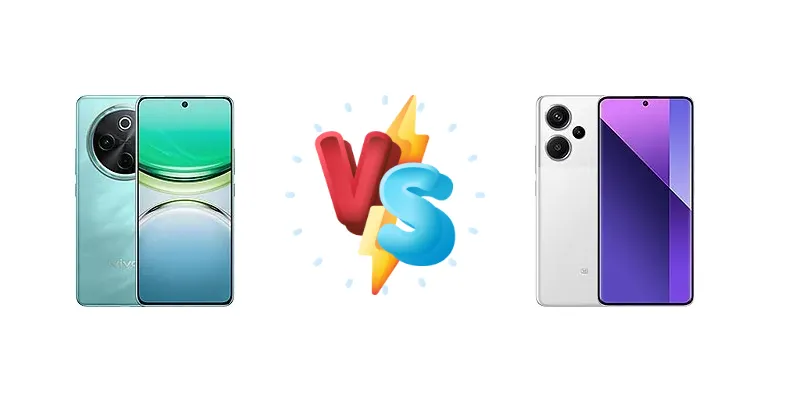
|
🏆 Quick Verdict
For the average user prioritizing rapid charging and a brighter display, the Xiaomi Redmi Note 13 Pro+ is the clear winner. Its 120W charging fully replenishes the battery in just 19 minutes, and the 1283 nits peak brightness provides excellent outdoor visibility. However, the vivo T4 offers a strong value proposition with a capable processor and versatile charging standards.
| PHONES | ||
|---|---|---|
| Phone Names | vivo T4 | Xiaomi Redmi Note 13 Pro+ |
| Network | ||
|---|---|---|
| 2G bands | GSM 850 / 900 / 1800 / 1900 | GSM 850 / 900 / 1800 / 1900 |
| 3G bands | HSDPA 800 / 850 / 900 / 2100 | HSDPA 800 / 850 / 900 / 1700(AWS) / 1900 / 2100 - International |
| 4G bands | 1, 3, 5, 8, 28, 38, 40, 41 | 1, 2, 3, 4, 5, 7, 8, 12, 13, 17, 18, 19, 20, 26, 28, 32, 38, 40, 41, 66 - International |
| 5G bands | 1, 3, 5, 8, 28, 38, 40, 41, 77, 78 SA/NSA | 1, 3, 5, 7, 8, 20, 28, 38, 40, 41, 66, 77, 78 SA/NSA- International |
| Speed | HSPA, LTE, 5G | HSPA, LTE, 5G |
| Technology | GSM / HSPA / LTE / 5G | GSM / CDMA / HSPA / EVDO / LTE / 5G |
| Launch | ||
|---|---|---|
| Announced | 2025, April 22 | 2023, September 21 |
| Status | Available. Released 2025, April 29 | Available. Released 2023, September 21 |
| Body | ||
|---|---|---|
| Build | - | Glass front (Gorilla Glass Victus), glass back or silicone polymer back (eco leather) |
| Dimensions | 163.4 x 76.4 x 7.9 mm (6.43 x 3.01 x 0.31 in) | 161.4 x 74.2 x 8.9 mm (6.35 x 2.92 x 0.35 in) |
| SIM | Nano-SIM + Nano-SIM | · Nano-SIM + eSIM· Nano-SIM + Nano-SIM |
| Weight | 199 g (7.02 oz) | 199 g or 204.5 g (7.02 oz) |
| Display | ||
|---|---|---|
| Protection | Shield Glass | Corning Gorilla Glass Victus |
| Resolution | 1080 x 2392 pixels (~388 ppi density) | 1220 x 2712 pixels, 20:9 ratio (~446 ppi density) |
| Size | 6.77 inches, 110.9 cm2 (~88.8% screen-to-body ratio) | 6.67 inches, 107.4 cm2 (~89.7% screen-to-body ratio) |
| Type | AMOLED, 1B colors, 120Hz, 3840Hz PWM, HDR, 800 nits (typ), 1300 nits (HBM), 5000 nits (peak) | AMOLED, 68B colors, 120Hz, 1920Hz PWM, Dolby Vision, HDR10+, 1800 nits (peak) |
| Platform | ||
|---|---|---|
| CPU | Octa-core (1x2.5 GHz Cortex-A720 & 3x2.4 GHz Cortex-A720 & 4x1.8 GHz Cortex-A520) | Octa-core (2x2.8 GHz Cortex-A715 & 6x2.0 GHz Cortex-A510) |
| Chipset | Qualcomm SM7635 Snapdragon 7s Gen 3 (4 nm) | Mediatek Dimensity 7200 Ultra (4 nm) |
| GPU | Adreno 810 | Mali-G610 MC4 |
| OS | Android 15, up to 2 major Android upgrades, Funtouch 15 | Android 13, up to 3 major Android upgrades, HyperOS |
| Memory | ||
|---|---|---|
| Card slot | No | No |
| Internal | 128GB 8GB RAM, 256GB 8GB RAM, 256GB 12GB RAM | 256GB 8GB RAM, 256GB 12GB RAM, 512GB 8GB RAM, 512GB 12GB RAM, 512GB 16GB RAM |
| Main Camera | ||
|---|---|---|
| Dual | 50 MP, f/1.8, (wide), 1/1.95", 0.8µm, PDAF, OIS Auxiliary lens | - |
| Features | LED flash, HDR, panorama | Dual-LED dual-tone flash, HDR, panorama |
| Triple | - | 200 MP, f/1.7, 23mm (wide), 1/1.4", 0.56µm, multi-directional PDAF, OIS 8 MP, f/2.2, 16mm, 120˚ (ultrawide), 1/4.0", 1.12µm 2 MP (macro) |
| Video | 4K@30fps, 1080p@30fps, gyro-EIS, OIS | 4K@24/30fps, 1080p@30/60/120fps, gyro-EIS |
| Selfie camera | ||
|---|---|---|
| Features | - | HDR, panorama |
| Single | 32 MP, f/2.0, (wide) | 16 MP, f/2.4, (wide) |
| Video | 4K@30fps, 1080p@30fps | 1080p@30/60fps |
| Sound | ||
|---|---|---|
| 35mm jack | No | No |
| Loudspeaker | Yes | Yes, with stereo speakers |
| Comms | ||
|---|---|---|
| Bluetooth | 5.2, A2DP, LE, aptX HD, aptX Adaptive | 5.3, A2DP, LE |
| Infrared port | Yes | Yes |
| NFC | No | Yes (market/region dependent) |
| Positioning | GPS, GALILEO, GLONASS, BDS | GPS, GLONASS, BDS, GALILEO, QZSS |
| Radio | No | No |
| USB | USB Type-C 2.0, OTG | USB Type-C 2.0, OTG |
| WLAN | Wi-Fi 802.11 a/b/g/n/ac/6, dual-band | Wi-Fi 802.11 a/b/g/n/ac/6, dual-band, Wi-Fi Direct |
| Features | ||
|---|---|---|
| Sensors | Fingerprint (under display, optical), accelerometer, gyro, proximity, compass | Fingerprint (under display, optical), accelerometer, gyro, proximity, compass |
| Battery | ||
|---|---|---|
| Charging | 90W wired, 55W PPS, 44W UFCS, 50% in 33 min 7.5W reverse wired Bypass Charging | 120W wired, PD3.0, 100% in 19 min |
| Type | Si/C Li-Ion 7300 mAh | Li-Po 5000 mAh |
| Misc | ||
|---|---|---|
| Colors | Emerald Blaze, Phantom Grey | Midnight Black (Fushion Black), Moonlight White (Fushion White), Aurora Purple, Fushion Purple, Camo Green |
| Models | V2502 | 23090RA98C, 23090RA98G, 23090RA98I |
| Price | ₹ 20,700 | $ 299.98 / £ 299.00 / € 208.98 / ₹ 24,999 |
| SAR | 0.99 W/kg (head) 0.87 W/kg (body) | 1.09 W/kg (head) 0.85 W/kg (body) |
| SAR EU | - | 0.98 W/kg (head) 1.00 W/kg (body) |
vivo T4
- Versatile charging support (90W, 55W PPS, 44W UFCS, Reverse Wired)
- Qualcomm Snapdragon 7s Gen 3 offers a balanced performance profile
- Potentially more affordable price point
- Slower charging speed compared to Redmi Note 13 Pro+
- Limited display information hinders a full comparison
Xiaomi Redmi Note 13 Pro+
- Ultra-fast 120W charging (0-100% in 19 minutes)
- High peak brightness (1283 nits) for excellent outdoor visibility
- Long active use battery life (10:38h)
- Limited charging standard support (PD3.0 only)
- Potentially higher price point
Display Comparison
The Redmi Note 13 Pro+ immediately stands out with its measured peak brightness of 1283 nits, offering superior visibility in direct sunlight compared to the vivo T4 (brightness data unavailable). While both utilize 4nm chipsets, the display’s impact on overall power consumption isn’t detailed, but the higher brightness will undoubtedly draw more power. The Redmi Note 13 Pro+ likely employs an AMOLED panel, common in this price bracket, but specifics like refresh rate and PWM dimming frequency are missing. The T4’s display specs are currently unknown, making a comprehensive comparison difficult, but the Redmi’s brightness advantage is significant.
Camera Comparison
Camera details are limited for both devices. Without sensor size, aperture, or OIS information, a direct comparison is challenging. However, the Redmi Note 13 Pro+’s potential for a higher-resolution main sensor (often seen in ‘Pro’ models) suggests a possible advantage in detail capture. The absence of information regarding image processing algorithms makes it difficult to assess the overall image quality. It’s safe to assume both phones will include standard features like night mode and portrait mode, but the quality will depend heavily on the underlying hardware and software tuning.
Performance
The Redmi Note 13 Pro+ is powered by the MediaTek Dimensity 7200 Ultra, featuring a dual-core CPU configuration with 2x2.8 GHz Cortex-A715 cores and 6x2.0 GHz Cortex-A510 cores. This contrasts with the vivo T4’s Qualcomm Snapdragon 7s Gen 3, which employs a 1x2.5 GHz Cortex-A720, 3x2.4 GHz Cortex-A720, and 4x1.8 GHz Cortex-A520 configuration. While clock speeds aren’t everything, the Dimensity 7200 Ultra’s newer Cortex-A715 cores generally offer a performance edge over the A720 in the Snapdragon 7s Gen 3. Both chipsets are built on a 4nm process, suggesting comparable efficiency, but the Redmi’s CPU architecture gives it a potential advantage in demanding tasks. RAM specifications are missing for both devices, but LPDDR5x is expected in this segment.
Battery Life
The Redmi Note 13 Pro+ boasts a significant advantage in charging speed with its 120W wired charging, achieving a full charge in just 19 minutes. This is considerably faster than the vivo T4’s 90W charging, which takes 33 minutes to reach 50%. The T4 compensates with broader charging standard support – 55W PPS, 44W UFCS, and reverse wired charging – offering greater compatibility with various chargers and accessories. The Redmi Note 13 Pro+ also demonstrates impressive battery life with an active use score of 10:38h, while the T4’s battery performance remains unknown. The faster charging of the Redmi Note 13 Pro+ is a major convenience factor for users who frequently need to top up their battery.
Buying Guide
Buy the vivo T4 if you need a balanced device with broad charging compatibility (90W wired, 55W PPS, 44W UFCS, and reverse wired charging) and prefer Qualcomm’s Snapdragon ecosystem. Buy the Xiaomi Redmi Note 13 Pro+ if you prioritize the fastest possible charging speeds, a brighter display for outdoor use, and a longer active use battery life of 10:38h, even if it means relying solely on PD3.0 for charging.