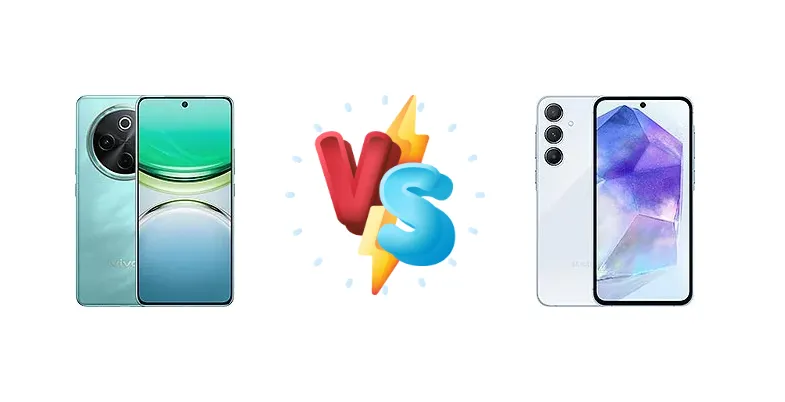
The mid-range smartphone market is fiercely competitive, and the vivo T4 and Samsung Galaxy A55 represent compelling options for users seeking a balance of features and affordability. The T4 aggressively targets charging speed and peak performance with its Snapdragon 7s Gen 3, while the A55 emphasizes a refined user experience and sustained performance with Samsung’s Exynos 1480. This comparison will dissect their key differences to determine which device best suits your needs.
🏆 Quick Verdict
For users prioritizing rapid charging and burst performance, the vivo T4 is the clear winner. Its 90W charging significantly outperforms the A55’s 25W. However, the Samsung Galaxy A55 edges ahead for those valuing consistent performance, a brighter display, and Samsung’s established software ecosystem.
| Network |
|---|
| 2G bands | GSM 850 / 900 / 1800 / 1900 | GSM 850 / 900 / 1800 / 1900 |
| 3G bands | HSDPA 800 / 850 / 900 / 2100 | HSDPA 850 / 900 / 1700(AWS) / 1900 / 2100 |
| 4G bands | 1, 3, 5, 8, 28, 38, 40, 41 | 1, 2, 3, 4, 5, 7, 8, 12, 17, 20, 25, 26, 28, 32, 38, 40, 41, 66 |
| 5G bands | 1, 3, 5, 8, 28, 38, 40, 41, 77, 78 SA/NSA | 1, 3, 5, 7, 8, 20, 28, 38, 40, 41, 66, 77, 78 SA/NSA/Sub6 |
| Speed | HSPA, LTE, 5G | HSPA, LTE, 5G |
| Technology | GSM / HSPA / LTE / 5G | GSM / HSPA / LTE / 5G |
| Launch |
|---|
| Announced | 2025, April 22 | 2024, March 11 |
| Status | Available. Released 2025, April 29 | Available. Released 2024, March 15 |
| Body |
|---|
| Build | - | Glass front (Gorilla Glass Victus+), glass back (Gorilla Glass), aluminum frame |
| Dimensions | 163.4 x 76.4 x 7.9 mm (6.43 x 3.01 x 0.31 in) | 161.1 x 77.4 x 8.2 mm (6.34 x 3.05 x 0.32 in) |
| SIM | Nano-SIM + Nano-SIM | · Nano-SIM· Nano-SIM + eSIM· Nano-SIM + Nano-SIM· Nano-SIM + Nano-SIM + eSIM (max 2 at a time) |
| Weight | 199 g (7.02 oz) | 213 g (7.51 oz) |
| Display |
|---|
| Protection | Shield Glass | Corning Gorilla Glass Victus+ |
| Resolution | 1080 x 2392 pixels (~388 ppi density) | 1080 x 2340 pixels, 19.5:9 ratio (~390 ppi density) |
| Size | 6.77 inches, 110.9 cm2 (~88.8% screen-to-body ratio) | 6.6 inches, 106.9 cm2 (~85.8% screen-to-body ratio) |
| Type | AMOLED, 1B colors, 120Hz, 3840Hz PWM, HDR, 800 nits (typ), 1300 nits (HBM), 5000 nits (peak) | Super AMOLED, 120Hz, HDR10+, 1000 nits (HBM) |
| Platform |
|---|
| CPU | Octa-core (1x2.5 GHz Cortex-A720 & 3x2.4 GHz Cortex-A720 & 4x1.8 GHz Cortex-A520) | Octa-core (4x2.75 GHz Cortex-A78 & 4x2.0 GHz Cortex-A55) |
| Chipset | Qualcomm SM7635 Snapdragon 7s Gen 3 (4 nm) | Exynos 1480 (4 nm) |
| GPU | Adreno 810 | Xclipse 530 |
| OS | Android 15, up to 2 major Android upgrades, Funtouch 15 | Android 14, up to 4 major Android upgrades, One UI 6.1 |
| Memory |
|---|
| Card slot | No | microSDXC (uses shared SIM slot) |
| Internal | 128GB 8GB RAM, 256GB 8GB RAM, 256GB 12GB RAM | 128GB 6GB RAM, 128GB 8GB RAM, 256GB 6GB RAM, 256GB 8GB RAM, 256GB 12GB RAM |
| Main Camera |
|---|
| Dual | 50 MP, f/1.8, (wide), 1/1.95", 0.8µm, PDAF, OIS
Auxiliary lens | - |
| Features | LED flash, HDR, panorama | LED flash, panorama, HDR |
| Triple | - | 50 MP, f/1.8, (wide), 1/1.56", 1.0µm, PDAF, OIS
12 MP, f/2.2, 123˚ (ultrawide), 1/3.06", 1.12µm
5 MP (macro) |
| Video | 4K@30fps, 1080p@30fps, gyro-EIS, OIS | 4K@30fps, 1080p@30/60fps, gyro-EIS |
| Selfie camera |
|---|
| Single | 32 MP, f/2.0, (wide) | 32 MP, f/2.2, 26mm (wide), 1/2.74", 0.8µm |
| Video | 4K@30fps, 1080p@30fps | 4K@30fps, 1080p@30/60fps |
| Sound |
|---|
| 35mm jack | No | No |
| Loudspeaker | Yes | Yes, with stereo speakers |
| Comms |
|---|
| Bluetooth | 5.2, A2DP, LE, aptX HD, aptX Adaptive | 5.3, A2DP, LE |
| Infrared port | Yes | - |
| NFC | No | Yes (market/region dependent) |
| Positioning | GPS, GALILEO, GLONASS, BDS | GPS, GALILEO, GLONASS, BDS, QZSS |
| Radio | No | No |
| USB | USB Type-C 2.0, OTG | USB Type-C 2.0, OTG |
| WLAN | Wi-Fi 802.11 a/b/g/n/ac/6, dual-band | Wi-Fi 802.11 a/b/g/n/ac/6, dual-band, Wi-Fi Direct |
| Features |
|---|
| Sensors | Fingerprint (under display, optical), accelerometer, gyro, proximity, compass | Fingerprint (under display, optical), accelerometer, gyro, compass |
| Battery |
|---|
| Charging | 90W wired, 55W PPS, 44W UFCS, 50% in 33 min
7.5W reverse wired
Bypass Charging | 25W wired |
| Type | Si/C Li-Ion 7300 mAh | Li-Ion 5000 mAh |
| Misc |
|---|
| Colors | Emerald Blaze, Phantom Grey | Iceblue, Lilac, Navy, Lemon |
| Models | V2502 | SM-A556V, SM-A556B, SM-A556B/DS, SM-A556E, SM-A556E/DS, SM-A5560 |
| Price | ₹ 20,700 | $ 324.99 / £ 251.50 / € 319.99 / ₹ 23,998 |
| SAR | 0.99 W/kg (head) 0.87 W/kg (body) | - |
| SAR EU | - | 0.68 W/kg (head) 1.04 W/kg (body) |
vivo T4
- Incredibly fast 90W charging
- Potentially higher peak CPU performance with Snapdragon 7s Gen 3
- Reverse wired charging capability
- Battery capacity unknown, potentially smaller than A55
- Sustained performance may be limited by thermal throttling
Samsung Galaxy A55
- Excellent battery life (13:27h active use)
- Bright and vibrant 1010 nit display
- Samsung’s One UI software and ecosystem
- Slow 25W charging
- Exynos 1480 may not match T4’s peak performance
Display Comparison
The Samsung Galaxy A55 boasts a significantly brighter display, reaching a measured 1010 nits, making it far more usable outdoors in direct sunlight compared to the vivo T4 (brightness data unavailable). While the T4’s panel technology isn’t specified, the A55’s likely utilizes a high-quality AMOLED panel. The A55’s display is likely to offer superior color accuracy and viewing angles. The absence of refresh rate data for the T4 makes a direct comparison difficult, but the A55’s display is a clear advantage for media consumption and outdoor visibility.
Camera Comparison
Without detailed camera specifications for the vivo T4, a direct comparison is limited. However, the A55’s camera system likely prioritizes image processing and consistency. The A55’s main sensor size is unknown, but Samsung’s image processing algorithms are generally well-regarded. The T4’s camera performance will likely depend heavily on software optimization. It’s reasonable to assume both phones will include standard features like HDR and night mode, but the A55’s established image pipeline gives it an edge in overall image quality and consistency. We can expect the A55 to deliver more reliable results across various lighting conditions.
Performance
The vivo T4’s Qualcomm Snapdragon 7s Gen 3 (4nm) features a unique CPU configuration – 1x2.5 GHz Cortex-A720, 3x2.4 GHz Cortex-A720, and 4x1.8 GHz Cortex-A520 – designed for a balance of performance and efficiency. The Samsung Galaxy A55, powered by the Exynos 1480 (4nm), employs a more traditional 4x2.75 GHz Cortex-A78 and 4x2.0 GHz Cortex-A55 setup. While the A55’s A78 cores have a higher clock speed, the T4’s newer Cortex-A720 cores offer architectural improvements. However, the A55’s sustained performance is likely superior due to the Exynos 1480’s better thermal management, potentially avoiding the throttling that could affect the T4 during prolonged intensive tasks. The T4’s GPU is also likely to deliver higher peak graphical performance.
Battery Life
The Samsung Galaxy A55 demonstrates impressive battery life, achieving 13 hours and 27 minutes of active use. The vivo T4’s battery capacity is not specified, but its standout feature is its charging speed. The T4 supports 90W wired charging, 55W PPS, and 44W UFCS, allowing a 50% charge in just 33 minutes. This is a massive advantage over the A55’s 25W charging. While the A55’s longer battery life is beneficial, the T4’s ultra-fast charging mitigates range anxiety, allowing for quick top-ups throughout the day. The T4 also offers 7.5W reverse wired charging, a feature absent on the A55.
Buying Guide
Buy the vivo T4 if you need blazing-fast charging, prioritize short bursts of high performance for gaming or demanding apps, and appreciate a more aggressive price point. Buy the Samsung Galaxy A55 if you prefer a more balanced experience with a brighter, more visible display, longer sustained performance during extended use, and the reliability of Samsung’s One UI software.
Frequently Asked Questions
❓ Does the Exynos 1480 in the Galaxy A55 tend to overheat during prolonged gaming sessions?
While the Exynos 1480 isn't known for extreme overheating, sustained high loads can lead to thermal throttling. Samsung’s software and thermal management are generally effective at mitigating this, but users engaging in extended gaming may experience some performance dips. The vivo T4, with its Snapdragon 7s Gen 3, might throttle more aggressively due to potentially less efficient cooling.
❓ How significant is the charging speed difference between 90W and 25W in real-world use?
The difference is substantial. The vivo T4’s 90W charging can add a 50% charge in just 33 minutes, while the Galaxy A55’s 25W charging will take considerably longer – likely over an hour for a similar charge level. This means the T4 can quickly top up during short breaks, while the A55 requires a longer charging commitment.
❓ Is the Snapdragon 7s Gen 3 in the vivo T4 powerful enough for demanding games like Genshin Impact or PUBG?
The Snapdragon 7s Gen 3 is capable of running demanding games, but you may need to adjust graphics settings for optimal performance. While it offers strong peak performance, sustained performance might be limited by thermal throttling. The Galaxy A55’s Exynos 1480 may provide a more consistent gaming experience, albeit potentially at slightly lower peak frame rates.
❓ Does the Samsung Galaxy A55 support software updates for a longer period than the vivo T4?
Samsung generally provides longer software support for its devices than vivo. The Galaxy A55 is likely to receive several years of Android OS updates and security patches, offering greater long-term value and security. Vivo’s update commitment for the T4 is typically shorter.