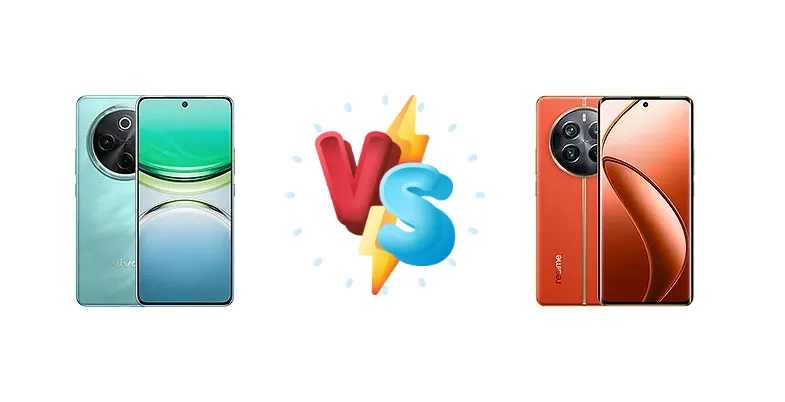
The mid-range smartphone market is fiercely competitive, and the vivo T4 and Realme 12 Pro+ are two contenders vying for your attention. The T4 boasts a newer Snapdragon 7s Gen 3 chipset and blazing-fast 90W charging, while the 12 Pro+ counters with a longer-lasting battery and a respectable 67W charging solution. This comparison will dissect their key differences to help you determine which device best suits your needs.
🏆 Quick Verdict
For users prioritizing raw performance and incredibly fast charging, the vivo T4 emerges as the winner. Its Snapdragon 7s Gen 3 offers a noticeable performance uplift over the 7s Gen 2 in the Realme 12 Pro+, and the 90W charging significantly reduces downtime. However, the Realme 12 Pro+ provides a more sustained battery experience.
| Network |
|---|
| 2G bands | GSM 850 / 900 / 1800 / 1900 | GSM 850 / 900 / 1800 / 1900 |
| 3G bands | HSDPA 800 / 850 / 900 / 2100 | HSDPA 850 / 900 / 2100 |
| 4G bands | 1, 3, 5, 8, 28, 38, 40, 41 | 1, 3, 5, 8, 28, 40, 41 |
| 5G bands | 1, 3, 5, 8, 28, 38, 40, 41, 77, 78 SA/NSA | 1, 3, 5, 8, 28, 40, 41, 77, 78 SA/NSA |
| Speed | HSPA, LTE, 5G | HSPA, LTE, 5G |
| Technology | GSM / HSPA / LTE / 5G | GSM / HSPA / LTE / 5G |
| Launch |
|---|
| Announced | 2025, April 22 | 2024, January 29 |
| Status | Available. Released 2025, April 29 | Available. Released 2024, January 29 |
| Body |
|---|
| Dimensions | 163.4 x 76.4 x 7.9 mm (6.43 x 3.01 x 0.31 in) | 161.5 x 74 x 8.8 mm (6.36 x 2.91 x 0.35 in) |
| SIM | Nano-SIM + Nano-SIM | Nano-SIM + Nano-SIM |
| Weight | 199 g (7.02 oz) | 196 g (6.91 oz) |
| Display |
|---|
| Protection | Shield Glass | - |
| Resolution | 1080 x 2392 pixels (~388 ppi density) | 1080 x 2412 pixels, 20:9 ratio (~394 ppi density) |
| Size | 6.77 inches, 110.9 cm2 (~88.8% screen-to-body ratio) | 6.7 inches, 108.0 cm2 (~90.4% screen-to-body ratio) |
| Type | AMOLED, 1B colors, 120Hz, 3840Hz PWM, HDR, 800 nits (typ), 1300 nits (HBM), 5000 nits (peak) | AMOLED, 1B colors, 120Hz, 800 nits (HBM), 950 nits (peak) |
| Platform |
|---|
| CPU | Octa-core (1x2.5 GHz Cortex-A720 & 3x2.4 GHz Cortex-A720 & 4x1.8 GHz Cortex-A520) | Octa-core (4x2.40 GHz Cortex-A78 & 4x1.95 GHz Cortex-A55) |
| Chipset | Qualcomm SM7635 Snapdragon 7s Gen 3 (4 nm) | Qualcomm SM7435-AB Snapdragon 7s Gen 2 (4 nm) |
| GPU | Adreno 810 | Adreno 710 |
| OS | Android 15, up to 2 major Android upgrades, Funtouch 15 | Android 14, Realme UI 5.0 |
| Memory |
|---|
| Card slot | No | No |
| Internal | 128GB 8GB RAM, 256GB 8GB RAM, 256GB 12GB RAM | 128GB 8GB RAM, 256GB 8GB RAM, 256GB 12GB RAM, 512GB 12GB RAM |
| Main Camera |
|---|
| Dual | 50 MP, f/1.8, (wide), 1/1.95", 0.8µm, PDAF, OIS
Auxiliary lens | - |
| Features | LED flash, HDR, panorama | LED flash, HDR, panorama |
| Triple | - | 50 MP, f/1.8, 24mm (wide), 1/1.56", 1.0µm, multi-directional PDAF, OIS
64 MP, f/2.8, 71mm, (periscope telephoto), 1/2.0", 0.7µm, PDAF, OIS, 3x optical zoom
8 MP, f/2.2, 16mm, 112˚ (ultrawide), 1/4.0", 1.12µm |
| Video | 4K@30fps, 1080p@30fps, gyro-EIS, OIS | 4K@30fps, 1080p@30/60/120fps, gyro-EIS |
| Selfie camera |
|---|
| Single | 32 MP, f/2.0, (wide) | 32 MP, f/2.4, 22mm (wide) |
| Video | 4K@30fps, 1080p@30fps | 1080p@30fps |
| Sound |
|---|
| 35mm jack | No | No |
| Loudspeaker | Yes | Yes, with stereo speakers |
| Comms |
|---|
| Bluetooth | 5.2, A2DP, LE, aptX HD, aptX Adaptive | 5.2, A2DP, LE |
| Infrared port | Yes | - |
| NFC | No | Yes (market/region dependent) |
| Positioning | GPS, GALILEO, GLONASS, BDS | GPS, GLONASS, GALILEO, BDS, QZSS |
| Radio | No | No |
| USB | USB Type-C 2.0, OTG | USB Type-C 2.0 |
| WLAN | Wi-Fi 802.11 a/b/g/n/ac/6, dual-band | Wi-Fi 802.11 a/b/g/n/ac/6, dual-band |
| Features |
|---|
| Sensors | Fingerprint (under display, optical), accelerometer, gyro, proximity, compass | Fingerprint (under display, optical), accelerometer, gyro, proximity, compass |
| Battery |
|---|
| Charging | 90W wired, 55W PPS, 44W UFCS, 50% in 33 min
7.5W reverse wired
Bypass Charging | 67W wired, 50% in 19 min |
| Type | Si/C Li-Ion 7300 mAh | 5000 mAh |
| Misc |
|---|
| Colors | Emerald Blaze, Phantom Grey | Submarine Blue, Navigator Beige, Explorer Red |
| Models | V2502 | RMX3840, RMX3841 |
| Price | ₹ 20,700 | $ 465.00 / £ 299.00 / € 344.26 / ₹ 28,400 |
| SAR | 0.99 W/kg (head) 0.87 W/kg (body) | - |
vivo T4
- Faster Snapdragon 7s Gen 3 chipset for improved performance
- Blazing-fast 90W wired charging
- Reverse wired charging capability
- Battery capacity not specified, potentially smaller than Realme 12 Pro+
- Display specifications unknown
Realme 12 Pro+
- Excellent battery life (13:24h active use)
- Good peak display brightness (802 nits)
- Reliable and balanced user experience
- Older Snapdragon 7s Gen 2 chipset
- Slower 67W charging compared to vivo T4
Display Comparison
The Realme 12 Pro+ features a display capable of reaching 802 nits of peak brightness, providing good visibility outdoors. While the vivo T4’s display specifications aren’t provided, Realme’s measured brightness gives it an edge in direct sunlight. Both devices utilize a 4nm chipset, suggesting similar power efficiency for the display panel. Without knowing the T4’s panel type (OLED vs LCD) or refresh rate, it’s difficult to assess color accuracy and smoothness, but the Realme 12 Pro+’s brightness is a clear advantage.
Camera Comparison
Without detailed camera specifications for either device beyond the chipsets, a direct comparison is limited. However, the Snapdragon 7s Gen 3 in the vivo T4 generally offers more advanced image signal processing capabilities than the 7s Gen 2 in the Realme 12 Pro+. This could result in better dynamic range and noise reduction in photos and videos. The absence of information regarding sensor sizes and OIS makes it impossible to definitively declare a camera winner, but the newer ISP in the T4 suggests a slight advantage in image quality.
Performance
The vivo T4’s Qualcomm SM7635 Snapdragon 7s Gen 3 (4nm) represents a generational leap over the Realme 12 Pro+'s Snapdragon 7s Gen 2 (4nm). The T4’s CPU configuration – 1x2.5 GHz Cortex-A720, 3x2.4 GHz Cortex-A720, and 4x1.8 GHz Cortex-A520 – utilizes newer Cortex-A720 cores compared to the 12 Pro+'s 4x2.40 GHz Cortex-A78 and 4x1.95 GHz Cortex-A55. This translates to improved single-core and multi-core performance in the T4, particularly in CPU-intensive tasks. While both are 4nm chips, the architectural improvements in the 7s Gen 3 provide a tangible performance benefit for gamers and power users.
Battery Life
The Realme 12 Pro+ boasts an active use battery score of 13:24h, indicating excellent endurance. The vivo T4’s battery capacity is not specified, but its 90W wired charging (with 55W PPS and 44W UFCS support) is significantly faster than the 12 Pro+'s 67W charging. The T4 can reach 50% charge in just 33 minutes, while the 12 Pro+ takes 19 minutes. This faster charging speed mitigates any potential disadvantage if the T4 has a smaller battery capacity. The T4 also offers 7.5W reverse wired charging, a feature absent in the 12 Pro+, adding to its versatility.
Buying Guide
Buy the vivo T4 if you need a phone that can handle demanding tasks like gaming and video editing with ease, and if minimizing charging time is a top priority. Buy the Realme 12 Pro+ if you prioritize all-day battery life and a more balanced user experience, even if it means sacrificing some peak performance and charging speed. The 12 Pro+ is ideal for users who primarily consume content and need a reliable device that won't require frequent top-ups.
Frequently Asked Questions
❓ Will the Snapdragon 7s Gen 3 in the vivo T4 handle demanding games like Genshin Impact at high settings?
The Snapdragon 7s Gen 3 is a capable chipset, and should handle Genshin Impact at medium to high settings with playable frame rates. However, sustained performance will depend on the phone's thermal management. The newer CPU architecture provides a performance advantage over the 7s Gen 2, but it's not a flagship-level processor.
❓ How much faster is the 90W charging on the vivo T4 compared to the 67W charging on the Realme 12 Pro+ in real-world use?
The 90W charging on the vivo T4 will significantly reduce charging times. While the Realme 12 Pro+ reaches 50% in 19 minutes, the T4 achieves the same in 33 minutes. This difference becomes more pronounced when charging from lower percentages, offering a more convenient experience for users who frequently need to top up their battery.
❓ Does the Realme 12 Pro+ support any form of fast wireless charging?
The provided specifications for the Realme 12 Pro+ do not mention wireless charging support. It only lists 67W wired charging.
❓ Is the difference in CPU architecture between the Snapdragon 7s Gen 3 and 7s Gen 2 noticeable for everyday tasks like browsing and social media?
For basic tasks like browsing and social media, the difference in CPU architecture will be minimal. Both chipsets are more than capable of handling these workloads smoothly. The benefits of the 7s Gen 3 become more apparent in demanding applications and multitasking scenarios.