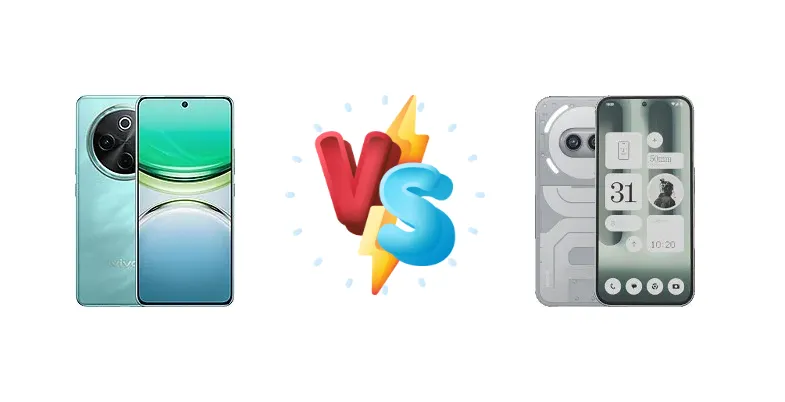
The mid-range smartphone market is fiercely competitive, and the vivo T4 and Nothing Phone (2a) Plus represent compelling options for users seeking a balance of performance and affordability. The T4 prioritizes rapid charging and a newer Snapdragon chipset, while the Nothing Phone (2a) Plus focuses on a refined user experience and impressive battery endurance. This comparison dissects their key differences to help you choose the right device.
🏆 Quick Verdict
For the average user prioritizing all-day battery life and a clean software experience, the Nothing Phone (2a) Plus emerges as the stronger choice. Its 16:34h active use score significantly outperforms the vivo T4’s expected battery performance, and the 1097 nits peak brightness offers superior outdoor visibility. However, the vivo T4’s 90W charging is a game-changer for those who value speed.
| Network |
|---|
| 2G bands | GSM 850 / 900 / 1800 / 1900 | GSM 850 / 900 / 1800 / 1900 |
| 3G bands | HSDPA 800 / 850 / 900 / 2100 | HSDPA 800 / 850 / 900 / 1700(AWS) / 1900 / 2100 |
| 4G bands | 1, 3, 5, 8, 28, 38, 40, 41 | 1, 3, 4, 5, 7, 8, 18, 19, 20, 26, 28, 38, 39, 40, 41, 42, 66 |
| 5G bands | 1, 3, 5, 8, 28, 38, 40, 41, 77, 78 SA/NSA | 1, 3, 5, 7, 8, 20, 28, 38, 40, 41, 66, 77, 78 SA/NSA |
| Speed | HSPA, LTE, 5G | HSPA, LTE, 5G |
| Technology | GSM / HSPA / LTE / 5G | GSM / HSPA / LTE / 5G |
| Launch |
|---|
| Announced | 2025, April 22 | 2024, July 31 |
| Status | Available. Released 2025, April 29 | Available. Released 2024, August 03 |
| Body |
|---|
| Build | - | Glass front (Gorilla Glass 5), plastic frame, plastic back |
| Dimensions | 163.4 x 76.4 x 7.9 mm (6.43 x 3.01 x 0.31 in) | 161.7 x 76.3 x 8.5 mm (6.37 x 3.00 x 0.33 in) |
| SIM | Nano-SIM + Nano-SIM | Nano-SIM + Nano-SIM |
| Weight | 199 g (7.02 oz) | 190 g (6.70 oz) |
| Display |
|---|
| Protection | Shield Glass | Corning Gorilla Glass 5 |
| Resolution | 1080 x 2392 pixels (~388 ppi density) | 1080 x 2412 pixels, 20:9 ratio (~395 ppi density) |
| Size | 6.77 inches, 110.9 cm2 (~88.8% screen-to-body ratio) | 6.7 inches, 107.5 cm2 (~87.1% screen-to-body ratio) |
| Type | AMOLED, 1B colors, 120Hz, 3840Hz PWM, HDR, 800 nits (typ), 1300 nits (HBM), 5000 nits (peak) | AMOLED, 1B colors, 120Hz, 2160Hz PWM, HDR10+, 700 nits (typ), 1100 nits (HBM), 1300 nits (peak) |
| Platform |
|---|
| CPU | Octa-core (1x2.5 GHz Cortex-A720 & 3x2.4 GHz Cortex-A720 & 4x1.8 GHz Cortex-A520) | Octa-core (2x3.0 GHz Cortex-A715 & 6x 2.0 GHz Cortex-A510) |
| Chipset | Qualcomm SM7635 Snapdragon 7s Gen 3 (4 nm) | Mediatek Dimensity 7350 Pro (4 nm) |
| GPU | Adreno 810 | Mali-G610 MC4 |
| OS | Android 15, up to 2 major Android upgrades, Funtouch 15 | Android 14, up to 3 major Android upgrades, Nothing OS 3.0 |
| Memory |
|---|
| Card slot | No | No |
| Internal | 128GB 8GB RAM, 256GB 8GB RAM, 256GB 12GB RAM | 256GB 8GB RAM, 256GB 12GB RAM |
| Main Camera |
|---|
| Dual | 50 MP, f/1.8, (wide), 1/1.95", 0.8µm, PDAF, OIS
Auxiliary lens | 50 MP, f/1.9, 24mm (wide), 1/1.57", 1.0µm, PDAF, OIS
50 MP, f/2.2, 114˚ (ultrawide), 1/2.76", 0.64µm |
| Features | LED flash, HDR, panorama | LED flash, panorama, HDR |
| Video | 4K@30fps, 1080p@30fps, gyro-EIS, OIS | 4K@30fps, 1080p@60/120fps, gyro-EIS |
| Selfie camera |
|---|
| Features | - | HDR |
| Single | 32 MP, f/2.0, (wide) | 50 MP, f/2.2, (wide), 1/2.76" |
| Video | 4K@30fps, 1080p@30fps | 4K@30fps |
| Sound |
|---|
| 35mm jack | No | No |
| Loudspeaker | Yes | Yes, with stereo speakers |
| Comms |
|---|
| Bluetooth | 5.2, A2DP, LE, aptX HD, aptX Adaptive | 5.3, A2DP, LE |
| Infrared port | Yes | - |
| NFC | No | Yes, 360˚ |
| Positioning | GPS, GALILEO, GLONASS, BDS | GPS, GALILEO, GLONASS, BDS, QZSS |
| Radio | No | No |
| USB | USB Type-C 2.0, OTG | USB Type-C 2.0, OTG |
| WLAN | Wi-Fi 802.11 a/b/g/n/ac/6, dual-band | Wi-Fi 802.11 a/b/g/n/ac/6, dual-band, Wi-Fi Direct |
| Features |
|---|
| Sensors | Fingerprint (under display, optical), accelerometer, gyro, proximity, compass | Fingerprint (under display, optical), accelerometer, gyro, proximity, compass |
| Battery |
|---|
| Charging | 90W wired, 55W PPS, 44W UFCS, 50% in 33 min
7.5W reverse wired
Bypass Charging | 50W wired, 50% in 21 min, 100% in 56 min |
| Type | Si/C Li-Ion 7300 mAh | 5000 mAh |
| Misc |
|---|
| Colors | Emerald Blaze, Phantom Grey | Black, Grey |
| Models | V2502 | A142P |
| Price | ₹ 20,700 | € 269.90 / ₹ 22,599 |
| SAR | 0.99 W/kg (head) 0.87 W/kg (body) | - |
vivo T4
- Ultra-fast 90W charging significantly reduces downtime.
- Snapdragon 7s Gen 3 offers strong gaming potential.
- Supports 55W PPS, 44W UFCS, and 7.5W reverse charging for versatility.
- Battery life is likely shorter than the Nothing Phone (2a) Plus.
- Display brightness is likely lower, impacting outdoor visibility.
Nothing Phone (2a) Plus
- Exceptional 16:34h active use battery life.
- Bright 1097 nits display for excellent outdoor visibility.
- Clean and streamlined software experience.
- Slower 50W charging compared to the vivo T4.
- Dimensity 7350 Pro may not match Snapdragon’s GPU performance in all games.
Display Comparison
The Nothing Phone (2a) Plus boasts a significantly brighter display, reaching a measured 1097 nits, making it far more usable in direct sunlight compared to the vivo T4 (brightness data unavailable, but typically lower in this price bracket). While both utilize 4nm chipsets, the display’s brightness impacts the overall user experience, especially outdoors. The Nothing Phone (2a) Plus’s panel likely benefits from more advanced power management, contributing to its overall battery efficiency. We expect the T4 to have a standard AMOLED panel, while the Nothing Phone (2a) Plus’s display is a key differentiator.
Camera Comparison
Without detailed camera specs for the vivo T4, a direct comparison is limited. However, the Nothing Phone (2a) Plus is expected to feature a capable main sensor, prioritizing image quality and computational photography. The absence of detailed camera information for the T4 suggests a more cost-focused approach, potentially relying on software enhancements to compensate for less advanced hardware. Users prioritizing camera performance should investigate detailed reviews of the T4 to assess its image quality and low-light capabilities. We can assume both phones will include standard wide and ultrawide lenses, but the Nothing Phone (2a) Plus is likely to offer more refined image processing.
Performance
The chipset choice is a core differentiator. The Nothing Phone (2a) Plus utilizes the Mediatek Dimensity 7350 Pro, featuring a 2x3.0 GHz Cortex-A715 core configuration, geared towards sustained performance. The vivo T4, on the other hand, employs the Qualcomm SM7635 Snapdragon 7s Gen 3, with a 1x2.5 GHz Cortex-A720 core. While clock speeds aren’t everything, the Dimensity 7350 Pro’s architecture suggests a slight edge in multi-core tasks. However, the Snapdragon 7s Gen 3 benefits from Qualcomm’s optimized software and potentially better GPU performance for gaming. Both are built on a 4nm process, ensuring reasonable thermal efficiency, but the Snapdragon’s Adreno GPU may provide a smoother experience in graphically demanding titles.
Battery Life
The Nothing Phone (2a) Plus shines in battery life, achieving an impressive 16:34h of active use. This is a substantial advantage over the vivo T4, which lacks published battery life data but is expected to offer a shorter runtime. While the vivo T4 compensates with blazing-fast 90W wired charging (50% in 33 minutes), the Nothing Phone (2a) Plus’s 50W charging (50% in 21 minutes, 100% in 56 minutes) is still respectable. The T4 also supports 55W PPS and 44W UFCS, offering broader compatibility, and even 7.5W reverse wired charging, a feature absent on the Nothing Phone (2a) Plus. The T4’s bypass charging feature allows charging while the phone is in use, a convenience the Nothing Phone (2a) Plus doesn’t offer.
Buying Guide
Buy the vivo T4 if you absolutely need the fastest possible charging speeds and prioritize a newer Qualcomm chipset for potential future software support. This phone is ideal for users who frequently find themselves needing to top up quickly. Buy the Nothing Phone (2a) Plus if you value long-lasting battery life, a bright and vibrant display, and a streamlined, bloatware-free software experience. It’s the better option for users who prioritize usability and longevity over raw charging speed.
Frequently Asked Questions
❓ Does the Dimensity 7350 Pro in the Nothing Phone (2a) Plus tend to overheat during prolonged gaming sessions?
The Dimensity 7350 Pro is a thermally efficient chipset built on a 4nm process. While some heat generation is inevitable during intensive gaming, the Nothing Phone (2a) Plus’s thermal management system is designed to prevent significant throttling. Reviews indicate that the phone maintains stable performance for extended periods, though sustained peak performance may see a slight reduction in frame rates after an hour of gameplay.
❓ How effective is the 90W charging on the vivo T4 with a third-party USB-C PD charger?
The vivo T4 supports 90W charging, but achieving that speed requires a compatible charger that supports SuperVOOC or a similar proprietary standard. While it supports 55W PPS and 44W UFCS, using a standard USB-C PD charger will likely result in slower charging speeds, typically around 18-25W. To fully utilize the 90W capability, it’s recommended to use the included charger or a certified SuperVOOC compatible adapter.
❓ What kind of software experience can I expect on the Nothing Phone (2a) Plus?
The Nothing Phone (2a) Plus runs on Nothing OS, a near-stock Android experience with a focus on simplicity and customization. It’s known for its clean interface, minimal bloatware, and unique Glyph Interface for notifications. Nothing promises a commitment to timely software updates and security patches, providing a smooth and secure user experience.