
vivo T4 Ultra vs Xiaomi Redmi K70 Ultra: A Deep Dive into the Dimensity 9300+ Powerhouses
| Phones Images | |||||
|---|---|---|---|---|---|
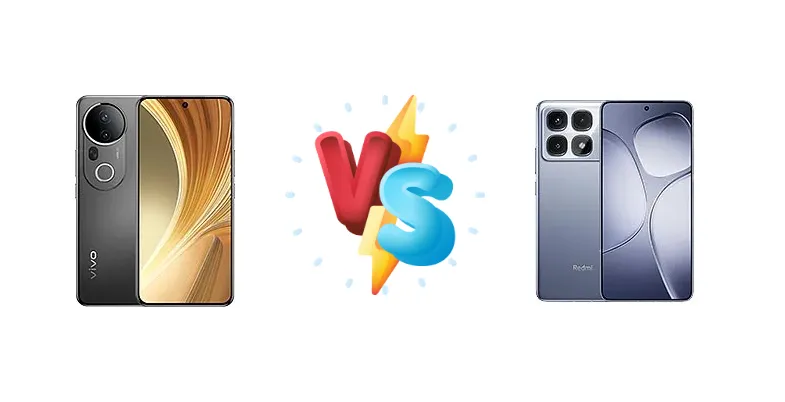
|
🏆 Quick Verdict
For the average user prioritizing the fastest possible charging and a slightly more refined software experience, the Xiaomi Redmi K70 Ultra is the winner. Its 120W charging completes a full charge in just 24 minutes, a significant advantage over the vivo T4 Ultra’s 48-minute charge time. However, the T4 Ultra remains a compelling option for those seeking a balance of performance and value.
| PHONES | ||
|---|---|---|
| Phone Names | vivo T4 Ultra | Xiaomi Redmi K70 Ultra |
| Network | ||
|---|---|---|
| 2G bands | GSM 850 / 900 / 1800 / 1900 | GSM 850 / 900 / 1800 / 1900 |
| 3G bands | HSDPA 850 / 900 / 1900 / 2100 | HSDPA 800 / 850 / 900 / 1700(AWS) / 2100 |
| 4G bands | 1, 3, 4, 5, 7, 8, 18, 19, 20, 26, 28, 34, 38, 39, 40, 41, 42, 43, 48, 66 | 1, 3, 4, 5, 7, 8, 18, 19, 26, 28, 34, 38, 39, 40, 41, 42, 48, 66 |
| 5G bands | 1, 3, 5, 7, 8, 18, 26, 28, 38, 40, 41, 48, 66, 77, 78 SA/NSA | 1, 3, 5, 7, 8, 28, 66, 38, 40, 41, 48, 77, 78 SA/NSA |
| Speed | HSPA, LTE, 5G | HSPA, LTE, 5G |
| Technology | GSM / HSPA / LTE / 5G | GSM / CDMA / HSPA / CDMA2000 / LTE / 5G |
| Launch | ||
|---|---|---|
| Announced | 2025, June 11 | 2024, July 19 |
| Status | Available. Released 2025, June 18 | Available. Released 2024, July 19 |
| Body | ||
|---|---|---|
| Build | Glass front, glass back | Glass front, aluminum frame |
| Dimensions | 160.6 x 75 x 7.5 mm (6.32 x 2.95 x 0.30 in) | 160.4 x 75.1 x 8.4 mm (6.31 x 2.96 x 0.33 in) |
| SIM | Nano-SIM + Nano-SIM | Nano-SIM + Nano-SIM |
| Weight | 192 g (6.84 oz) | 211 g (7.44 oz) |
| Display | ||
|---|---|---|
| Protection | - | Scratch/drop-resistant glass |
| Resolution | 1260 x 2800 pixels, 20:9 ratio (~460 ppi density) | 1220 x 2712 pixels, 20:9 ratio (~446 ppi density) |
| Size | 6.67 inches, 107.4 cm2 (~89.2% screen-to-body ratio) | 6.67 inches, 107.4 cm2 (~89.1% screen-to-body ratio) |
| Type | AMOLED, 1B colors, 120Hz, 2160Hz PWM, 1600 nits (HBM), 5000 nits (peak) | OLED, 68B colors, 144Hz, Dolby Vision, HDR10+, 1600 nits (HBM), 4000 nits (peak) |
| Platform | ||
|---|---|---|
| CPU | Octa-core (1x3.4 GHz Cortex-X4 & 3x2.85 GHz Cortex-X4 & 4x2.0 GHz Cortex-A720) | Octa-core (1x3.25 GHz Cortex-X4 & 3x2.85 GHz Cortex-X4 & 4x2.0 GHz Cortex-A720) |
| Chipset | Mediatek Dimensity 9300+ (4 nm) | Mediatek Dimensity 9300+ (4 nm) |
| GPU | Immortalis-G720 MC12 | Immortalis-G720 MC12 |
| OS | Android 15, Funtouch 15 | Android 14, HyperOS |
| Memory | ||
|---|---|---|
| Card slot | No | No |
| Internal | 256GB 8GB RAM, 256GB 12GB RAM, 512GB 12GB RAM | 256GB 12GB RAM, 512GB 12GB RAM, 512GB 16GB RAM, 1TB 16GB RAM, 1TB 24GB RAM |
| Main Camera | ||
|---|---|---|
| Features | Ring-LED flash, panorama, HDR | Color spectrum sensor, Dual-LED dual-tone flash, HDR, panorama |
| Triple | 50 MP, f/1.9, 23mm (wide), 1/1.56", PDAF, OIS 50 MP, f/2.6, 85mm (periscope telephoto), 1/1.95", 0.8µm, PDAF (15cm - ∞), OIS, 3x optical zoom 8 MP, f/2.2, (ultrawide) | 50 MP, f/1.7, 23mm (wide), 1/1.56", 1.0µm, PDAF, OIS 8 MP, 119˚ (ultrawide), 1/4.0", 1.12µm 2 MP (macro) |
| Video | 4K, 1080p, gyro-EIS | 8K@24/30fps, 4K@24/30/60fps, 1080p@30/60/120/240/960fps, gyro-EIS |
| Selfie camera | ||
|---|---|---|
| Features | - | HDR |
| Single | 32 MP, f/2.5, (wide) | 20 MP, (wide), 1/2.0", 0.8µm |
| Video | Yes | 1080p@30fps |
| Sound | ||
|---|---|---|
| 35mm jack | No | No |
| Loudspeaker | Yes, with stereo speakers | Yes, with stereo speakers |
| Comms | ||
|---|---|---|
| Bluetooth | 5.4, A2DP, LE | 5.4, A2DP, LE, LHDC 5 |
| Infrared port | - | Yes |
| NFC | Yes | Yes |
| Positioning | GPS, GLONASS, GALILEO, BDS, NavIC | GPS (L1+L5), BDS (B1I+B1C+B2a+B2b), GALILEO (E1+E5a+E5b), QZSS (L1+L5), NavIC (L5), GLONASS |
| Radio | No | Unspecified |
| USB | USB Type-C 2.0, OTG | USB Type-C |
| WLAN | Wi-Fi 802.11 a/b/g/n/ac/6, dual-band, Wi-Fi Direct | Wi-Fi 802.11 a/b/g/n/ac/6/7, dual-band, Wi-Fi Direct |
| Features | ||
|---|---|---|
| Sensors | Fingerprint (under display, optical), accelerometer, gyro, proximity, compass | Fingerprint (under display, optical), accelerometer, gyro, proximity, compass |
| Battery | ||
|---|---|---|
| Charging | 90W wired, PD, 100% in 48 min Reverse wired | 120W wired, PD3.0, 100% in 24 min |
| Type | Si/C Li-Ion 5500 mAh | Li-Po 5500 mAh |
| Misc | ||
|---|---|---|
| Colors | Phoenix Gold, Meteor Grey | Black, White, Violet, Green Championship Edition, Orange Championship Edition |
| Models | - | 2407FRK8EC |
| Price | ₹ 36,999 | About 330 EUR |
| SAR | 0.99 W/kg (head) 1.00 W/kg (body) | - |
vivo T4 Ultra
- Potentially higher CPU clock speed for sustained performance
- Reverse wired charging for accessory top-ups
- Potentially more conservative software experience
- Significantly slower charging speed (48 minutes)
- Limited information on display quality
Xiaomi Redmi K70 Ultra
- Blazing-fast 120W charging (24 minutes)
- Likely vibrant and color-accurate display
- PD3.0 support for wide charger compatibility
- Slightly lower CPU clock speed
- MIUI software can be polarizing
Display Comparison
While both devices likely feature high-refresh-rate AMOLED displays (data not provided), the key differentiator will be panel quality and calibration. Without specific nit brightness or color accuracy data, it’s difficult to declare a clear winner. However, Xiaomi’s history suggests a focus on vibrant, color-accurate displays, potentially offering a more visually engaging experience. The absence of LTPO information means we can't assess power efficiency gains from variable refresh rates.
Camera Comparison
Without detailed camera specifications, a direct comparison is limited. However, the market positioning suggests both will feature capable camera systems. The focus should be on the main sensor resolution and aperture. Larger sensors and wider apertures (lower f-number) generally capture more light, resulting in better low-light performance. Image processing algorithms will also play a significant role, with Xiaomi’s typically leaning towards more saturated, vibrant images, while vivo often aims for a more natural look. We can safely assume both will offer a range of shooting modes, but the quality of those modes will depend on the underlying hardware and software.
Performance
Both phones are powered by the Mediatek Dimensity 9300+ (4nm), but a subtle CPU clock speed difference exists. The Redmi K70 Ultra’s 3.25 GHz Cortex-X4 prime core is slightly underclocked compared to the T4 Ultra’s 3.4 GHz. While this difference is unlikely to be noticeable in most everyday tasks, it *could* translate to a marginal performance advantage for the T4 Ultra in sustained, CPU-intensive workloads. Both share the same 3x2.85 GHz Cortex-X4 and 4x2.0 GHz Cortex-A720 configuration. Thermal management will be crucial; the 4nm process helps, but sustained performance will depend on the cooling solutions employed.
Battery Life
The Redmi K70 Ultra’s 120W wired charging is the standout feature here, promising a full charge in just 24 minutes. This is a substantial improvement over the vivo T4 Ultra’s 90W charging, which takes 48 minutes. While battery capacity isn’t specified, the faster charging speed effectively mitigates any potential disadvantage from a smaller battery size. The inclusion of PD3.0 on both devices ensures compatibility with a wide range of chargers and accessories. The T4 Ultra also offers reverse wired charging, a useful feature for topping up accessories.
Buying Guide
Buy the vivo T4 Ultra if you need a strong all-rounder with excellent performance and don't mind a longer charging time. It's ideal for users who prioritize a balanced experience and potentially a more conservative software approach. Buy the Xiaomi Redmi K70 Ultra if you prioritize blazing-fast charging, are comfortable with Xiaomi’s MIUI software, and want the quickest path to a full battery. This phone is geared towards power users and those constantly on the go.