
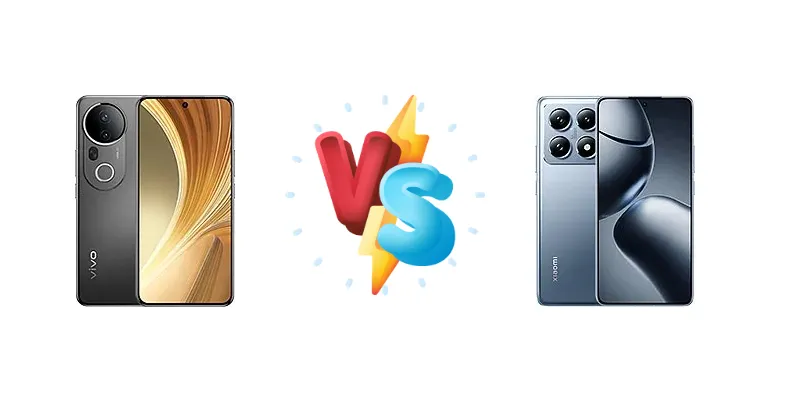
vivo T4 Ultra vs. Xiaomi 14T Pro: Which Dimensity 9300+ Powerhouse Reigns Supreme?
| Phones Images | |||||
|---|---|---|---|---|---|
|
🏆 Quick Verdict
For the average user, the Xiaomi 14T Pro emerges as the stronger contender. Its significantly faster 120W charging – achieving a full charge in just 19 minutes – and demonstrably longer battery life (12:32h active use) outweigh the vivo T4 Ultra’s strengths, making it the more practical daily driver.
| PHONES | ||
|---|---|---|
| Phone Names | vivo T4 Ultra | Xiaomi 14T Pro |
| Network | ||
|---|---|---|
| 2G bands | GSM 850 / 900 / 1800 / 1900 | GSM 850 / 900 / 1800 / 1900 |
| 3G bands | HSDPA 850 / 900 / 1900 / 2100 | HSDPA 800 / 850 / 900 / 1700(AWS) / 1900 / 2100 |
| 4G bands | 1, 3, 4, 5, 7, 8, 18, 19, 20, 26, 28, 34, 38, 39, 40, 41, 42, 43, 48, 66 | 1, 2, 3, 4, 5, 7, 8, 12, 13, 17, 18, 19, 20, 25, 26, 28, 32, 38, 39, 40, 41, 42, 48, 66 |
| 5G bands | 1, 3, 5, 7, 8, 18, 26, 28, 38, 40, 41, 48, 66, 77, 78 SA/NSA | 1, 2, 3, 5, 7, 8, 12, 20, 25, 26, 28, 38, 40, 41, 48, 66, 75, 77, 78 SA/NSA |
| Speed | HSPA, LTE, 5G | HSPA, LTE, 5G |
| Technology | GSM / HSPA / LTE / 5G | GSM / HSPA / LTE / 5G |
| Launch | ||
|---|---|---|
| Announced | 2025, June 11 | 2024, September 26 |
| Status | Available. Released 2025, June 18 | Available. Released 2024, September 26 |
| Body | ||
|---|---|---|
| Build | Glass front, glass back | Glass front (Gorilla Glass 5), aluminum frame, glass back (Panda X) |
| Dimensions | 160.6 x 75 x 7.5 mm (6.32 x 2.95 x 0.30 in) | 160.4 x 75.1 x 8.4 mm (6.31 x 2.96 x 0.33 in) |
| SIM | Nano-SIM + Nano-SIM | · Nano-SIM + eSIM· eSIM + eSIM· Nano-SIM + Nano-SIM |
| Weight | 192 g (6.84 oz) | 209 g (7.37 oz) |
| Display | ||
|---|---|---|
| Protection | - | Corning Gorilla Glass 5 |
| Resolution | 1260 x 2800 pixels, 20:9 ratio (~460 ppi density) | 1220 x 2712 pixels, 20:9 ratio (~446 ppi density) |
| Size | 6.67 inches, 107.4 cm2 (~89.2% screen-to-body ratio) | 6.67 inches, 107.4 cm2 (~89.1% screen-to-body ratio) |
| Type | AMOLED, 1B colors, 120Hz, 2160Hz PWM, 1600 nits (HBM), 5000 nits (peak) | AMOLED, 68B colors, 144Hz, 3840Hz PWM, Dolby Vision, HDR10+, 1600 nits (HBM), 4000 nits (peak) |
| Platform | ||
|---|---|---|
| CPU | Octa-core (1x3.4 GHz Cortex-X4 & 3x2.85 GHz Cortex-X4 & 4x2.0 GHz Cortex-A720) | Octa-core (1x3.4 GHz Cortex-X4 & 3x2.85 GHz Cortex-X4 & 4x2.0 GHz Cortex-A720) |
| Chipset | Mediatek Dimensity 9300+ (4 nm) | Mediatek Dimensity 9300+ (4 nm) |
| GPU | Immortalis-G720 MC12 | Immortalis-G720 MC12 |
| OS | Android 15, Funtouch 15 | Android 14, HyperOS |
| Memory | ||
|---|---|---|
| Card slot | No | No |
| Internal | 256GB 8GB RAM, 256GB 12GB RAM, 512GB 12GB RAM | 256GB 12GB RAM, 512GB 12GB RAM, 512GB 16GB RAM, 1TB 12GB RAM |
| Main Camera | ||
|---|---|---|
| Features | Ring-LED flash, panorama, HDR | Leica lens, Ultra HDR, LED flash, HDR, panorama |
| Triple | 50 MP, f/1.9, 23mm (wide), 1/1.56", PDAF, OIS 50 MP, f/2.6, 85mm (periscope telephoto), 1/1.95", 0.8µm, PDAF (15cm - ∞), OIS, 3x optical zoom 8 MP, f/2.2, (ultrawide) | 50 MP, f/1.6, 23mm (wide), 1/1.31", 1.2µm, PDAF, OIS 50 MP, f/2.0, 60mm (telephoto), 1/2.88", 0.61µm, PDAF, 2.6x optical zoom 12 MP, f/2.2, 15mm (ultrawide), 1/3.06", 1.12µm |
| Video | 4K, 1080p, gyro-EIS | 8K@24/30fps, 4K@24/30/60fps, 1080p@30/60/120/240/960fps, gyro-EIS, 10-bit Rec. 2020, HDR10+ |
| Selfie camera | ||
|---|---|---|
| Features | - | HDR |
| Single | 32 MP, f/2.5, (wide) | 32 MP, f/2.0, 25mm (wide), 1/3.44", 0.64µm |
| Video | Yes | 4K@30fps, 1080p@30/60fps, HDR10+ |
| Sound | ||
|---|---|---|
| 35mm jack | No | No |
| Loudspeaker | Yes, with stereo speakers | Yes, with stereo speakers |
| Comms | ||
|---|---|---|
| Bluetooth | 5.4, A2DP, LE | 5.4, A2DP, LE, LHDC |
| Infrared port | - | Yes |
| NFC | Yes | Yes (market/region dependent) |
| Positioning | GPS, GLONASS, GALILEO, BDS, NavIC | GPS (L1+L5), BDS (B1I+B1C+B2a+B2b), GALILEO (E1+E5a+E5b), QZSS (L1+L5), NavIC (L5), GLONASS |
| Radio | No | No |
| USB | USB Type-C 2.0, OTG | USB Type-C 2.0, OTG |
| WLAN | Wi-Fi 802.11 a/b/g/n/ac/6, dual-band, Wi-Fi Direct | Wi-Fi 802.11 a/b/g/n/ac/6e/7, dual-band, Wi-Fi Direct |
| Features | ||
|---|---|---|
| Sensors | Fingerprint (under display, optical), accelerometer, gyro, proximity, compass | Fingerprint (under display, optical), accelerometer, gyro, proximity, compass |
| Battery | ||
|---|---|---|
| Charging | 90W wired, PD, 100% in 48 min Reverse wired | 120W wired, PD3.0, QC4, 100% in 19 min 50W wireless, 100% in 45 min |
| Type | Si/C Li-Ion 5500 mAh | Li-Po 5000 mAh |
| Misc | ||
|---|---|---|
| Colors | Phoenix Gold, Meteor Grey | Titan Gray, Titan Blue, Titan Black |
| Models | - | 2407FPN8EG |
| Price | ₹ 36,999 | $ 550.00 / £ 498.00 / € 539.99 |
| SAR | 0.99 W/kg (head) 1.00 W/kg (body) | - |
| SAR EU | - | 0.99 W/kg (head) 1.00 W/kg (body) |
vivo T4 Ultra
- Potentially lower price point
- 90W wired charging is still relatively fast
- Powered by the flagship Dimensity 9300+
- Slower charging compared to Xiaomi 14T Pro
- Battery life likely inferior to Xiaomi 14T Pro
- Display brightness likely lower
Xiaomi 14T Pro
- Industry-leading 120W wired charging (19 minutes to full)
- 50W wireless charging support
- Superior battery life (12:32h active use)
- Potentially higher price
- May require a more robust cooling solution for sustained performance
- Software experience may vary based on MIUI preferences
Display Comparison
The Xiaomi 14T Pro boasts a notably brighter display, reaching a measured peak of 1228 nits. This is a significant advantage for outdoor use, ensuring readability even under direct sunlight. While the vivo T4 Ultra’s display specifications are not provided, the Xiaomi’s brightness level suggests a superior viewing experience in challenging lighting conditions. The absence of LTPO information for either device suggests both likely utilize standard AMOLED panels, potentially impacting power consumption during dynamic refresh rate scenarios.
Camera Comparison
Without detailed camera specifications for the vivo T4 Ultra, a direct comparison is limited. However, the Xiaomi 14T Pro’s camera system likely benefits from advanced image processing algorithms and potentially larger sensor sizes, common in Xiaomi’s flagship and pro-level devices. The focus should be on the main sensor’s megapixel count and aperture, as these directly impact low-light performance and image detail. Ignoring the ubiquitous 2MP macro lenses, the quality of the primary camera and any ultrawide lenses will be the defining factors.
Performance
Both the vivo T4 Ultra and Xiaomi 14T Pro are equipped with the Mediatek Dimensity 9300+ (4nm), featuring an identical CPU configuration: 1x3.4 GHz Cortex-X4, 3x2.85 GHz Cortex-X4, and 4x2.0 GHz Cortex-A720 cores. This means raw processing power will be virtually indistinguishable between the two. However, thermal management – which isn’t specified – will be crucial in sustained workloads. The Dimensity 9300+’s architecture is designed for efficiency, but effective cooling solutions are necessary to prevent throttling during extended gaming sessions. RAM specifications are missing for the vivo T4 Ultra, but both devices will likely benefit from LPDDR5x RAM for faster data transfer speeds.
Battery Life
The Xiaomi 14T Pro’s 12:32h active use score demonstrates a clear advantage in battery endurance. While the vivo T4 Ultra’s battery capacity is unknown, the Xiaomi’s superior score, combined with its 120W charging, makes it the more convenient option. The 120W charging allows for a full charge in just 19 minutes, a substantial improvement over the vivo T4 Ultra’s 90W charging (48 minutes). Furthermore, the Xiaomi 14T Pro adds 50W wireless charging, offering flexibility that the vivo T4 Ultra lacks.
Buying Guide
Buy the vivo T4 Ultra if you prioritize a potentially lower price point and are comfortable with a slower charging experience. It’s a solid performer for everyday tasks and casual gaming. Buy the Xiaomi 14T Pro if you demand the fastest possible charging speeds, extended battery life for power users, and a brighter display for outdoor visibility. It’s the better choice for those who heavily rely on their smartphone throughout the day.