
vivo T4 Ultra vs Samsung Galaxy S23 FE: A Deep Dive into Performance and Value
| Phones Images | |||||
|---|---|---|---|---|---|
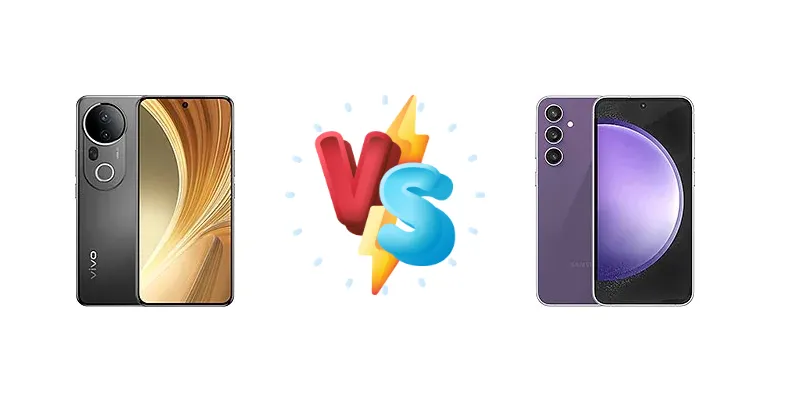
|
🏆 Quick Verdict
For users prioritizing raw performance and charging speed, the vivo T4 Ultra emerges as the winner. Its Dimensity 9300+ offers a significant leap over both the Snapdragon 8 Gen 1 and Exynos 2200 variants of the S23 FE. However, the S23 FE’s more polished software and established camera system make it a strong contender for those valuing a complete package.
| PHONES | ||
|---|---|---|
| Phone Names | vivo T4 Ultra | Samsung Galaxy S23 FE |
| Network | ||
|---|---|---|
| 2G bands | GSM 850 / 900 / 1800 / 1900 | GSM 850 / 900 / 1800 / 1900 |
| 3G bands | HSDPA 850 / 900 / 1900 / 2100 | HSDPA 850 / 900 / 1700(AWS) / 1900 / 2100 |
| 4G bands | 1, 3, 4, 5, 7, 8, 18, 19, 20, 26, 28, 34, 38, 39, 40, 41, 42, 43, 48, 66 | 1, 2, 3, 4, 5, 7, 8, 12, 13, 17, 20, 26, 28, 38, 40, 41, 66 - International |
| 5G bands | 1, 3, 5, 7, 8, 18, 26, 28, 38, 40, 41, 48, 66, 77, 78 SA/NSA | 1, 2, 3, 5, 7, 8, 20, 28, 38, 40, 41, 66, 77, 78 SA/NSA/Sub6 - International |
| Speed | HSPA, LTE, 5G | HSPA, LTE, 5G |
| Technology | GSM / HSPA / LTE / 5G | GSM / HSPA / LTE / 5G |
| Launch | ||
|---|---|---|
| Announced | 2025, June 11 | 2023, October 04 |
| Status | Available. Released 2025, June 18 | Available. Released 2023, October 05 |
| Body | ||
|---|---|---|
| Build | Glass front, glass back | Glass front (Gorilla Glass 5), glass back (Gorilla Glass 5), aluminum frame |
| Dimensions | 160.6 x 75 x 7.5 mm (6.32 x 2.95 x 0.30 in) | 158 x 76.5 x 8.2 mm (6.22 x 3.01 x 0.32 in) |
| SIM | Nano-SIM + Nano-SIM | · Nano-SIM· Nano-SIM + Nano-SIM· Nano-SIM + Nano-SIM + eSIM (max 2 at a time) |
| Weight | 192 g (6.84 oz) | 209 g (7.37 oz) |
| Display | ||
|---|---|---|
| Protection | - | Corning Gorilla Glass 5 |
| Resolution | 1260 x 2800 pixels, 20:9 ratio (~460 ppi density) | 1080 x 2340 pixels, 19.5:9 ratio (~403 ppi density) |
| Size | 6.67 inches, 107.4 cm2 (~89.2% screen-to-body ratio) | 6.4 inches, 100.5 cm2 (~83.2% screen-to-body ratio) |
| Type | AMOLED, 1B colors, 120Hz, 2160Hz PWM, 1600 nits (HBM), 5000 nits (peak) | Dynamic AMOLED 2X, 120Hz, HDR10+, 1450 nits (peak) |
| Platform | ||
|---|---|---|
| CPU | Octa-core (1x3.4 GHz Cortex-X4 & 3x2.85 GHz Cortex-X4 & 4x2.0 GHz Cortex-A720) | Octa-core (1x2.8 GHz Cortex-X2 & 3x2.50 GHz Cortex-A710 & 4x1.8 GHz Cortex-A510) - InternationalOcta-core (1x3.00 GHz Cortex-X2 & 3x2.50 GHz Cortex-A710 & 4x1.80 GHz Cortex-A510) - USA |
| Chipset | Mediatek Dimensity 9300+ (4 nm) | Exynos 2200 (4 nm) - InternationalQualcomm SM8450 Snapdragon 8 Gen 1 (4 nm) - USA |
| GPU | Immortalis-G720 MC12 | Xclipse 920 - InternationalAdreno 730 - USA |
| OS | Android 15, Funtouch 15 | Android 13, up to 4 major Android upgrades, One UI 8 |
| Memory | ||
|---|---|---|
| Card slot | No | No |
| Internal | 256GB 8GB RAM, 256GB 12GB RAM, 512GB 12GB RAM | 128GB 8GB RAM, 256GB 8GB RAM |
| Main Camera | ||
|---|---|---|
| Features | Ring-LED flash, panorama, HDR | LED flash, HDR, panorama |
| Triple | 50 MP, f/1.9, 23mm (wide), 1/1.56", PDAF, OIS 50 MP, f/2.6, 85mm (periscope telephoto), 1/1.95", 0.8µm, PDAF (15cm - ∞), OIS, 3x optical zoom 8 MP, f/2.2, (ultrawide) | 50 MP, f/1.8, 23mm (wide), 1/1.57", 1.0µm, dual pixel PDAF, OIS 8 MP, f/2.4, 76mm (telephoto), 1/4.5", 1.0µm, PDAF, OIS, 3x optical zoom 12 MP, f/2.2, 13mm, 123˚ (ultrawide), 1/3.0", 1.12µm |
| Video | 4K, 1080p, gyro-EIS | 8K@24fps, 4K@30/60fps, 1080p@30/60/120/240fps |
| Selfie camera | ||
|---|---|---|
| Single | 32 MP, f/2.5, (wide) | 10 MP, f/2.4, 25mm (wide), 1/3.0", 1.22µm |
| Video | Yes | 4K@30/60fps, 1080p@30/60fps; gyro-EIS |
| Sound | ||
|---|---|---|
| 35mm jack | No | No |
| Loudspeaker | Yes, with stereo speakers | Yes, with stereo speakers |
| Comms | ||
|---|---|---|
| Bluetooth | 5.4, A2DP, LE | 5.3, A2DP, LE |
| NFC | Yes | Yes |
| Positioning | GPS, GLONASS, GALILEO, BDS, NavIC | GPS, GLONASS, GALILEO, BDS |
| Radio | No | Unspecified |
| USB | USB Type-C 2.0, OTG | USB Type-C, OTG |
| WLAN | Wi-Fi 802.11 a/b/g/n/ac/6, dual-band, Wi-Fi Direct | Wi-Fi 802.11 a/b/g/n/ac/6e, dual-band, Wi-Fi Direct |
| Features | ||
|---|---|---|
| Sensors | Fingerprint (under display, optical), accelerometer, gyro, proximity, compass | Fingerprint (under display, optical), accelerometer, gyro, compass |
| Battery | ||
|---|---|---|
| Charging | 90W wired, PD, 100% in 48 min Reverse wired | 25W wired, PD3.0, 50% in 30 min 15W wireless Reverse wireless |
| Type | Si/C Li-Ion 5500 mAh | Li-Ion 4500 mAh |
| Misc | ||
|---|---|---|
| Colors | Phoenix Gold, Meteor Grey | Mint, Cream, Graphite, Purple, Indigo, Tangerine |
| Models | - | SM-S711B, SM-S711B/DS, SM-S711U1, SM-S711U, SM-S711W, SM-S7110, SM-S711N |
| Price | ₹ 36,999 | $ 219.95 / C$ 327.90 / £ 248.99 / € 272.00 / ₹ 34,999 |
| SAR | 0.99 W/kg (head) 1.00 W/kg (body) | 0.80 W/kg (head) 0.72 W/kg (body) |
| SAR EU | - | 0.76 W/kg (head) 1.04 W/kg (body) |
vivo T4 Ultra
- Significantly faster charging (90W)
- More powerful processor (Dimensity 9300+)
- Reverse wired charging
- Less established brand reputation
- Camera performance is unknown
Samsung Galaxy S23 FE
- Refined software experience (One UI)
- Versatile and well-regarded camera system
- Strong brand recognition and ecosystem
- Slower charging (25W)
- Processor performance lags behind T4 Ultra
Display Comparison
The Samsung Galaxy S23 FE boasts a peak brightness of 985 nits, providing excellent visibility in direct sunlight. While the vivo T4 Ultra’s display specifications are not provided, it’s likely to be slightly dimmer. Both phones utilize 4nm chipsets, which contribute to efficient power consumption and potentially better display performance. The S23 FE’s display is likely to benefit from Samsung’s established color calibration expertise, offering more accurate colors out of the box. The absence of LTPO technology on either device suggests a standard 120Hz refresh rate, impacting battery life during prolonged use.
Camera Comparison
The Samsung Galaxy S23 FE’s camera system is a known quantity, offering a versatile setup with strong image processing capabilities. While specific sensor details are missing for the T4 Ultra, the S23 FE’s established reputation for image quality and video stabilization gives it an edge. The S23 FE likely benefits from Samsung’s advanced computational photography algorithms, delivering consistently good results in various lighting conditions. The absence of detailed camera specs for the T4 Ultra makes a direct comparison difficult, but it will need to deliver exceptional image quality to compete with Samsung’s offering. We can assume the T4 Ultra will have a focus on computational photography as well, but the S23 FE has a head start in software optimization.
Performance
The vivo T4 Ultra’s Mediatek Dimensity 9300+ is the clear performance leader. Its Cortex-X4 prime core clocked at 3.4 GHz, coupled with three additional Cortex-X4 cores, provides a substantial advantage over the S23 FE’s Cortex-X2 based Exynos 2200 (2.8 GHz) or Snapdragon 8 Gen 1 (3.0 GHz). The Dimensity 9300+'s newer architecture and 4nm process node translate to superior multi-core performance and improved thermal efficiency, minimizing throttling during sustained workloads. The S23 FE’s performance will vary depending on the region, with the Snapdragon variant generally offering better sustained performance than the Exynos version. Both phones utilize octa-core CPUs, but the architectural differences heavily favor the vivo.
Battery Life
The Samsung Galaxy S23 FE achieves an active use score of 8 hours and 28 minutes, demonstrating solid battery life. The vivo T4 Ultra compensates for a potentially smaller battery capacity with its incredibly fast 90W wired charging, achieving a full charge in just 48 minutes. The S23 FE’s 25W charging is significantly slower, taking 30 minutes to reach 50%. The T4 Ultra also offers reverse wired charging, a feature absent on the S23 FE. While the S23 FE may offer slightly longer overall battery life, the T4 Ultra’s charging speed is a game-changer for users who frequently need to top up their device.
Buying Guide
Buy the vivo T4 Ultra if you need uncompromising processing power for demanding tasks like gaming and video editing, and if rapid charging is a top priority. You'll benefit from the latest chipset technology and a significantly faster charging experience. Buy the Samsung Galaxy S23 FE if you prefer a more refined software experience, a versatile camera system with strong image processing, and the brand recognition of Samsung's ecosystem. It's the safer choice for users prioritizing a well-rounded experience over bleeding-edge specs.