
vivo T4 Ultra vs Nothing Phone (2a) Plus: A Head-to-Head Performance and Value Showdown
| Phones Images | |||||
|---|---|---|---|---|---|
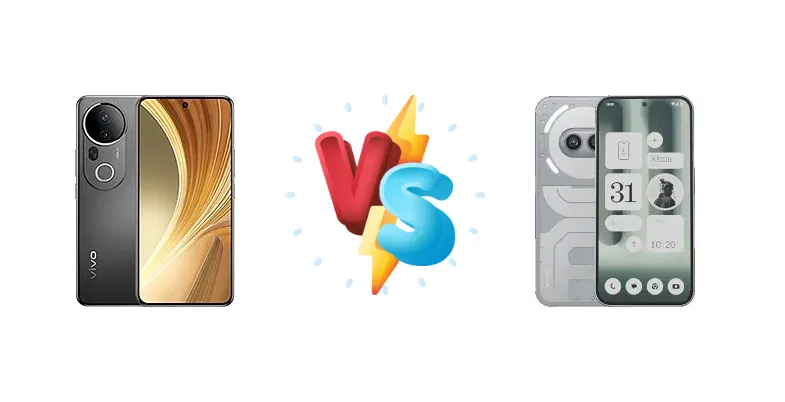
|
🏆 Quick Verdict
For users prioritizing peak performance and rapid charging, the vivo T4 Ultra is the clear winner. Its Dimensity 9300+ chipset delivers significantly more processing power. However, the Nothing Phone (2a) Plus offers a compelling alternative for those who value all-day battery life and a bright, vibrant display.
| PHONES | ||
|---|---|---|
| Phone Names | vivo T4 Ultra | Nothing Phone (2a) Plus |
| Network | ||
|---|---|---|
| 2G bands | GSM 850 / 900 / 1800 / 1900 | GSM 850 / 900 / 1800 / 1900 |
| 3G bands | HSDPA 850 / 900 / 1900 / 2100 | HSDPA 800 / 850 / 900 / 1700(AWS) / 1900 / 2100 |
| 4G bands | 1, 3, 4, 5, 7, 8, 18, 19, 20, 26, 28, 34, 38, 39, 40, 41, 42, 43, 48, 66 | 1, 3, 4, 5, 7, 8, 18, 19, 20, 26, 28, 38, 39, 40, 41, 42, 66 |
| 5G bands | 1, 3, 5, 7, 8, 18, 26, 28, 38, 40, 41, 48, 66, 77, 78 SA/NSA | 1, 3, 5, 7, 8, 20, 28, 38, 40, 41, 66, 77, 78 SA/NSA |
| Speed | HSPA, LTE, 5G | HSPA, LTE, 5G |
| Technology | GSM / HSPA / LTE / 5G | GSM / HSPA / LTE / 5G |
| Launch | ||
|---|---|---|
| Announced | 2025, June 11 | 2024, July 31 |
| Status | Available. Released 2025, June 18 | Available. Released 2024, August 03 |
| Body | ||
|---|---|---|
| Build | Glass front, glass back | Glass front (Gorilla Glass 5), plastic frame, plastic back |
| Dimensions | 160.6 x 75 x 7.5 mm (6.32 x 2.95 x 0.30 in) | 161.7 x 76.3 x 8.5 mm (6.37 x 3.00 x 0.33 in) |
| SIM | Nano-SIM + Nano-SIM | Nano-SIM + Nano-SIM |
| Weight | 192 g (6.84 oz) | 190 g (6.70 oz) |
| Display | ||
|---|---|---|
| Protection | - | Corning Gorilla Glass 5 |
| Resolution | 1260 x 2800 pixels, 20:9 ratio (~460 ppi density) | 1080 x 2412 pixels, 20:9 ratio (~395 ppi density) |
| Size | 6.67 inches, 107.4 cm2 (~89.2% screen-to-body ratio) | 6.7 inches, 107.5 cm2 (~87.1% screen-to-body ratio) |
| Type | AMOLED, 1B colors, 120Hz, 2160Hz PWM, 1600 nits (HBM), 5000 nits (peak) | AMOLED, 1B colors, 120Hz, 2160Hz PWM, HDR10+, 700 nits (typ), 1100 nits (HBM), 1300 nits (peak) |
| Platform | ||
|---|---|---|
| CPU | Octa-core (1x3.4 GHz Cortex-X4 & 3x2.85 GHz Cortex-X4 & 4x2.0 GHz Cortex-A720) | Octa-core (2x3.0 GHz Cortex-A715 & 6x 2.0 GHz Cortex-A510) |
| Chipset | Mediatek Dimensity 9300+ (4 nm) | Mediatek Dimensity 7350 Pro (4 nm) |
| GPU | Immortalis-G720 MC12 | Mali-G610 MC4 |
| OS | Android 15, Funtouch 15 | Android 14, up to 3 major Android upgrades, Nothing OS 3.0 |
| Memory | ||
|---|---|---|
| Card slot | No | No |
| Internal | 256GB 8GB RAM, 256GB 12GB RAM, 512GB 12GB RAM | 256GB 8GB RAM, 256GB 12GB RAM |
| Main Camera | ||
|---|---|---|
| Dual | - | 50 MP, f/1.9, 24mm (wide), 1/1.57", 1.0µm, PDAF, OIS 50 MP, f/2.2, 114˚ (ultrawide), 1/2.76", 0.64µm |
| Features | Ring-LED flash, panorama, HDR | LED flash, panorama, HDR |
| Triple | 50 MP, f/1.9, 23mm (wide), 1/1.56", PDAF, OIS 50 MP, f/2.6, 85mm (periscope telephoto), 1/1.95", 0.8µm, PDAF (15cm - ∞), OIS, 3x optical zoom 8 MP, f/2.2, (ultrawide) | - |
| Video | 4K, 1080p, gyro-EIS | 4K@30fps, 1080p@60/120fps, gyro-EIS |
| Selfie camera | ||
|---|---|---|
| Features | - | HDR |
| Single | 32 MP, f/2.5, (wide) | 50 MP, f/2.2, (wide), 1/2.76" |
| Video | Yes | 4K@30fps |
| Sound | ||
|---|---|---|
| 35mm jack | No | No |
| Loudspeaker | Yes, with stereo speakers | Yes, with stereo speakers |
| Comms | ||
|---|---|---|
| Bluetooth | 5.4, A2DP, LE | 5.3, A2DP, LE |
| NFC | Yes | Yes, 360˚ |
| Positioning | GPS, GLONASS, GALILEO, BDS, NavIC | GPS, GALILEO, GLONASS, BDS, QZSS |
| Radio | No | No |
| USB | USB Type-C 2.0, OTG | USB Type-C 2.0, OTG |
| WLAN | Wi-Fi 802.11 a/b/g/n/ac/6, dual-band, Wi-Fi Direct | Wi-Fi 802.11 a/b/g/n/ac/6, dual-band, Wi-Fi Direct |
| Features | ||
|---|---|---|
| Sensors | Fingerprint (under display, optical), accelerometer, gyro, proximity, compass | Fingerprint (under display, optical), accelerometer, gyro, proximity, compass |
| Battery | ||
|---|---|---|
| Charging | 90W wired, PD, 100% in 48 min Reverse wired | 50W wired, 50% in 21 min, 100% in 56 min |
| Type | Si/C Li-Ion 5500 mAh | 5000 mAh |
| Misc | ||
|---|---|---|
| Colors | Phoenix Gold, Meteor Grey | Black, Grey |
| Models | - | A142P |
| Price | ₹ 36,999 | € 269.90 / ₹ 22,599 |
| SAR | 0.99 W/kg (head) 1.00 W/kg (body) | - |
vivo T4 Ultra
- Significantly faster processor with Dimensity 9300+
- Ultra-fast 90W wired charging
- Potential for superior gaming performance
- Battery life potentially lower than Nothing Phone (2a) Plus
- Display brightness and quality currently unknown
Nothing Phone (2a) Plus
- Excellent battery life (16:34h active use)
- Bright 1097 nit display
- Clean and minimalist software experience
- Less powerful Dimensity 7350 Pro chipset
- Slower 50W charging
Display Comparison
The Nothing Phone (2a) Plus boasts a brighter display, reaching a measured peak of 1097 nits, making it more visible outdoors under direct sunlight. While the vivo T4 Ultra’s display specs are currently unavailable, the Nothing Phone (2a) Plus’s brightness advantage is a significant benefit for everyday use. The Nothing Phone (2a) Plus’s panel likely utilizes a standard refresh rate, while the T4 Ultra’s panel characteristics remain unknown. Color accuracy and viewing angles will be crucial differentiators, but without further data on the T4 Ultra, the Nothing Phone (2a) Plus currently holds the edge in display quality.
Camera Comparison
Without detailed camera specifications for the vivo T4 Ultra, a direct comparison is limited. However, the Nothing Phone (2a) Plus’s camera system is likely to focus on computational photography and image processing. The T4 Ultra’s potential advantage lies in a potentially larger main sensor, which could capture more light and detail. The absence of OIS information for both phones is a concern, as it impacts low-light performance and video stabilization. The inclusion of a 2MP macro camera on the Nothing Phone (2a) Plus is a common, but often underutilized, feature, offering limited practical benefit for most users.
Performance
The vivo T4 Ultra’s Mediatek Dimensity 9300+ chipset represents a substantial leap in performance over the Nothing Phone (2a) Plus’s Dimensity 7350 Pro. The 9300+ features a unique core configuration – 1x3.4 GHz Cortex-X4, 3x2.85 GHz Cortex-X4, and 4x2.0 GHz Cortex-A720 – designed for sustained peak performance. The 7350 Pro, with its 2x3.0 GHz Cortex-A715 and 6x2.0 GHz Cortex-A510 cores, is a capable chip but cannot match the 9300+'s raw horsepower. This translates to faster app loading times, smoother multitasking, and significantly better gaming performance on the T4 Ultra. The 4nm fabrication process is shared by both, but the architectural differences favor the vivo.
Battery Life
The Nothing Phone (2a) Plus shines in battery life, achieving an active use score of 16:34 hours. While the vivo T4 Ultra’s battery capacity is unknown, its 90W wired charging significantly outperforms the Nothing Phone (2a) Plus’s 50W charging. The T4 Ultra can reach 100% charge in just 48 minutes, while the Nothing Phone (2a) Plus takes 56 minutes. The Nothing Phone (2a) Plus’s longer battery life is ideal for users who prioritize all-day usage, while the T4 Ultra’s faster charging mitigates the inconvenience of a potentially smaller battery.
Buying Guide
Buy the vivo T4 Ultra if you are a power user who demands the fastest possible performance for gaming, video editing, or multitasking, and appreciate the convenience of 90W fast charging. Buy the Nothing Phone (2a) Plus if you prioritize long battery life, a bright and easily viewable display, and a clean, minimalist software experience, even if it means sacrificing some raw processing speed.