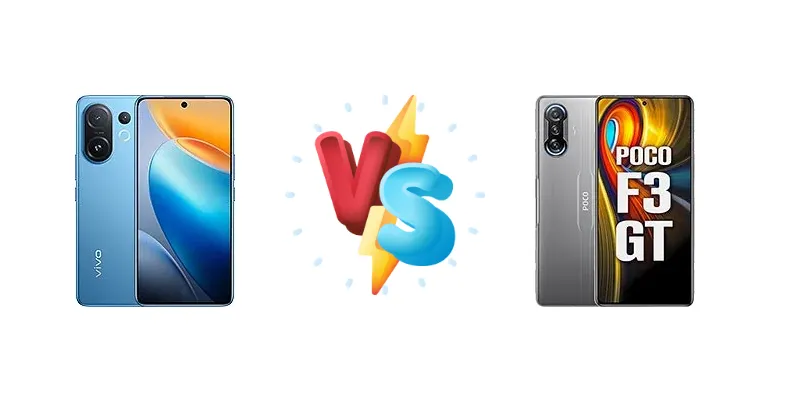
The vivo T4 Pro and Xiaomi Poco F3 GT represent distinct approaches to the mid-range smartphone market. The Poco F3 GT, released in 2021, prioritized raw gaming performance with the Dimensity 1200, while the newer vivo T4 Pro focuses on a balance of power and efficiency with the Snapdragon 7 Gen 4. This comparison dissects their key differences to help you choose the right device.
🏆 Quick Verdict
For the average user, the vivo T4 Pro is the better choice. Its newer Snapdragon 7 Gen 4 chipset offers comparable performance to the Dimensity 1200, but with significantly improved power efficiency and faster 90W charging. While the F3 GT still holds its own, the T4 Pro represents a more modern and refined experience.
| Network |
|---|
| 2G bands | GSM 850 / 900 / 1800 / 1900 | GSM 850 / 900 / 1800 / 1900 |
| 3G bands | HSDPA 800 / 850 / 900 / 1700(AWS) / 1900 / 2100 | HSDPA 850 / 900 / 1900 / 2100 |
| 4G bands | 1, 3, 4, 5, 7, 8, 18, 19, 20, 26, 28, 38, 39, 40, 41, 42, 66 | 1, 3, 5, 8, 40, 41 |
| 5G bands | 1, 3, 5, 8, 28, 38, 40, 41, 66, 77, 78 SA/NSA | 77, 78 SA/NSA |
| Speed | HSPA, LTE, 5G | HSPA, LTE, 5G |
| Technology | GSM / HSPA / LTE / 5G | GSM / HSPA / LTE / 5G |
| Launch |
|---|
| Announced | 2025, August 26 | 2021, July 23 |
| Status | Available. Released 2025, August 26 | Available. Released 2021, July 26 |
| Body |
|---|
| Build | Glass front, plastic frame, plastic back | Glass front (Gorilla Glass 5), glass back (Gorilla Glass 5) |
| Dimensions | 163.5 x 77 x 7.5 mm (6.44 x 3.03 x 0.30 in) | 161.9 x 76.9 x 8.3 mm (6.37 x 3.03 x 0.33 in) |
| SIM | Nano-SIM + Nano-SIM | Nano-SIM + Nano-SIM |
| Weight | 192 g (6.77 oz) | 205 g (7.23 oz) |
| | - | Physical pop-up gaming triggers
IP53, dust and splash resistant |
| Display |
|---|
| Protection | Diamond Shield Glass | Corning Gorilla Glass 5 |
| Resolution | 1080 x 2392 pixels (~388 ppi density) | 1080 x 2400 pixels, 20:9 ratio (~395 ppi density) |
| Size | 6.77 inches, 110.9 cm2 (~88.1% screen-to-body ratio) | 6.67 inches, 107.4 cm2 (~86.3% screen-to-body ratio) |
| Type | AMOLED, 1B colors, HDR10+, 120Hz, 1500 nits (HBM), 5000 nits (peak) | AMOLED, 1B colors, 120Hz, HDR10+, 500 nits (typ) |
| Platform |
|---|
| CPU | Octa-core (1x2.8 GHz Cortex-720 & 4x2.4 GHz Cortex-720 & 3x1.8 GHz Cortex-520) | Octa-core (1x3.0 GHz Cortex-A78 & 3x2.6 GHz Cortex-A78 & 4x2.0 GHz Cortex-A55) |
| Chipset | Qualcomm SM7750-AB Snapdragon 7 Gen 4 (4 nm) | Mediatek Dimensity 1200 (6 nm) |
| GPU | Adreno 722 | Mali-G77 MC9 |
| OS | Android 15, up to 4 major Android upgrades, Funtouch 15 | Android 11, upgradable to Android 12, MIUI 13 for POCO |
| Memory |
|---|
| Card slot | No | No |
| Internal | 128GB 8GB RAM, 256GB 8GB RAM, 256GB 12GB RAM | 128GB 6GB RAM, 128GB 8GB RAM, 256GB 8GB RAM |
| | - | UFS 3.1 |
| Main Camera |
|---|
| Features | Ring-LED flash, panorama, HDR | Dual-LED flash, HDR, panorama |
| Single | - | 16 MP, f/2.5, (wide), 1/3.06" 1.0µm |
| Triple | 50 MP, f/1.8, 26mm (wide), 1/1.95", 0.8µm, PDAF, OIS
50 MP, f/2.7, 73mm (periscope telephoto), 1/1.95", 0.8µm, PDAF, OIS, 3x optical zoom
Auxiliary lens | 64 MP, f/1.7, 26mm (wide), 1/2.0", 0.7µm, PDAF
8 MP, f/2.2, 120˚ (ultrawide)
2 MP (macro) |
| Video | 4K@30fps, 1080p@30fps, gyro-EIS, OIS | 4K@30fps, 1080p@30/60/120fps, 720p@960fps, HDR |
| Selfie camera |
|---|
| Features | - | HDR, panorama |
| Single | 32 MP, f/2.5, 30mm (wide) | 16 MP, f/2.5, (wide), 1/3.06" 1.0µm |
| Video | 4K@30fps, 1080p@30fps | 1080p@30fps, HDR |
| Sound |
|---|
| 3.5mm jack | - | No |
| 35mm jack | No | No |
| Loudspeaker | Yes, with stereo speakers | Yes, with stereo speakers |
| | - | 24-bit/192kHz audio
Tuned by JBL |
| Comms |
|---|
| Bluetooth | 5.4, A2DP, LE | 5.1, A2DP, LE |
| Infrared port | Yes | Yes |
| NFC | No | Yes (market/region dependent) |
| Positioning | GPS, GALILEO, GLONASS, QZSS, BDS, NavIC | GPS, GLONASS, GALILEO, BDS |
| Radio | No | No |
| USB | USB Type-C 2.0, OTG | USB Type-C 2.0, OTG |
| WLAN | Wi-Fi 802.11 a/b/g/n/ac/6, dual-band | Wi-Fi 802.11 a/b/g/n/ac/6, dual-band, Wi-Fi Direct |
| Features |
|---|
| Sensors | Fingerprint (under display, optical), accelerometer, gyro, proximity, compass | Fingerprint (side-mounted), accelerometer, gyro, proximity, compass |
| Battery |
|---|
| Charging | 90W wired, PD
7.5W reverse wired
Bypass charging | 67W wired, PD3.0, QC3, 100% in 42 min |
| Type | Si/C Li-Ion 6500 mAh | Li-Po 5065 mAh |
| Misc |
|---|
| Colors | Nitro Blue, Blaze Gold | Predator Black, Gunmetal Silver |
| Models | V2510 | MZB09C6IN, M2104K10I |
| Price | ₹ 27,890 | About 300 EUR |
| SAR | 0.99 W/kg (head) 0.93 W/kg (body) | 0.81 W/kg (head) 0.48 W/kg (body) |
vivo T4 Pro
- Faster 90W charging for quicker top-ups
- More power-efficient Snapdragon 7 Gen 4 chipset
- Bypass charging allows use while charging
- Specific display specs are unknown
- Camera details are currently unavailable
Xiaomi Poco F3 GT
- Potentially higher peak gaming performance with Dimensity 1200
- Likely higher refresh rate display for smoother gaming
- May offer a larger main camera sensor
- Less power-efficient chipset leading to potential throttling
- Slower 67W charging compared to the T4 Pro
- Older chipset architecture
Display Comparison
Neither device's display specifications are provided, so a direct comparison is limited. However, given the Poco F3 GT's gaming focus, it likely features a higher refresh rate panel (120Hz is common for this chipset) to enhance visual fluidity. The vivo T4 Pro, being a more recent release, may benefit from advancements in panel technology, potentially offering improved color accuracy and brightness. Bezels are likely comparable, typical of mid-range devices. Without specific data, it's difficult to declare a clear winner.
Camera Comparison
Without camera specifications, analysis is limited. However, the market positioning suggests the Poco F3 GT may prioritize a larger main sensor for better low-light performance, a common strategy for gaming phones aiming for a premium feel. The vivo T4 Pro, being newer, likely benefits from improved image processing algorithms and potentially more advanced features. The absence of information regarding OIS (Optical Image Stabilization) makes it impossible to assess video recording capabilities. It's safe to assume both devices include standard wide and ultrawide lenses, but details regarding sensor size and aperture are crucial for a definitive comparison.
Performance
The core difference lies in the chipsets. The Xiaomi Poco F3 GT’s MediaTek Dimensity 1200 (6nm) boasts a Cortex-A78 prime core clocked at 3.0 GHz, aiming for peak performance. However, the vivo T4 Pro’s Snapdragon 7 Gen 4 (4nm) utilizes a more modern architecture, with a Cortex-720 prime core at 2.8 GHz. While the Dimensity 1200 has a higher clock speed, the 4nm process of the Snapdragon 7 Gen 4 provides superior power efficiency. This translates to less heat generation and reduced throttling during sustained workloads. The Snapdragon's CPU core configuration (1x2.8GHz + 4x2.4GHz + 3x1.8GHz) is designed for a balanced performance profile, while the Dimensity 1200 (1x3.0GHz + 3x2.6GHz + 4x2.0GHz) leans towards raw power. The T4 Pro's efficiency will benefit everyday users and moderate gamers, while the F3 GT might offer a slight edge in benchmark scores but potentially at the cost of thermal management.
Battery Life
The vivo T4 Pro’s 90W wired charging is a significant advantage over the Poco F3 GT’s 67W charging. The T4 Pro can likely achieve a full charge in under an hour, while the F3 GT takes approximately 42 minutes. While the F3 GT's charging speed is respectable, the T4 Pro's 90W charging offers a more convenient and faster top-up experience. The inclusion of bypass charging on the T4 Pro allows for charging while the device is in use, further enhancing usability. Battery capacity is not specified for either device, but the Snapdragon 7 Gen 4’s efficiency suggests the T4 Pro will deliver longer battery life despite potentially having a smaller capacity.
Buying Guide
Buy the vivo T4 Pro if you prioritize all-day battery life, efficient performance for everyday tasks and moderate gaming, and the convenience of incredibly fast 90W charging. Buy the Xiaomi Poco F3 GT if you are a hardcore mobile gamer who values maximum sustained performance, even at the cost of battery life and thermal throttling, and can find it at a significantly discounted price.
Frequently Asked Questions
❓ Will the Dimensity 1200 in the Poco F3 GT overheat during prolonged gaming sessions?
The Dimensity 1200 is a powerful chip, but its 6nm process and higher power draw can lead to thermal throttling during extended gaming. While the F3 GT may offer initial high performance, sustained gaming could result in reduced frame rates as the chip heats up. The Snapdragon 7 Gen 4 in the T4 Pro, with its 4nm process, is designed to manage heat more effectively.
❓ How much faster is the 90W charging on the vivo T4 Pro compared to the 67W charging on the Poco F3 GT in real-world use?
The 90W charging on the T4 Pro will noticeably reduce charging time. While the F3 GT takes around 42 minutes for a full charge, the T4 Pro is likely to achieve a full charge in under an hour, potentially around 50-55 minutes. This difference is particularly beneficial for users who need a quick top-up before leaving the house.
❓ Does the Snapdragon 7 Gen 4 in the vivo T4 Pro offer enough of a performance boost to justify upgrading from a phone with a Snapdragon 778G?
The Snapdragon 7 Gen 4 represents a significant architectural upgrade over the 778G. While not a massive leap, you'll see improvements in CPU and GPU performance, as well as enhanced AI capabilities. The efficiency gains are also substantial, leading to better battery life. If you're looking for a noticeable improvement in overall performance and battery life, the T4 Pro is a worthwhile upgrade.