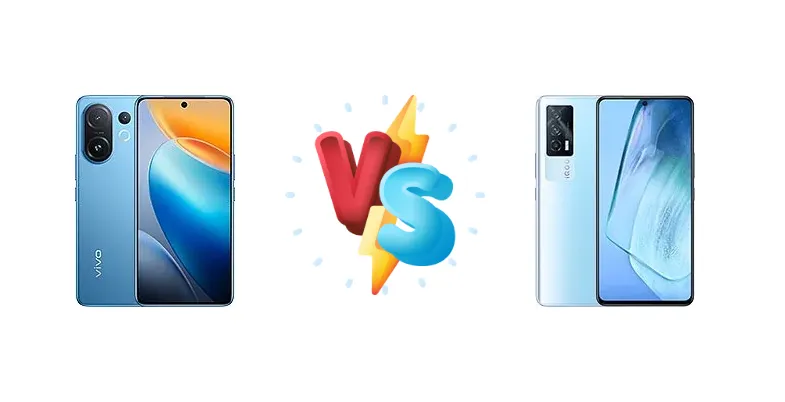
The vivo iQOO 7 (India) and the vivo T4 Pro represent distinct approaches to the mid-range smartphone market. The iQOO 7, leveraging the older but potent Snapdragon 870, aims for raw performance. The T4 Pro, with the newer Snapdragon 7 Gen 4, focuses on efficiency and a more modern feature set. This comparison dissects their strengths and weaknesses to determine which device delivers the best experience.
🏆 Quick Verdict
For most users, the vivo iQOO 7 (India) offers a more compelling package. While the Snapdragon 7 Gen 4 in the T4 Pro is efficient, the Snapdragon 870 in the iQOO 7 provides a noticeable performance uplift in demanding tasks and gaming, justifying its slightly older chipset. The iQOO 7's faster charging also adds to its appeal.
| Network |
|---|
| 2G bands | GSM 850 / 900 / 1800 / 1900 | GSM 850 / 900 / 1800 / 1900 |
| 3G bands | HSDPA 800 / 850 / 900 / 1700(AWS) / 1900 / 2100 | HSDPA 850 / 900 / 2100 |
| 4G bands | 1, 3, 4, 5, 7, 8, 18, 19, 20, 26, 28, 38, 39, 40, 41, 42, 66 | 1, 3, 5, 8, 38, 40, 41 |
| 5G bands | 1, 3, 5, 8, 28, 38, 40, 41, 66, 77, 78 SA/NSA | SA/NSA |
| Speed | HSPA, LTE, 5G | HSPA, LTE, 5G |
| Technology | GSM / HSPA / LTE / 5G | GSM / HSPA / LTE / 5G |
| Launch |
|---|
| Announced | 2025, August 26 | 2021, April 26 |
| Status | Available. Released 2025, August 26 | Available. Released 2021, May 01 |
| Body |
|---|
| Build | Glass front, plastic frame, plastic back | - |
| Dimensions | 163.5 x 77 x 7.5 mm (6.44 x 3.03 x 0.30 in) | 163.3 x 76.4 x 8.4 mm (6.43 x 3.01 x 0.33 in) |
| SIM | Nano-SIM + Nano-SIM | Nano-SIM + Nano-SIM |
| Weight | 192 g (6.77 oz) | 196 g (6.91 oz) |
| Display |
|---|
| Protection | Diamond Shield Glass | - |
| Resolution | 1080 x 2392 pixels (~388 ppi density) | 1080 x 2400 pixels, 20:9 ratio (~398 ppi density) |
| Size | 6.77 inches, 110.9 cm2 (~88.1% screen-to-body ratio) | 6.62 inches, 105.8 cm2 (~84.8% screen-to-body ratio) |
| Type | AMOLED, 1B colors, HDR10+, 120Hz, 1500 nits (HBM), 5000 nits (peak) | AMOLED, 120Hz, HDR10+, 1300 nits (peak) |
| Platform |
|---|
| CPU | Octa-core (1x2.8 GHz Cortex-720 & 4x2.4 GHz Cortex-720 & 3x1.8 GHz Cortex-520) | Octa-core (1x3.2 GHz Kryo 585 & 3x2.42 GHz Kryo 585 & 4x1.80 GHz Kryo 585) |
| Chipset | Qualcomm SM7750-AB Snapdragon 7 Gen 4 (4 nm) | Qualcomm SM8250-AC Snapdragon 870 5G (7 nm) |
| GPU | Adreno 722 | Adreno 650 |
| OS | Android 15, up to 4 major Android upgrades, Funtouch 15 | Android 11, Funtouch 11.1 |
| Memory |
|---|
| Card slot | No | No |
| Internal | 128GB 8GB RAM, 256GB 8GB RAM, 256GB 12GB RAM | 128GB 8GB RAM, 256GB 8GB RAM, 256GB 12GB RAM |
| Main Camera |
|---|
| Dual | - | 48 MP, f/1.8, 25mm (wide), 1/2.0", 0.8µm, PDAF, OIS
13 MP, f/2.2, 16mm, 120˚ (ultrawide)
Auxiliary lens |
| Features | Ring-LED flash, panorama, HDR | Dual-LED dual-tone flash, HDR, panorama |
| Single | - | 16 MP, f/2.0, (wide) |
| Triple | 50 MP, f/1.8, 26mm (wide), 1/1.95", 0.8µm, PDAF, OIS
50 MP, f/2.7, 73mm (periscope telephoto), 1/1.95", 0.8µm, PDAF, OIS, 3x optical zoom
Auxiliary lens | - |
| Video | 4K@30fps, 1080p@30fps, gyro-EIS, OIS | 4K@30fps, 1080p@30fps |
| Selfie camera |
|---|
| Features | - | HDR |
| Single | 32 MP, f/2.5, 30mm (wide) | 16 MP, f/2.0, (wide) |
| Video | 4K@30fps, 1080p@30fps | 1080p@30fps |
| Sound |
|---|
| 3.5mm jack | - | No |
| 35mm jack | No | No |
| Loudspeaker | Yes, with stereo speakers | Yes, with dual speakers |
| | - | 24-bit/192kHz audio |
| Comms |
|---|
| Bluetooth | 5.4, A2DP, LE | 5.1, A2DP, LE, aptX HD, aptX Adaptive |
| Infrared port | Yes | - |
| NFC | No | Yes |
| Positioning | GPS, GALILEO, GLONASS, QZSS, BDS, NavIC | GPS |
| Radio | No | No |
| USB | USB Type-C 2.0, OTG | USB Type-C 2.0, OTG |
| WLAN | Wi-Fi 802.11 a/b/g/n/ac/6, dual-band | Wi-Fi 802.11 a/b/g/n/ac, dual-band, Wi-Fi Direct |
| Features |
|---|
| Sensors | Fingerprint (under display, optical), accelerometer, gyro, proximity, compass | Fingerprint (under display, optical), accelerometer, gyro, proximity, compass |
| Battery |
|---|
| Charging | 90W wired, PD
7.5W reverse wired
Bypass charging | 66W wired, 100% in 22 min |
| Type | Si/C Li-Ion 6500 mAh | 4400 mAh |
| Misc |
|---|
| Colors | Nitro Blue, Blaze Gold | Solid Ice, Storm Black, Monster Orange |
| Models | V2510 | - |
| Price | ₹ 27,890 | About 350 EUR |
| SAR | 0.99 W/kg (head) 0.93 W/kg (body) | - |
vivo T4 Pro
- Faster 90W charging with PD
- More modern Snapdragon 7 Gen 4 architecture
- 7.5W reverse wired charging
- Less powerful CPU compared to Snapdragon 870
- Potentially lower sustained performance due to chipset limitations
vivo iQOO 7 (India)
- More powerful Snapdragon 870 processor
- Faster performance in demanding tasks and gaming
- Potentially better camera ISP
- Older chipset architecture
- Slower 66W charging compared to T4 Pro
Display Comparison
Neither device's display specifications are provided, so a direct comparison is limited. However, given the iQOO brand's gaming focus, it's reasonable to expect a higher refresh rate panel on the iQOO 7. The T4 Pro, being newer, *may* benefit from improved color accuracy and potentially higher peak brightness, but this is speculative. The absence of LTPO technology on either device suggests both will likely rely on adaptive refresh rate switching to conserve power.
Camera Comparison
Without specific camera sensor details, a detailed comparison is difficult. However, iQOO phones generally prioritize camera performance, suggesting the iQOO 7 may have a more sophisticated camera system. The Snapdragon 870’s ISP (Image Signal Processor) is also more capable than the 7 Gen 4’s, potentially leading to better image processing, especially in low-light conditions. We can assume both phones will feature a multi-camera setup, but the iQOO 7 is more likely to have a larger main sensor and optical image stabilization (OIS).
Performance
The core difference lies in the chipsets. The iQOO 7’s Snapdragon 870 (7nm) boasts a higher peak CPU clock speed (3.2 GHz Kryo 585) compared to the T4 Pro’s Snapdragon 7 Gen 4 (4nm, 2.8 GHz Cortex-720). While the 7 Gen 4 benefits from a more efficient 4nm process, the 870’s larger L3 cache and more powerful CPU cores translate to superior performance in benchmarks and real-world applications. The T4 Pro’s newer architecture *should* offer better sustained performance due to improved thermal management, but the 870’s raw power is likely to be more noticeable. Both devices utilize an octa-core configuration, but the architectural differences in the CPU cores are significant.
Battery Life
The iQOO 7 features 66W wired charging, claiming a full charge in 22 minutes. The T4 Pro boasts a faster 90W wired charging with PD, and also includes 7.5W reverse wired charging. While the T4 Pro’s charging is quicker, the iQOO 7’s 66W is still very respectable. The actual battery capacity of both devices is unknown, but the faster charging of the T4 Pro could offset a potentially smaller battery size, providing comparable real-world usage.
Buying Guide
Buy the vivo T4 Pro if you prioritize long-term software support and a more modern chipset architecture, even if it means sacrificing some peak performance. It's ideal for everyday users who value battery life and efficient multitasking. Buy the vivo iQOO 7 (India) if you're a gamer or power user who demands the highest possible performance for the price, and are willing to trade some efficiency for that extra horsepower. It's the better choice for those who frequently engage in resource-intensive applications.
Frequently Asked Questions
❓ Will the Snapdragon 870 in the iQOO 7 overheat during prolonged gaming sessions?
The Snapdragon 870 is known for its good thermal performance, but it can still throttle under sustained load. iQOO typically implements effective cooling solutions in their gaming-focused devices, mitigating throttling to a degree. However, the T4 Pro's 4nm process *should* theoretically run cooler, but the 870's raw power provides a performance buffer before throttling becomes noticeable.
❓ Does the Snapdragon 7 Gen 4 in the T4 Pro offer significant improvements in power efficiency compared to the 870?
The 4nm process of the Snapdragon 7 Gen 4 does offer improved power efficiency. However, the Snapdragon 870 is still relatively efficient, and the performance difference is substantial. The T4 Pro will likely exhibit longer battery life during light usage, but the iQOO 7's performance advantage will likely outweigh the efficiency gains during demanding tasks.
❓ Is the 90W charging on the T4 Pro significantly faster in real-world use than the iQOO 7's 66W?
Yes, 90W charging is noticeably faster. While the iQOO 7's 66W is quick, the T4 Pro can top up the battery from 0-100% in a shorter timeframe. This is particularly beneficial for users who frequently need to quickly recharge their phone.