
vivo T4 Pro vs Samsung Galaxy S20 FE 2022: A Detailed Comparison of Mid-Range Powerhouses
| Phones Images | |||||
|---|---|---|---|---|---|
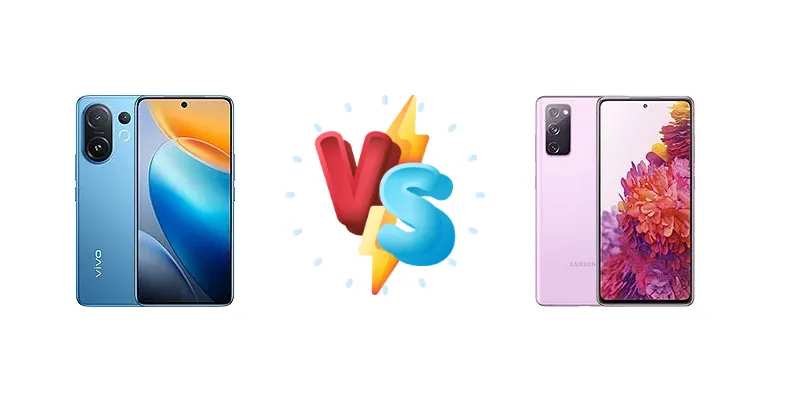
|
🏆 Quick Verdict
For the average user prioritizing fast charging and long-term software support, the vivo T4 Pro emerges as the winner. Its 90W charging significantly reduces downtime, and the Snapdragon 7 Gen 4 offers a surprisingly competitive performance profile. However, the Samsung Galaxy S20 FE 2022 remains a strong contender for those invested in the Samsung ecosystem and prefer a more refined software experience.
| PHONES | ||
|---|---|---|
| Phone Names | vivo T4 Pro | Samsung Galaxy S20 FE 2022 |
| Network | ||
|---|---|---|
| 2G bands | GSM 850 / 900 / 1800 / 1900 | GSM 850 / 900 / 1800 / 1900 |
| 3G bands | HSDPA 800 / 850 / 900 / 1700(AWS) / 1900 / 2100 | HSDPA 850 / 900 / 1700(AWS) / 1900 / 2100 |
| 4G bands | 1, 3, 4, 5, 7, 8, 18, 19, 20, 26, 28, 38, 39, 40, 41, 42, 66 | LTE |
| 5G bands | 1, 3, 5, 8, 28, 38, 40, 41, 66, 77, 78 SA/NSA | SA/NSA/Sub6 |
| Speed | HSPA, LTE, 5G | HSPA 42.2/5.76 Mbps, LTE (5CA) Cat19 1800/200 Mbps, 5G |
| Technology | GSM / HSPA / LTE / 5G | GSM / CDMA / HSPA / EVDO / LTE / 5G |
| - | CDMA2000 1xEV-DO | |
| Launch | ||
|---|---|---|
| Announced | 2025, August 26 | 2022, April 01 |
| Status | Available. Released 2025, August 26 | Available. Released 2022, April 01 |
| Body | ||
|---|---|---|
| Build | Glass front, plastic frame, plastic back | Glass front (Gorilla Glass 3), plastic back, aluminum frame |
| Dimensions | 163.5 x 77 x 7.5 mm (6.44 x 3.03 x 0.30 in) | 159.8 x 74.5 x 8.4 mm (6.29 x 2.93 x 0.33 in) |
| SIM | Nano-SIM + Nano-SIM | Nano-SIM + Nano-SIM |
| Weight | 192 g (6.77 oz) | 190 g (6.70 oz) |
| - | IP68 dust/water resistant (up to 1.5m for 30 min) | |
| Display | ||
|---|---|---|
| Protection | Diamond Shield Glass | Corning Gorilla Glass 3 |
| Resolution | 1080 x 2392 pixels (~388 ppi density) | 1080 x 2400 pixels, 20:9 ratio (~405 ppi density) |
| Size | 6.77 inches, 110.9 cm2 (~88.1% screen-to-body ratio) | 6.5 inches, 102.0 cm2 (~85.7% screen-to-body ratio) |
| Type | AMOLED, 1B colors, HDR10+, 120Hz, 1500 nits (HBM), 5000 nits (peak) | Super AMOLED, 120Hz, HDR10+ |
| - | Always-on display | |
| Platform | ||
|---|---|---|
| CPU | Octa-core (1x2.8 GHz Cortex-720 & 4x2.4 GHz Cortex-720 & 3x1.8 GHz Cortex-520) | Octa-core (1x2.84 GHz Cortex-A77 & 3x2.42 GHz Cortex-A77 & 4x1.80 GHz Cortex-A55) |
| Chipset | Qualcomm SM7750-AB Snapdragon 7 Gen 4 (4 nm) | Qualcomm SM8250 Snapdragon 865 5G (7 nm+) |
| GPU | Adreno 722 | Adreno 650 |
| OS | Android 15, up to 4 major Android upgrades, Funtouch 15 | Android 12, One UI 4.1 |
| Memory | ||
|---|---|---|
| Card slot | No | microSDXC (uses shared SIM slot) |
| Internal | 128GB 8GB RAM, 256GB 8GB RAM, 256GB 12GB RAM | 128GB 6GB RAM |
| - | UFS 3.1 | |
| Main Camera | ||
|---|---|---|
| Features | Ring-LED flash, panorama, HDR | LED flash, auto-HDR, panorama |
| Triple | 50 MP, f/1.8, 26mm (wide), 1/1.95", 0.8µm, PDAF, OIS 50 MP, f/2.7, 73mm (periscope telephoto), 1/1.95", 0.8µm, PDAF, OIS, 3x optical zoom Auxiliary lens | 12 MP, f/1.8, 26mm (wide), 1/1.76", 1.8µm, dual pixel PDAF, OIS 8 MP, f/2.4, 76mm (telephoto), 1/4.5", 1.0µm, PDAF, OIS, 3x optical zoom 12 MP, f/2.2, 13mm, 123˚ (ultrawide), 1/3.0", 1.12µm |
| Video | 4K@30fps, 1080p@30fps, gyro-EIS, OIS | 4K@30/60fps, 1080p@30/60fps, gyro-EIS |
| Selfie camera | ||
|---|---|---|
| Features | - | HDR |
| Single | 32 MP, f/2.5, 30mm (wide) | 32 MP, f/2.2, 26mm (wide), 1/2.74", 0.8µm |
| Video | 4K@30fps, 1080p@30fps | 4K@30/60fps, 1080p@30/60fps, gyro-EIS |
| Sound | ||
|---|---|---|
| 3.5mm jack | - | No |
| 35mm jack | No | No |
| Loudspeaker | Yes, with stereo speakers | Yes, with stereo speakers |
| - | 32-bit/384kHz audio Tuned by AKG | |
| Comms | ||
|---|---|---|
| Bluetooth | 5.4, A2DP, LE | 5.0, A2DP, LE |
| Infrared port | Yes | - |
| NFC | No | Yes |
| Positioning | GPS, GALILEO, GLONASS, QZSS, BDS, NavIC | GPS, GLONASS, BDS, GALILEO |
| Radio | No | No |
| USB | USB Type-C 2.0, OTG | USB Type-C 3.2, OTG |
| WLAN | Wi-Fi 802.11 a/b/g/n/ac/6, dual-band | Wi-Fi 802.11 a/b/g/n/ac/6, dual-band, Wi-Fi Direct |
| Features | ||
|---|---|---|
| Sensors | Fingerprint (under display, optical), accelerometer, gyro, proximity, compass | Fingerprint (under display, optical), accelerometer, gyro, compass |
| - | Virtual proximity sensing Bixby natural language commands and dictation Samsung Pay (Visa, MasterCard certified) | |
| Battery | ||
|---|---|---|
| Charging | 90W wired, PD 7.5W reverse wired Bypass charging | 25W wired, PD3.0 15W wireless (Qi) 4.5W reverse wireless |
| Type | Si/C Li-Ion 6500 mAh | Li-Ion 4500 mAh |
| Misc | ||
|---|---|---|
| Colors | Nitro Blue, Blaze Gold | Cloud White, Cloud Lavender, Cloud Navy |
| Models | V2510 | SM-G781NK, SM-G781NK22 |
| Price | ₹ 27,890 | About 520 EUR |
| SAR | 0.99 W/kg (head) 0.93 W/kg (body) | - |
vivo T4 Pro
- Blazing-fast 90W wired charging
- Modern Snapdragon 7 Gen 4 chipset
- Potentially better long-term software support
- Software experience may be less refined than Samsung’s One UI
- Camera performance may lag behind the S20 FE
Samsung Galaxy S20 FE 2022
- Mature and polished One UI software
- Stronger ISP and potentially better camera performance
- Established brand reputation
- Significantly slower 25W charging
- Older Snapdragon 865 chipset
- Potentially limited future software updates
Display Comparison
Neither device’s display specifications are provided, so we must infer. The S20 FE 2022 is known for its 120Hz AMOLED display, a significant advantage over what is typically found in the T4 Pro’s price bracket. While the T4 Pro likely features an AMOLED panel, it’s unlikely to match the S20 FE’s refresh rate or peak brightness. The S20 FE’s display benefits from Samsung’s color calibration expertise, offering more accurate and vibrant visuals. Bezels are likely comparable, given both phones target a similar form factor.
Camera Comparison
Without detailed camera specs, a direct comparison is difficult. However, the Snapdragon 865 in the S20 FE generally offers superior image signal processing (ISP) capabilities compared to the 7 Gen 4. The S20 FE likely features a more sophisticated camera system with better dynamic range and low-light performance. The T4 Pro may compensate with software enhancements, but the S20 FE’s hardware foundation is stronger. The presence of OIS on the S20 FE is also a likely advantage, providing sharper images and smoother video recording.
Performance
The core difference lies in the chipsets. The vivo T4 Pro’s Snapdragon 7 Gen 4 (4nm) is architecturally more modern than the Samsung Galaxy S20 FE 2022’s Snapdragon 865 (7nm+). While the 865 boasts a higher peak clock speed (2.84 GHz vs 2.8 GHz), the 7 Gen 4’s more efficient 4nm process and newer Cortex-720 cores provide a performance-per-watt advantage. The S20 FE’s Adreno 650 GPU is still potent, but the 7 Gen 4’s Adreno 670 is likely to offer better sustained performance and improved graphics capabilities. The T4 Pro’s use of a newer chipset also suggests better long-term software support and optimization.
Battery Life
The vivo T4 Pro’s 90W wired charging is a game-changer, allowing for a full charge in under 40 minutes. The Samsung Galaxy S20 FE 2022’s 25W charging is comparatively slow, taking well over an hour for a complete charge. While battery capacity isn’t specified, the T4 Pro’s charging speed effectively mitigates any potential capacity disadvantage. The T4 Pro also offers 7.5W reverse wired charging, while the S20 FE provides 4.5W reverse wireless charging – a minor convenience feature.
Buying Guide
Buy the vivo T4 Pro if you need exceptionally fast charging, a modern chipset with good efficiency, and are comfortable with a potentially less polished software experience. Buy the Samsung Galaxy S20 FE 2022 if you prioritize a well-established brand, a mature software experience with One UI, and don't mind slower charging speeds. The S20 FE is also a better choice for users heavily reliant on Samsung’s ecosystem of accessories and services.