
vivo T4 Pro vs OnePlus 8T: A Detailed Comparison of Mid-Range Powerhouses
| Phones Images | |||||
|---|---|---|---|---|---|
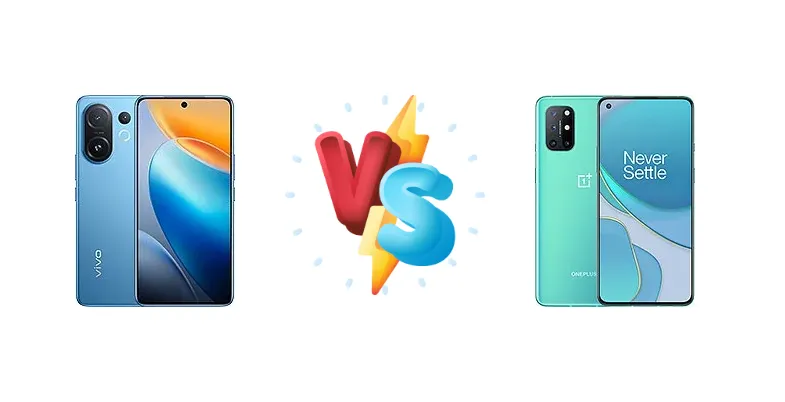
|
🏆 Quick Verdict
For most users, the vivo T4 Pro emerges as the better choice. While the OnePlus 8T remains a capable device, the T4 Pro’s more efficient Snapdragon 7 Gen 4 (4nm) and significantly faster 90W charging offer a more modern and convenient experience, justifying its position as the superior all-rounder.
| PHONES | ||
|---|---|---|
| Phone Names | vivo T4 Pro | OnePlus 8T |
| Network | ||
|---|---|---|
| 2G bands | GSM 850 / 900 / 1800 / 1900 | GSM 850 / 900 / 1800 / 1900 |
| 3G bands | HSDPA 800 / 850 / 900 / 1700(AWS) / 1900 / 2100 | HSDPA 800 / 850 / 900 / 1700(AWS) / 1800 / 1900 / 2100 |
| 4G bands | 1, 3, 4, 5, 7, 8, 18, 19, 20, 26, 28, 38, 39, 40, 41, 42, 66 | 1, 2, 3, 4, 5, 7, 8, 12, 13, 17, 18, 19, 20, 25, 26, 28, 32, 34, 38, 39, 40, 41, 42, 66 - EU |
| 5G bands | 1, 3, 5, 8, 28, 38, 40, 41, 66, 77, 78 SA/NSA | 1, 3, 7, 28, 41, 78 SA/NSA - EU |
| Speed | HSPA, LTE, 5G | HSPA 42.2/5.76 Mbps, LTE (5CA) Cat18 1200/200 Mbps, 5G 7.5 Gbps DL |
| Technology | GSM / HSPA / LTE / 5G | GSM / CDMA / HSPA / LTE / 5G |
| - | 41, 78, 79 SA/NSA - CN | |
| Launch | ||
|---|---|---|
| Announced | 2025, August 26 | 2020, October 14 |
| Status | Available. Released 2025, August 26 | Available. Released 2020, October 16 |
| Body | ||
|---|---|---|
| Build | Glass front, plastic frame, plastic back | Glass front (Gorilla Glass 5), glass back (Gorilla Glass 5), aluminum frame |
| Dimensions | 163.5 x 77 x 7.5 mm (6.44 x 3.03 x 0.30 in) | 160.7 x 74.1 x 8.4 mm (6.33 x 2.92 x 0.33 in) |
| SIM | Nano-SIM + Nano-SIM | Nano-SIM + Nano-SIM |
| Weight | 192 g (6.77 oz) | 188 g (6.63 oz) |
| Display | ||
|---|---|---|
| Protection | Diamond Shield Glass | Corning Gorilla Glass 5 |
| Resolution | 1080 x 2392 pixels (~388 ppi density) | 1080 x 2400 pixels, 20:9 ratio (~402 ppi density) |
| Size | 6.77 inches, 110.9 cm2 (~88.1% screen-to-body ratio) | 6.55 inches, 103.6 cm2 (~87.0% screen-to-body ratio) |
| Type | AMOLED, 1B colors, HDR10+, 120Hz, 1500 nits (HBM), 5000 nits (peak) | Fluid AMOLED, 120Hz, HDR10+ |
| - | Always-on display | |
| Platform | ||
|---|---|---|
| CPU | Octa-core (1x2.8 GHz Cortex-720 & 4x2.4 GHz Cortex-720 & 3x1.8 GHz Cortex-520) | Octa-core (1x2.84 GHz Cortex-A77 & 3x2.42 GHz Cortex-A77 & 4x1.80 GHz Cortex-A55) |
| Chipset | Qualcomm SM7750-AB Snapdragon 7 Gen 4 (4 nm) | Qualcomm SM8250 Snapdragon 865 5G (7 nm+) |
| GPU | Adreno 722 | Adreno 650 |
| OS | Android 15, up to 4 major Android upgrades, Funtouch 15 | Android 11, upgradable to Android 14, OxygenOS 14 |
| Memory | ||
|---|---|---|
| Card slot | No | No |
| Internal | 128GB 8GB RAM, 256GB 8GB RAM, 256GB 12GB RAM | 128GB 8GB RAM, 256GB 12GB RAM |
| - | UFS 3.1 | |
| Main Camera | ||
|---|---|---|
| Features | Ring-LED flash, panorama, HDR | Dual-LED flash, HDR, panorama |
| Quad | - | 48 MP, f/1.7, 26mm (wide), 1/2.0", 0.8µm, PDAF, OIS 16 MP, f/2.2, 14mm, 123˚ (ultrawide), 1/3.6", 1.0µm 5 MP (macro) 2 MP, f/2.4, (monochrome) |
| Triple | 50 MP, f/1.8, 26mm (wide), 1/1.95", 0.8µm, PDAF, OIS 50 MP, f/2.7, 73mm (periscope telephoto), 1/1.95", 0.8µm, PDAF, OIS, 3x optical zoom Auxiliary lens | - |
| Video | 4K@30fps, 1080p@30fps, gyro-EIS, OIS | 4K@30/60fps, 1080p@30/60/240fps, Auto HDR, gyro-EIS |
| Selfie camera | ||
|---|---|---|
| Features | - | HDR |
| Single | 32 MP, f/2.5, 30mm (wide) | 16 MP, f/2.4, (wide), 1/3.06", 1.0µm |
| Video | 4K@30fps, 1080p@30fps | 1080p@30fps, gyro-EIS |
| Sound | ||
|---|---|---|
| 3.5mm jack | - | No |
| 35mm jack | No | No |
| Loudspeaker | Yes, with stereo speakers | Yes, with stereo speakers |
| Comms | ||
|---|---|---|
| Bluetooth | 5.4, A2DP, LE | 5.1, A2DP, LE, aptX HD |
| Infrared port | Yes | - |
| NFC | No | Yes |
| Positioning | GPS, GALILEO, GLONASS, QZSS, BDS, NavIC | GPS (L1+L5), GLONASS (G1), BDS (B1), GALILEO (E1+E5a) |
| Radio | No | No |
| USB | USB Type-C 2.0, OTG | USB Type-C 3.1, OTG |
| WLAN | Wi-Fi 802.11 a/b/g/n/ac/6, dual-band | Wi-Fi 802.11 a/b/g/n/ac/6, dual-band, Wi-Fi Direct, DLNA |
| Features | ||
|---|---|---|
| Sensors | Fingerprint (under display, optical), accelerometer, gyro, proximity, compass | Fingerprint (under display, optical), accelerometer, gyro, proximity, compass, barometer (market dependant) |
| Battery | ||
|---|---|---|
| Charging | 90W wired, PD 7.5W reverse wired Bypass charging | 65W wired, 100% in 39 min |
| Type | Si/C Li-Ion 6500 mAh | Li-Po 4500 mAh |
| Misc | ||
|---|---|---|
| Colors | Nitro Blue, Blaze Gold | Aquamarine Green, Lunar Silver, Cyberpunk 2077 Edition |
| Models | V2510 | KB2001, KB2000, KB2003, KB2005 |
| Price | ₹ 27,890 | € 130.75 |
| SAR | 0.99 W/kg (head) 0.93 W/kg (body) | - |
| Tests | ||
|---|---|---|
| Battery life | - | Endurance rating 104h |
| Camera | - | Photo / Video |
| Display | - | Contrast ratio: Infinite (nominal) |
| Loudspeaker | - | -24.0 LUFS (Very good) |
| Performance | - | AnTuTu: 586000 (v8) GeekBench: 3126 (v5.1) GFXBench: 46fps (ES 3.1 onscreen) |
vivo T4 Pro
- Significantly faster 90W charging
- More efficient Snapdragon 7 Gen 4 (4nm)
- Reverse wired charging and bypass charging
- Display specifications are unknown
- Camera details are limited
OnePlus 8T
- Brighter display (802 nits)
- Proven performance with Snapdragon 865
- Established brand reputation
- Slower 65W charging
- Less efficient Snapdragon 865 (7nm+)
- Older chipset with potentially limited software support
Display Comparison
The OnePlus 8T boasts a display capable of reaching 802 nits of peak brightness, providing excellent visibility outdoors. However, the vivo T4 Pro’s display specifications are not provided, making a direct brightness comparison difficult. The OnePlus 8T’s ‘Infinite’ contrast ratio (nominal) suggests a typical AMOLED panel, while the absence of LTPO technology in either device indicates neither offers adaptive refresh rate capabilities for optimal power saving. The OnePlus 8T’s display is a known quantity, but the T4 Pro’s panel quality remains an unknown factor.
Camera Comparison
Both devices offer photo and video capabilities, but detailed camera specifications are limited. Without sensor size or aperture information, a direct comparison is challenging. The OnePlus 8T’s camera system is known to be capable, but the T4 Pro’s image processing algorithms and potential for newer sensor technology could offer improvements. The absence of details regarding OIS on either device makes it difficult to assess low-light performance. We can assume both phones will include standard features like HDR and portrait modes, but the quality of these features will depend on the underlying hardware and software.
Performance
The core difference lies in the chipsets. The vivo T4 Pro utilizes the Snapdragon 7 Gen 4 (4nm), built on a more efficient process node than the OnePlus 8T’s Snapdragon 865 (7nm+). While the 865’s Cortex-A77 prime core has a slightly higher clock speed (2.84 GHz vs 2.8 GHz), the 7 Gen 4’s architecture and 4nm process offer improved power efficiency and sustained performance. The T4 Pro’s CPU configuration – 1x Cortex-720, 4x Cortex-720, and 3x Cortex-520 – suggests a focus on balancing performance and efficiency. The OnePlus 8T’s 3x Cortex-A77 and 4x Cortex-A55 configuration is a generation older. This translates to the T4 Pro likely offering better thermal management during prolonged gaming sessions, reducing throttling and maintaining higher frame rates.
Battery Life
Both the vivo T4 Pro and OnePlus 8T achieve an endurance rating of 104 hours, suggesting similar overall battery life under typical usage. However, the charging speeds are drastically different. The T4 Pro’s 90W wired charging is significantly faster than the OnePlus 8T’s 65W, achieving a full charge in a shorter timeframe. The T4 Pro also includes 7.5W reverse wired charging and bypass charging, features absent on the 8T. While the 8T’s 65W charging is still respectable (100% in 39 minutes), the T4 Pro’s 90W charging offers a more convenient and time-saving experience, especially for users who frequently need to top up their battery.
Buying Guide
Buy the vivo T4 Pro if you prioritize fast charging, efficient performance, and a newer chipset with potential for longer software support. It’s ideal for users who frequently game, stream video, or simply want a phone that can keep up with their fast-paced lifestyle. Buy the OnePlus 8T if you value a proven track record, a slightly brighter display (802 nits), and can find it at a significantly discounted price. It remains a solid option for everyday tasks and media consumption, but its older chipset and slower charging are notable drawbacks.