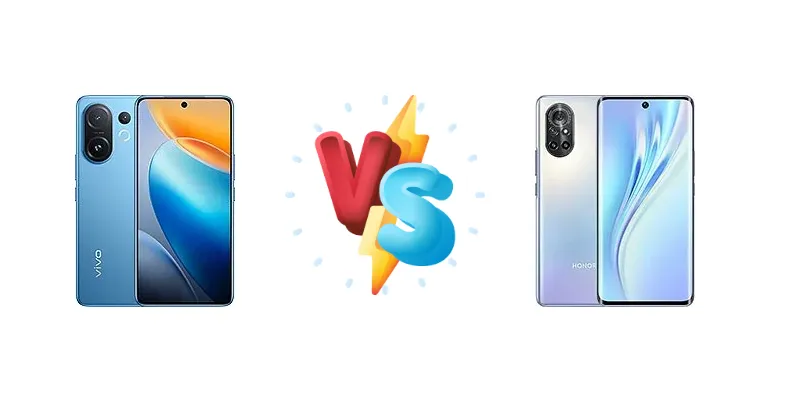
The mid-range smartphone market is fiercely competitive, and the vivo T4 Pro and Honor V40 Lite represent compelling options for budget-conscious buyers. The T4 Pro brings Qualcomm’s newer, more efficient Snapdragon 7 Gen 4 to the table, while the V40 Lite relies on the established Mediatek Dimensity 800U. This comparison dissects their key differences, focusing on performance, charging, and overall value to help you make the right choice.
🏆 Quick Verdict
For most users, the vivo T4 Pro emerges as the stronger contender. Its Snapdragon 7 Gen 4 chipset, built on a 4nm process, offers a noticeable efficiency and performance advantage over the 7nm Dimensity 800U. The significantly faster 90W charging further solidifies its position, making it ideal for users prioritizing speed and longevity.
| Network |
|---|
| 2G bands | GSM 850 / 900 / 1800 / 1900 | GSM 850 / 900 / 1800 / 1900 |
| 3G bands | HSDPA 800 / 850 / 900 / 1700(AWS) / 1900 / 2100 | HSDPA 800 / 850 / 900 / 1700(AWS) / 1900 / 2100 |
| 4G bands | 1, 3, 4, 5, 7, 8, 18, 19, 20, 26, 28, 38, 39, 40, 41, 42, 66 | 1, 2, 3, 4, 5, 8, 18, 19, 26, 34, 38, 39, 40, 41 |
| 5G bands | 1, 3, 5, 8, 28, 38, 40, 41, 66, 77, 78 SA/NSA | 1, 28, 41, 77, 78 SA/NSA |
| Speed | HSPA, LTE, 5G | HSPA, LTE, 5G |
| Technology | GSM / HSPA / LTE / 5G | GSM / CDMA / HSPA / LTE / 5G |
| | - | CDMA 800 |
| Launch |
|---|
| Announced | 2025, August 26 | 2021, March 23 |
| Status | Available. Released 2025, August 26 | Available. Released 2021, March 28 |
| Body |
|---|
| Build | Glass front, plastic frame, plastic back | - |
| Dimensions | 163.5 x 77 x 7.5 mm (6.44 x 3.03 x 0.30 in) | 160.1 x 74.1 x 7.6 mm (6.30 x 2.92 x 0.30 in) |
| SIM | Nano-SIM + Nano-SIM | Nano-SIM + Nano-SIM |
| Weight | 192 g (6.77 oz) | 169 g (5.96 oz) |
| Display |
|---|
| Protection | Diamond Shield Glass | - |
| Resolution | 1080 x 2392 pixels (~388 ppi density) | 1080 x 2340 pixels, 19.5:9 ratio (~392 ppi density) |
| Size | 6.77 inches, 110.9 cm2 (~88.1% screen-to-body ratio) | 6.57 inches, 106.0 cm2 (~89.3% screen-to-body ratio) |
| Type | AMOLED, 1B colors, HDR10+, 120Hz, 1500 nits (HBM), 5000 nits (peak) | OLED, 1B colors, HDR10, 90Hz |
| Platform |
|---|
| CPU | Octa-core (1x2.8 GHz Cortex-720 & 4x2.4 GHz Cortex-720 & 3x1.8 GHz Cortex-520) | Octa-core (2x2.4 GHz Cortex-A76 & 6x2.0 GHz Cortex-A55) |
| Chipset | Qualcomm SM7750-AB Snapdragon 7 Gen 4 (4 nm) | Mediatek Dimensity 800U (7 nm) |
| GPU | Adreno 722 | Mali-G57 MC3 |
| OS | Android 15, up to 4 major Android upgrades, Funtouch 15 | Android 10, Magic UI 4.0, no Google Play Services |
| Memory |
|---|
| Card slot | No | No |
| Internal | 128GB 8GB RAM, 256GB 8GB RAM, 256GB 12GB RAM | 128GB 8GB RAM, 256GB 8GB RAM |
| | - | UFS |
| Main Camera |
|---|
| Features | Ring-LED flash, panorama, HDR | LED flash, panorama, HDR |
| Quad | - | 64 MP, f/1.9, 26mm (wide), PDAF
8 MP, f/2.4, 120˚, 17mm (ultrawide)
2 MP (macro)
Auxiliary lens |
| Single | - | 32 MP, f/2.0, 26mm (wide) |
| Triple | 50 MP, f/1.8, 26mm (wide), 1/1.95", 0.8µm, PDAF, OIS
50 MP, f/2.7, 73mm (periscope telephoto), 1/1.95", 0.8µm, PDAF, OIS, 3x optical zoom
Auxiliary lens | - |
| Video | 4K@30fps, 1080p@30fps, gyro-EIS, OIS | 4K, 1080p, 720p@960fps, gyro-EIS |
| Selfie camera |
|---|
| Features | - | HDR |
| Single | 32 MP, f/2.5, 30mm (wide) | 32 MP, f/2.0, 26mm (wide) |
| Video | 4K@30fps, 1080p@30fps | 4K |
| Sound |
|---|
| 3.5mm jack | - | No |
| 35mm jack | No | No |
| Loudspeaker | Yes, with stereo speakers | Yes |
| Comms |
|---|
| Bluetooth | 5.4, A2DP, LE | 5.1, A2DP, LE |
| Infrared port | Yes | - |
| NFC | No | Yes |
| Positioning | GPS, GALILEO, GLONASS, QZSS, BDS, NavIC | GPS, GLONASS, BDS, GALILEO |
| Radio | No | No |
| USB | USB Type-C 2.0, OTG | USB Type-C 2.0, OTG |
| WLAN | Wi-Fi 802.11 a/b/g/n/ac/6, dual-band | Wi-Fi 802.11 a/b/g/n/ac, dual-band, Wi-Fi Direct |
| Features |
|---|
| Sensors | Fingerprint (under display, optical), accelerometer, gyro, proximity, compass | Fingerprint (under display, optical), accelerometer, gyro, proximity, compass |
| Battery |
|---|
| Charging | 90W wired, PD
7.5W reverse wired
Bypass charging | 66W wired, 60% in 15 min, 100% in 35 min
5W reverse wired |
| Type | Si/C Li-Ion 6500 mAh | Li-Po 3800 mAh |
| Misc |
|---|
| Colors | Nitro Blue, Blaze Gold | Black, Blue, Green |
| Models | V2510 | ALA-AN70 |
| Price | ₹ 27,890 | About 390 EUR |
| SAR | 0.99 W/kg (head) 0.93 W/kg (body) | - |
vivo T4 Pro
- Faster and more efficient Snapdragon 7 Gen 4 chipset
- Significantly faster 90W wired charging
- Potential for better thermal management due to 4nm process
- Brand recognition may be lower than Honor
- Camera specs are currently unknown
Honor V40 Lite
- Potentially lower price point
- Established brand reputation
- Decent 66W fast charging
- Older and less efficient Dimensity 800U chipset
- Slower charging compared to the T4 Pro
- Likely less optimized for modern apps and games
Display Comparison
Neither device’s display specifications are provided, so a direct comparison is limited. However, given the T4 Pro’s newer chipset and positioning, it’s reasonable to expect a higher peak brightness and potentially a higher refresh rate. The Honor V40 Lite, being an older model, likely features a standard 60Hz panel. Color accuracy will depend on panel calibration, a detail absent from the provided data. Bezels are also unknown, but newer devices generally aim for slimmer designs.
Camera Comparison
Without sensor details, a precise camera comparison is impossible. However, the chipset plays a role in image signal processing (ISP). The Snapdragon 7 Gen 4 likely benefits from Qualcomm’s newer ISP, potentially offering better noise reduction and dynamic range. The absence of information on OIS or lens apertures prevents a deeper analysis. It’s safe to assume both phones will feature a multi-camera setup, but image quality will heavily depend on the main sensor’s size and quality, which remains unknown.
Performance
The core difference lies in the chipsets. The vivo T4 Pro’s Qualcomm Snapdragon 7 Gen 4 (4nm) is a significant upgrade over the Honor V40 Lite’s Mediatek Dimensity 800U (7nm). The 4nm fabrication process inherently leads to better power efficiency and reduced thermal throttling. The Snapdragon 7 Gen 4’s CPU configuration – a 1x2.8 GHz Cortex-720, 4x2.4 GHz Cortex-720, and 3x1.8 GHz Cortex-520 – offers a more modern architecture than the Dimensity 800U’s 2x2.4 GHz Cortex-A76 and 6x2.0 GHz Cortex-A55. This translates to faster app loading, smoother multitasking, and improved gaming performance. While both are octa-core, the Snapdragon’s core design is more optimized for current workloads.
Battery Life
The vivo T4 Pro’s 90W wired charging is a clear advantage over the Honor V40 Lite’s 66W charging. Honor claims 60% charge in 15 minutes and 100% in 35 minutes, while vivo offers bypass charging. While battery capacity isn’t specified, the Snapdragon 7 Gen 4’s superior efficiency means the T4 Pro will likely deliver comparable or better battery life despite potentially having a smaller battery. The 90W charging significantly reduces downtime, a crucial benefit for heavy users.
Buying Guide
Buy the vivo T4 Pro if you need a phone that balances performance with battery life, and value rapid charging. It’s the better choice for gamers and power users who demand responsiveness. Buy the Honor V40 Lite if you prioritize a slightly more established brand reputation and are comfortable with a less powerful chipset and slower charging speeds, potentially at a lower price point.
Frequently Asked Questions
❓ Will the Snapdragon 7 Gen 4 in the vivo T4 Pro handle demanding games like Genshin Impact smoothly?
The Snapdragon 7 Gen 4 is a capable chipset for gaming. While it won't match flagship performance, it should handle Genshin Impact at medium settings with playable frame rates. The 4nm process also helps mitigate thermal throttling during extended gaming sessions, maintaining consistent performance.
❓ How much faster is the 90W charging on the vivo T4 Pro compared to the 66W charging on the Honor V40 Lite in real-world use?
The 90W charging on the T4 Pro will noticeably reduce charging time. While the V40 Lite takes 35 minutes for a full charge, the T4 Pro should achieve a full charge in around 30-35 minutes, and will gain a substantial percentage in just 15-20 minutes, making it ideal for quick top-ups.
❓ Does the Dimensity 800U in the Honor V40 Lite struggle with multitasking or running multiple apps simultaneously?
The Dimensity 800U is a capable chip, but it may exhibit some slowdown when handling a large number of apps simultaneously. The Snapdragon 7 Gen 4 in the T4 Pro, with its more modern architecture, will provide a smoother multitasking experience.