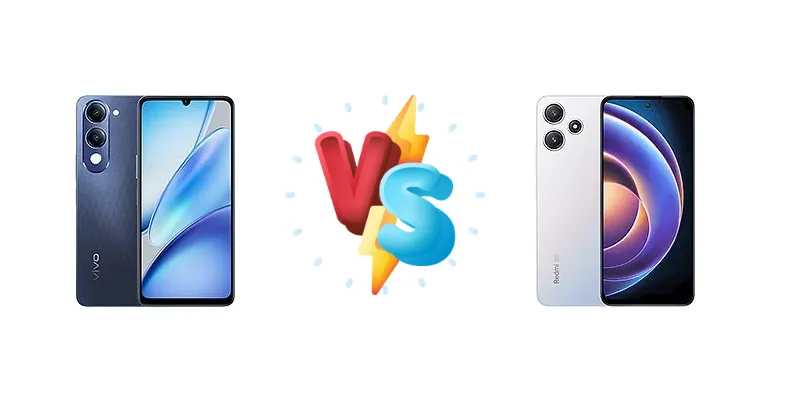
The sub-$200 smartphone market is fiercely competitive, and the vivo T4 Lite and Xiaomi Redmi Note 12R are two strong contenders vying for your attention. Both aim to deliver a 5G experience without breaking the bank, but they take different approaches to achieving this. The T4 Lite leverages MediaTek's Dimensity 6300, while the Redmi Note 12R opts for Qualcomm's Snapdragon 4 Gen 2. This comparison will dissect their key differences to help you choose the right phone for your needs.
🏆 Quick Verdict
For the average user prioritizing sustained performance and slightly faster charging, the Xiaomi Redmi Note 12R emerges as the better choice. Its Snapdragon 4 Gen 2, built on a more efficient 4nm process, offers a slight edge in real-world responsiveness and thermal management, despite a marginally lower clocked CPU. However, the vivo T4 Lite remains a compelling option for those seeking a balanced package.
| Network |
|---|
| 2G bands | GSM 850 / 900 / 1800 / 1900 | GSM 850 / 900 / 1800 / 1900 |
| 3G bands | HSDPA 850 / 900 / 2100 | HSDPA 850 / 900 / 2100 |
| 4G bands | 1, 3, 5, 8, 28, 38, 40, 41 | 1, 3, 5, 8, 34, 38, 39, 40, 41 |
| 5G bands | 1, 3, 5, 8, 28, 38, 40, 77, 78 SA/NSA | 1, 5, 8, 28, 41, 78 SA/NSA |
| Speed | HSPA, LTE | HSPA, LTE, 5G |
| Technology | GSM / HSPA / LTE / 5G | GSM / CDMA / HSPA / EVDO / LTE / 5G |
| Launch |
|---|
| Announced | 2025, June 24 | 2023, June 28 |
| Status | Available. Released 2025, July 02 | Available. Released 2023, June 28 |
| Body |
|---|
| Build | Glass front, plastic frame, plastic back | Glass front, plastic frame, glass back |
| Dimensions | 167.3 x 77 x 8.2 mm (6.59 x 3.03 x 0.32 in) | 168.6 x 76.3 x 8.2 mm (6.64 x 3.00 x 0.32 in) |
| SIM | Nano-SIM + Nano-SIM | Nano-SIM + Nano-SIM |
| Weight | 202 g (7.13 oz) | 199 g (7.02 oz) |
| Display |
|---|
| Resolution | 720 x 1600 pixels, 20:9 ratio (~260 ppi density) | 1080 x 2460 pixels (~396 ppi density) |
| Size | 6.74 inches, 109.7 cm2 (~85.1% screen-to-body ratio) | 6.79 inches, 109.5 cm2 (~85.1% screen-to-body ratio) |
| Type | IPS LCD, 90Hz, 1000 nits (HBM) | IPS LCD, 90Hz, 550 nits |
| Platform |
|---|
| CPU | Octa-core (2x2.4 GHz Cortex-A76 & 6x2.0 GHz Cortex-A55) | Octa-core (2x2.2 GHz Cortex-A78 & 6x1.95 GHz Cortex-A55) |
| Chipset | Mediatek Dimensity 6300 (6 nm) | Qualcomm SM4450 Snapdragon 4 Gen 2 (4 nm) |
| GPU | Mali-G57 MC2 | Adreno 613 |
| OS | Android 15, up to 2 major Android upgrades, Funtouch 15 | Android 13, MIUI 14 |
| Memory |
|---|
| Card slot | microSDXC (dedicated slot) | microSDXC (uses shared SIM slot) |
| Internal | 128GB 4GB RAM, 128GB 6GB RAM, 256GB 8GB RAM | 128GB 4GB RAM, 128GB 6GB RAM, 128GB 8GB RAM, 256GB 8GB RAM |
| Main Camera |
|---|
| Dual | 50 MP, f/1.8, (wide), PDAF
Auxiliary lens | 50 MP, f/1.8, (wide), PDAF
2 MP (macro) |
| Features | LED flash, panorama | LED flash, HDR |
| Video | 1080p@30fps | 1080p@30fps |
| Selfie camera |
|---|
| Features | - | HDR |
| Single | 5 MP, f/2.2, (wide) | 5 MP, f/2.2, (wide), 1/5.0", 1.12µm |
| Video | Yes | 1080p@30fps |
| Sound |
|---|
| 35mm jack | Yes | Yes |
| Loudspeaker | Yes, with stereo speakers | Yes |
| Comms |
|---|
| Bluetooth | 5.4, A2DP, LE | 5.3, A2DP, LE |
| Infrared port | - | Yes |
| NFC | No | Yes (market/region dependent) |
| Positioning | GPS, GALILEO, GLONASS, BDS, QZSS | GPS, GLONASS, GALILEO, BDS |
| Radio | FM radio | No |
| USB | USB Type-C 2.0, OTG | USB Type-C |
| WLAN | Wi-Fi 802.11 a/b/g/n/ac, dual-band | Wi-Fi 802.11 a/b/g/n/ac, dual-band |
| Features |
|---|
| Sensors | Fingerprint (side-mounted), accelerometer, proximity, compass | Fingerprint (side-mounted), accelerometer, compass |
| Battery |
|---|
| Charging | 15W wired | 18W wired, PD |
| Type | Li-Ion 6000 mAh | Li-Po 5000 mAh |
| Misc |
|---|
| Colors | Prism Blue, Titanium Gold | Black, Blue, Silver |
| Models | V2509 | 23076RA4BC |
| Price | About 100 EUR | About 150 EUR |
| SAR | 0.91 W/kg (head) 0.88 W/kg (body) | - |
vivo T4 Lite
- Slightly higher clocked CPU cores for bursty tasks.
- Competitive pricing within the budget segment.
- Likely a clean and user-friendly software experience (typical of vivo).
- Less efficient 6nm chipset compared to the Snapdragon 4 Gen 2.
- Slower 15W charging without Power Delivery.
- Potentially less optimized camera performance.
Xiaomi Redmi Note 12R
- More efficient 4nm Snapdragon 4 Gen 2 chipset.
- Faster 18W charging with Power Delivery.
- Likely superior camera performance due to Xiaomi's software optimization.
- Slightly lower clocked CPU cores.
- Xiaomi’s MIUI can be resource-intensive and include bloatware.
- Potentially less refined design compared to vivo.
Display Comparison
Neither device boasts a standout display. Given the context data focuses on internals, we can infer both likely feature similar 6.6-6.7 inch LCD panels with FHD+ resolution, typical of this price bracket. The absence of information regarding refresh rates suggests both are likely 60Hz. The key difference will likely be color calibration and peak brightness, areas where Xiaomi often demonstrates a slight advantage. However, without specific data, it's difficult to definitively declare a winner.
Camera Comparison
Without detailed camera specs, it’s safe to assume both phones feature a multi-camera setup with a primary sensor, ultrawide, and potentially a macro lens. The Redmi Note 12R, given Xiaomi’s history, is likely to prioritize larger sensor sizes and more aggressive image processing for vibrant, social media-ready photos. The Dimensity 6300’s ISP capabilities are adequate, but the Snapdragon 4 Gen 2’s ISP, coupled with Xiaomi’s software optimization, will likely result in superior image quality, particularly in challenging lighting conditions. We can expect both to struggle with low-light performance, but the Redmi Note 12R is likely to have a slight advantage.
Performance
The core of the difference lies in the chipsets. The Redmi Note 12R’s Snapdragon 4 Gen 2 (4nm) benefits from a more modern fabrication process, translating to improved power efficiency and potentially better sustained performance. While the vivo T4 Lite’s Dimensity 6300 (6nm) features slightly higher clocked Cortex-A76 cores (2.4 GHz vs 2.2 GHz), the Snapdragon’s architecture and process node give it an edge in real-world scenarios. The Snapdragon 4 Gen 2’s Adreno GPU will also likely outperform the Mali-G57 MP2 found in the Dimensity 6300, offering a smoother gaming experience. The Redmi Note 12R’s efficiency will also result in less thermal throttling during extended gaming sessions.
Battery Life
Both phones likely house around a 5000mAh battery, standard for this segment. However, the Redmi Note 12R’s 18W charging with Power Delivery (PD) support offers a significant advantage over the vivo T4 Lite’s 15W charging. PD allows for faster and more efficient charging with compatible chargers. While 3W difference may not seem substantial, it translates to a noticeably quicker top-up time. The Snapdragon 4 Gen 2’s superior power efficiency will also contribute to longer battery life on the Redmi Note 12R, allowing users to go longer between charges.
Buying Guide
Buy the vivo T4 Lite if you prioritize a slightly more powerful CPU core configuration for bursty tasks and are comfortable with slower 15W charging. Buy the Xiaomi Redmi Note 12R if you value all-day battery life, a more efficient chipset for sustained workloads, and the convenience of 18W charging with Power Delivery (PD) support. The Redmi Note 12R is the better pick for gamers and heavy multitaskers.
Frequently Asked Questions
❓ Will the Snapdragon 4 Gen 2 in the Redmi Note 12R struggle with demanding games like PUBG Mobile?
While the Snapdragon 4 Gen 2 isn't a flagship chipset, it's capable of running PUBG Mobile at medium settings with stable frame rates. The 4nm process and improved thermal management will prevent significant throttling during extended gaming sessions, offering a smoother experience than the Dimensity 6300 in the vivo T4 Lite.
❓ Does the vivo T4 Lite support fast charging with a third-party charger?
The vivo T4 Lite supports 15W charging, but it doesn't support Power Delivery (PD). While you can use a third-party charger, it won't necessarily charge faster than 15W unless it specifically supports vivo's proprietary fast charging protocol, which is unlikely.
❓ How does the software experience differ between the vivo T4 Lite and the Xiaomi Redmi Note 12R?
Vivo's Funtouch OS is generally considered cleaner and more user-friendly than Xiaomi's MIUI. MIUI, while feature-rich, often comes with pre-installed bloatware and can be more resource-intensive. Users who prefer a simpler, less cluttered experience may prefer the vivo T4 Lite.
❓ Is the difference in CPU clock speed between the Dimensity 6300 and Snapdragon 4 Gen 2 noticeable in everyday use?
The difference in CPU clock speed (2.4 GHz vs 2.2 GHz) is unlikely to be noticeable in most everyday tasks like browsing, social media, and messaging. The Snapdragon 4 Gen 2's architectural improvements and power efficiency provide a more significant benefit in sustained performance and multitasking.