
Google Pixel 6a vs. vivo T4 Lite: A Detailed Comparison of Mid-Range Powerhouses
| Phones Images | |||||
|---|---|---|---|---|---|
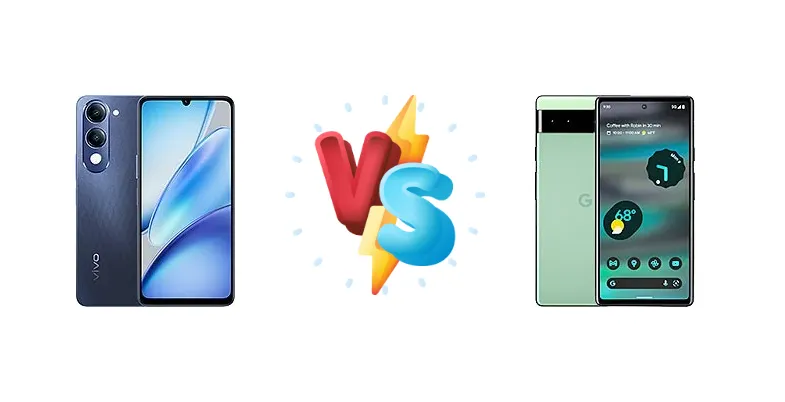
|
🏆 Quick Verdict
For most users, the Google Pixel 6a emerges as the stronger choice. Its Google Tensor chip delivers significantly better performance and superior image processing capabilities, justifying the potential price premium. However, the vivo T4 Lite offers a compelling alternative for those prioritizing efficiency and a potentially lower cost of entry.
| PHONES | ||
|---|---|---|
| Phone Names | vivo T4 Lite | Google Pixel 6a |
| Network | ||
|---|---|---|
| 2G bands | GSM 850 / 900 / 1800 / 1900 | GSM 850 / 900 / 1800 / 1900 |
| 3G bands | HSDPA 850 / 900 / 2100 | HSDPA 800 / 850 / 900 / 1700(AWS) / 1900 / 2100 |
| 4G bands | 1, 3, 5, 8, 28, 38, 40, 41 | 1, 2, 3, 4, 5, 7, 8, 12, 13, 14, 17, 18, 19, 20, 25, 26, 28, 29, 30, 38, 39, 40, 41, 42, 48, 66, 71 - GX7AS, GB62Z (USA/Canada) |
| 5G bands | 1, 3, 5, 8, 28, 38, 40, 77, 78 SA/NSA | 1, 2, 3, 5, 7, 8, 12, 20, 25, 28, 30, 38, 40, 41, 48, 66, 71, 77, 78 SA/NSA/Sub6 - GX7AS (USA/Canada) |
| Speed | HSPA, LTE | HSPA, LTE, 5G |
| Technology | GSM / HSPA / LTE / 5G | GSM / HSPA / LTE / 5G |
| - | 1, 2, 3, 5, 7, 8, 12, 20, 25, 28, 30, 40, 48, 66, 71, 77, 78 SA/NSA/Sub6 - G1AZG (International) | |
| Launch | ||
|---|---|---|
| Announced | 2025, June 24 | 2022, May 11 |
| Status | Available. Released 2025, July 02 | Available. Released 2022, July 21 |
| Body | ||
|---|---|---|
| Build | Glass front, plastic frame, plastic back | Glass front (Gorilla Glass 3), aluminum frame, plastic back |
| Dimensions | 167.3 x 77 x 8.2 mm (6.59 x 3.03 x 0.32 in) | 152.2 x 71.8 x 8.9 mm (5.99 x 2.83 x 0.35 in) |
| SIM | Nano-SIM + Nano-SIM | Nano-SIM + eSIM |
| Weight | 202 g (7.13 oz) | 178 g (6.28 oz) |
| - | IP67 dust/water resistant (up to 1m for 30 min) | |
| Display | ||
|---|---|---|
| Protection | - | Corning Gorilla Glass 3 |
| Resolution | 720 x 1600 pixels, 20:9 ratio (~260 ppi density) | 1080 x 2400 pixels, 20:9 ratio (~429 ppi density) |
| Size | 6.74 inches, 109.7 cm2 (~85.1% screen-to-body ratio) | 6.1 inches, 90.7 cm2 (~83.0% screen-to-body ratio) |
| Type | IPS LCD, 90Hz, 1000 nits (HBM) | OLED, HDR |
| - | Always-on display | |
| Platform | ||
|---|---|---|
| CPU | Octa-core (2x2.4 GHz Cortex-A76 & 6x2.0 GHz Cortex-A55) | Octa-core (2x2.80 GHz Cortex-X1 & 2x2.25 GHz Cortex-A76 & 4x1.80 GHz Cortex-A55) |
| Chipset | Mediatek Dimensity 6300 (6 nm) | Google Tensor (5 nm) |
| GPU | Mali-G57 MC2 | Mali-G78 MP20 |
| OS | Android 15, up to 2 major Android upgrades, Funtouch 15 | Android 12, upgradable to Android 15, up to 5 major Android upgrades |
| Memory | ||
|---|---|---|
| Card slot | microSDXC (dedicated slot) | No |
| Internal | 128GB 4GB RAM, 128GB 6GB RAM, 256GB 8GB RAM | 128GB 6GB RAM |
| - | UFS 3.1 | |
| Main Camera | ||
|---|---|---|
| Dual | 50 MP, f/1.8, (wide), PDAF Auxiliary lens | 12.2 MP, f/1.7, 27mm, (wide), 1/2.55", 1.4µm, dual pixel PDAF, OIS 12 MP, f/2.2, 17mm, 114˚ (ultrawide), 1.25µm |
| Features | LED flash, panorama | Dual-LED flash, Pixel Shift, Auto-HDR, panorama |
| Single | - | 8 MP, f/2.0, 24mm (wide), 1.12µm |
| Video | 1080p@30fps | 4K@30/60fps, 1080p@30/60/120/240fps; gyro-EIS, OIS |
| Selfie camera | ||
|---|---|---|
| Features | - | HDR, panorama |
| Single | 5 MP, f/2.2, (wide) | 8 MP, f/2.0, 24mm (wide), 1.12µm |
| Video | Yes | 1080p@30fps |
| Sound | ||
|---|---|---|
| 3.5mm jack | - | No |
| 35mm jack | Yes | No |
| Loudspeaker | Yes, with stereo speakers | Yes, with stereo speakers |
| Comms | ||
|---|---|---|
| Bluetooth | 5.4, A2DP, LE | 5.2, A2DP, LE |
| NFC | No | Yes |
| Positioning | GPS, GALILEO, GLONASS, BDS, QZSS | GPS, GLONASS, GALILEO, QZSS |
| Radio | FM radio | No |
| USB | USB Type-C 2.0, OTG | USB Type-C 3.1 |
| WLAN | Wi-Fi 802.11 a/b/g/n/ac, dual-band | Wi-Fi 802.11 a/b/g/n/ac/6e, dual-band, Wi-Fi Direct |
| Features | ||
|---|---|---|
| Sensors | Fingerprint (side-mounted), accelerometer, proximity, compass | Fingerprint (under display, optical), accelerometer, gyro, proximity, compass, barometer |
| Battery | ||
|---|---|---|
| Charging | 15W wired | 18W wired, PD3.0 |
| Type | Li-Ion 6000 mAh | Li-Po 4410 mAh |
| Misc | ||
|---|---|---|
| Colors | Prism Blue, Titanium Gold | Chalk, Charcoal, Sage |
| Models | V2509 | GX7AS, GB62Z, G1AZG, GB17L |
| Price | About 100 EUR | $ 138.99 / C$ 228.74 / ₹ 23,999 |
| SAR | 0.91 W/kg (head) 0.88 W/kg (body) | - |
| Tests | ||
|---|---|---|
| Battery life | - | Endurance rating 94h |
| Display | - | Contrast ratio: Infinite (nominal) |
vivo T4 Lite
- Superior performance with Google Tensor chip
- Exceptional camera quality and image processing
- Faster charging with PD3.0 support
- Potentially higher price point
- May run slightly warmer under heavy load
Google Pixel 6a
- Potentially more affordable price
- Good battery efficiency with Dimensity 6300
- Decent performance for everyday tasks
- Significantly slower performance compared to Pixel 6a
- Likely inferior camera quality
Display Comparison
The Pixel 6a boasts a notably brighter display, reaching a measured peak of 876 nits, compared to an unspecified brightness for the vivo T4 Lite. This translates to better visibility under direct sunlight. While both phones likely utilize OLED panels (implied by the Pixel 6a’s ‘Infinite’ contrast ratio), the Pixel 6a’s higher peak brightness and Google’s display calibration offer a more vibrant and accurate viewing experience. The lack of high refresh rate information for the T4 Lite suggests the Pixel 6a likely offers a smoother scrolling experience, if it also features a higher refresh rate.
Camera Comparison
The Pixel 6a’s camera system is a major differentiator. While specific sensor details for the vivo T4 Lite are missing, the Pixel 6a’s image processing capabilities, powered by the Tensor chip, are renowned for their dynamic range and detail. Google’s computational photography algorithms excel in low-light conditions, producing consistently high-quality images. The absence of OIS information for the T4 Lite suggests the Pixel 6a will offer superior image stabilization, especially for video recording. The Pixel 6a’s focus on software optimization likely delivers a more refined and consistent camera experience, even if the hardware isn’t dramatically superior.
Performance
The core difference lies in the chipsets. The Google Tensor (5nm) significantly outperforms the Mediatek Dimensity 6300 (6nm) in raw processing power. The Tensor’s Cortex-X1 prime core, clocked at 2.80 GHz, provides a substantial performance boost over the T4 Lite’s Cortex-A76 cores at 2.4 GHz. This advantage is particularly noticeable in demanding tasks like video editing and gaming. While the 6nm process of the Dimensity 6300 offers good efficiency, the Tensor’s architectural advantages and optimized software integration give the Pixel 6a a clear edge. The Pixel 6a’s Tensor chip also benefits from Google’s dedicated AI processing unit, enhancing features like voice recognition and image processing.
Battery Life
Both phones achieve an impressive 94-hour endurance rating, suggesting comparable real-world battery life despite differing battery capacities (not specified for the T4 Lite). However, the Pixel 6a supports 18W wired charging with PD3.0, offering faster and more versatile charging compared to the T4 Lite’s 15W charging. While the difference isn’t massive, the Pixel 6a’s faster charging can provide a noticeable convenience boost, especially for users who frequently need to top up their battery.
Buying Guide
Buy the vivo T4 Lite if you need a reliable daily driver with decent performance for basic tasks and prioritize battery efficiency over raw power. Buy the Google Pixel 6a if you value a superior camera experience, faster performance for demanding apps, and guaranteed software updates directly from Google, even if it means slightly slower charging speeds.