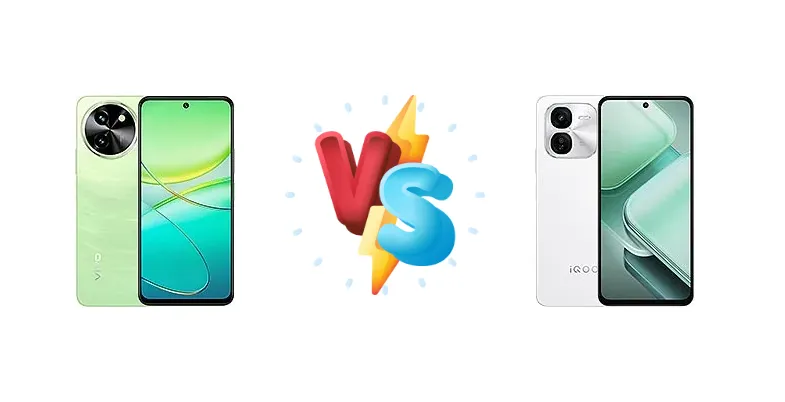
The vivo T3x and iQOO Z9x present a fascinating case study in brand segmentation. Both devices are powered by the Qualcomm Snapdragon 6 Gen 1, making a direct hardware comparison less about raw power and more about nuanced features and software optimization. This review dissects the subtle differences to help you choose the right device for your needs.
🏆 Quick Verdict
For the average user, the iQOO Z9x edges out the vivo T3x due to the inclusion of reverse wired charging. While both offer identical performance thanks to the Snapdragon 6 Gen 1, the added versatility of being able to charge other devices makes the Z9x a slightly more compelling package.
| Network |
|---|
| 2G bands | GSM 850 / 900 / 1800 / 1900 | GSM 850 / 900 / 1800 / 1900 |
| 3G bands | HSDPA 850 / 900 / 2100 | HSDPA 850 / 900 / 2100 |
| 4G bands | 1, 3, 5, 8, 28, 38, 40, 41 | 1, 3, 5, 7, 8, 20, 28, 38, 40, 41 - Global |
| 5G bands | 1, 3, 5, 8, 28, 40, 77, 78 SA/NSA | 1, 3, 8, 28, 38, 40, 41, 77, 78 SA/NSA - Global |
| Speed | HSPA, LTE, 5G | HSPA, LTE, 5G |
| Technology | GSM / HSPA / LTE / 5G | GSM / CDMA / HSPA / LTE / 5G |
| Launch |
|---|
| Announced | 2024, April 17 | 2024, April 24 |
| Status | Available. Released 2024, April 24 | Available. Released 2024, April 29 |
| Body |
|---|
| Build | Glass front, plastic frame, plastic back | Glass front, plastic back, plastic frame |
| Dimensions | 165.7 x 76 x 8 mm (6.52 x 2.99 x 0.31 in) | 165.7 x 76 x 8 mm (6.52 x 2.99 x 0.31 in) |
| SIM | Nano-SIM + Nano-SIM | Nano-SIM + Nano-SIM |
| Weight | 199 g (7.02 oz) | 199 g (7.05 oz) |
| Display |
|---|
| Resolution | 1080 x 2408 pixels, 20:9 ratio (~393 ppi density) | 1080 x 2408 pixels, 20:9 ratio (~393 ppi density) |
| Size | 6.72 inches, 108.8 cm2 (~86.4% screen-to-body ratio) | 6.72 inches, 108.8 cm2 (~86.4% screen-to-body ratio) |
| Type | IPS LCD, 120Hz, 1000 nits (peak) | IPS LCD, 120Hz, 1000 nits (peak) |
| Platform |
|---|
| CPU | Octa-core (4x2.2 GHz Cortex-A78 & 4x1.8 GHz Cortex-A55) | Octa-core (4x2.2 GHz Cortex-A78 & 4x1.8 GHz Cortex-A55) |
| Chipset | Qualcomm SM6450 Snapdragon 6 Gen 1 (4 nm) | Qualcomm SM6450 Snapdragon 6 Gen 1 (4 nm) |
| GPU | Adreno 710 | Adreno 710 |
| OS | Android 14, Funtouch 14 | Android 14, Funtouch OS 14 (International), OriginOS (China) |
| Memory |
|---|
| Card slot | microSDXC (uses shared SIM slot) | microSDXC (uses shared SIM slot) |
| Internal | 128GB 4GB RAM, 128GB 6GB RAM, 128GB 8GB RAM, 256GB 8GB RAM | 128GB 4GB RAM, 128GB 6GB RAM, 128GB 8GB RAM, 256GB 8GB RAM, 256GB 12GB RAM |
| Main Camera |
|---|
| Dual | 50 MP, f/1.8, (wide), PDAF
Auxiliary lens | 50 MP, f/1.8, (wide), 1/1.95", 0.8µm, PDAF
Auxiliary lens |
| Features | LED flash, HDR, panorama | LED flash, panorama, HDR |
| Video | 4K@30fps (8GB RAM version only), 1080p@30fps | 4K, 1080p, gyro-EIS |
| Selfie camera |
|---|
| Single | 8 MP, f/2.1, (wide) | 8 MP, f/2.1, (wide) |
| Video | 1080p@30fps | 1080p@30fps |
| Sound |
|---|
| 35mm jack | Yes | Yes |
| Loudspeaker | Yes, with stereo speakers | Yes, with stereo speakers |
| Comms |
|---|
| Bluetooth | 5.1, A2DP, LE | 5.1, A2DP, LE, aptX HD, aptX Adaptive |
| NFC | No | Yes (market/region dependent) |
| Positioning | GPS, GALILEO, GLONASS, BDS, QZSS | GPS, GALILEO, GLONASS, QZSS, BDS (B1I+B1c) |
| Radio | No | Unspecified |
| USB | USB Type-C 2.0, OTG | USB Type-C 2.0, OTG |
| WLAN | Wi-Fi 802.11 a/b/g/n/ac, dual-band | Wi-Fi 802.11 a/b/g/n/ac, dual-band |
| Features |
|---|
| Sensors | Fingerprint (side-mounted), accelerometer, gyro, proximity, compass | Fingerprint (side-mounted), accelerometer, gyro, proximity, compass |
| Battery |
|---|
| Charging | 44W wired | 44W wired
Reverse wired |
| Type | 6000 mAh | 6000 mAh |
| Misc |
|---|
| Colors | Crimson Bliss, Celestial Green | Tornado Green (Northern Green), Storm Grey (Mystic Black), White |
| Models | V2338 | V2353A, I2219 |
| Price | About 150 EUR | ₹ 13,499 |
vivo T3x
- Clean and streamlined software experience (likely)
- Efficient Snapdragon 6 Gen 1 chipset
- 44W fast charging
- Lacks reverse charging functionality
- Camera specs currently unknown
vivo iQOO Z9x
- Efficient Snapdragon 6 Gen 1 chipset
- 44W fast charging
- Convenient reverse wired charging
- Potentially more bloatware (typical of iQOO)
- Camera specs currently unknown
Display Comparison
Both the vivo T3x and iQOO Z9x are expected to feature LCD panels, common in this price bracket. While specific details like peak brightness and color gamut coverage are currently unavailable, the focus will likely be on providing a clear and vibrant viewing experience for everyday use. Bezels are anticipated to be moderate, prioritizing affordability over an edge-to-edge display. The absence of AMOLED technology means users shouldn't expect the deep blacks and high contrast ratios found in more expensive devices.
Camera Comparison
Camera performance is an area where details are currently sparse. Both devices are likely to feature a multi-camera setup, but the specifics of the main sensor, ultrawide, and any additional lenses remain unknown. The presence of a 2MP macro camera is probable, but its utility is limited due to the small sensor size and lack of optical image stabilization (OIS). Image processing algorithms will play a significant role in determining the final image quality, and differences in vivo and iQOO's software tuning could lead to variations in color accuracy, dynamic range, and noise reduction.
Performance
The core of both devices is the Qualcomm SM6450 Snapdragon 6 Gen 1 (4nm). This chipset, with its octa-core configuration (4x2.2 GHz Cortex-A78 & 4x1.8 GHz Cortex-A55), delivers a capable performance for daily tasks, social media, and moderate gaming. The 4nm process node is crucial, offering improved thermal efficiency compared to older, larger-node chipsets, which translates to less throttling during sustained workloads. RAM configurations are likely to be similar, potentially LPDDR4X or LPDDR5, impacting multitasking performance. Given the identical chipset, real-world performance differences will likely stem from software optimization and thermal management strategies employed by vivo and iQOO.
Battery Life
Both the vivo T3x and iQOO Z9x support 44W wired charging, promising relatively quick top-ups. While the battery capacity remains unspecified, a typical range for this segment is 5000mAh. The 44W charging should deliver a full charge in approximately 60-80 minutes. However, the iQOO Z9x distinguishes itself with the addition of reverse wired charging, allowing it to function as a power bank for other devices. This feature is particularly useful for users who frequently travel or rely on multiple gadgets.
Buying Guide
Buy the vivo T3x if you prioritize a clean, streamlined software experience and are less concerned with power-sharing capabilities. It's a solid choice for everyday tasks and media consumption. Buy the iQOO Z9x if you frequently travel or share power with friends, as the reverse wired charging feature provides a significant convenience factor. It's also ideal for users who appreciate a more feature-rich software experience, typical of the iQOO brand.
Frequently Asked Questions
❓ Will the Snapdragon 6 Gen 1 handle demanding games like PUBG Mobile or Call of Duty?
The Snapdragon 6 Gen 1 is capable of running PUBG Mobile and Call of Duty, but you'll likely need to lower the graphics settings to medium or low to achieve a consistently smooth frame rate. Expect playable performance at 30-60fps, but don't anticipate ultra-high settings or sustained high frame rates.
❓ How effective is the 44W charging on these devices? What's the expected 0-100% charge time?
44W charging is relatively fast for this price segment. Expect a full charge from 0-100% to take between 60 and 80 minutes, depending on the battery capacity (likely around 5000mAh). The first 30-50% will charge the quickest, with the charging speed tapering off as the battery nears full capacity.
❓ Is the reverse wired charging on the iQOO Z9x compatible with all devices?
The reverse wired charging on the iQOO Z9x is compatible with most devices that charge via USB-C. However, the charging speed will vary depending on the receiving device's power requirements and charging protocol. It won't be as fast as using a dedicated charger, but it's a convenient option for topping up smaller devices like earbuds or smartwatches.