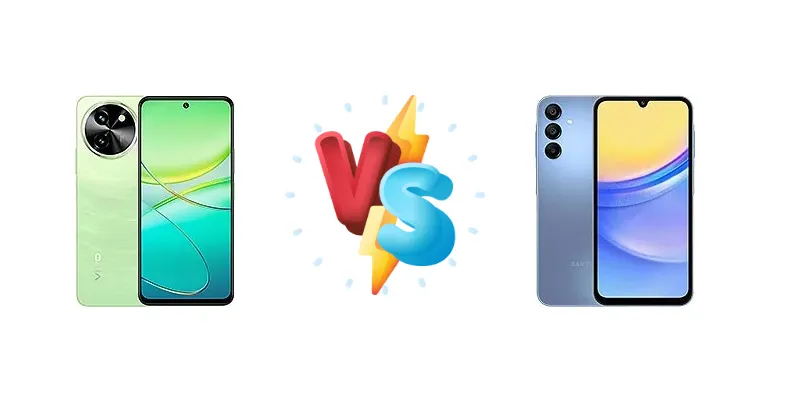
The sub-$250 5G smartphone market is heating up. The vivo T3x and Samsung Galaxy A15 5G represent compelling options, but cater to slightly different priorities. The T3x focuses on raw processing power with a newer Snapdragon chipset, while the A15 5G prioritizes display brightness and all-day battery life. This comparison dissects the key differences to help you choose the right phone for your needs.
🏆 Quick Verdict
For most users, the vivo T3x is the better buy. Its Snapdragon 6 Gen 1 chipset, built on a more efficient 4nm process, delivers noticeably snappier performance than the Galaxy A15 5G’s Dimensity 6100+. While the A15 5G boasts a brighter display and longer battery life in active use, the T3x’s performance advantage is more impactful for everyday tasks and light gaming.
| Network |
|---|
| 2G bands | GSM 850 / 900 / 1800 / 1900 | GSM 850 / 900 / 1800 / 1900 |
| 3G bands | HSDPA 850 / 900 / 2100 | HSDPA 850 / 900 / 1700(AWS) / 1900 / 2100 |
| 4G bands | 1, 3, 5, 8, 28, 38, 40, 41 | 1, 2, 3, 4, 5, 7, 8, 12, 17, 20, 26, 28, 38, 40, 41, 66 |
| 5G bands | 1, 3, 5, 8, 28, 40, 77, 78 SA/NSA | 1, 3, 5, 7, 8, 26, 28, 40, 41, 66, 77, 78 SA/NSA/Sub6 |
| Speed | HSPA, LTE, 5G | HSPA, LTE, 5G |
| Technology | GSM / HSPA / LTE / 5G | GSM / HSPA / LTE / 5G |
| Launch |
|---|
| Announced | 2024, April 17 | 2023, December 11 |
| Status | Available. Released 2024, April 24 | Available. Released 2023, December 16 |
| Body |
|---|
| Build | Glass front, plastic frame, plastic back | Glass front, plastic back, plastic frame |
| Dimensions | 165.7 x 76 x 8 mm (6.52 x 2.99 x 0.31 in) | 160.1 x 76.8 x 8.4 mm (6.30 x 3.02 x 0.33 in) |
| SIM | Nano-SIM + Nano-SIM | · Nano-SIM· Nano-SIM + Nano-SIM |
| Weight | 199 g (7.02 oz) | 200 g (7.05 oz) |
| Display |
|---|
| Resolution | 1080 x 2408 pixels, 20:9 ratio (~393 ppi density) | 1080 x 2340 pixels, 19.5:9 ratio (~396 ppi density) |
| Size | 6.72 inches, 108.8 cm2 (~86.4% screen-to-body ratio) | 6.5 inches, 103.7 cm2 (~84.3% screen-to-body ratio) |
| Type | IPS LCD, 120Hz, 1000 nits (peak) | Super AMOLED, 90Hz, 800 nits (HBM) |
| Platform |
|---|
| CPU | Octa-core (4x2.2 GHz Cortex-A78 & 4x1.8 GHz Cortex-A55) | Octa-core (2x2.2 GHz Cortex-A76 & 6x2.0 GHz Cortex-A55) |
| Chipset | Qualcomm SM6450 Snapdragon 6 Gen 1 (4 nm) | Mediatek Dimensity 6100+ (6 nm) |
| GPU | Adreno 710 | Mali-G57 MC2 |
| OS | Android 14, Funtouch 14 | Android 14, upgradable to Android 16, One UI 8, up to 4 major Android upgrades |
| Memory |
|---|
| Card slot | microSDXC (uses shared SIM slot) | microSDXC (uses shared SIM slot) |
| Internal | 128GB 4GB RAM, 128GB 6GB RAM, 128GB 8GB RAM, 256GB 8GB RAM | 64GB 4GB RAM, 128GB 4GB RAM, 128GB 6GB RAM, 128GB 8GB RAM, 256GB 8GB RAM |
| Main Camera |
|---|
| Dual | 50 MP, f/1.8, (wide), PDAF
Auxiliary lens | - |
| Features | LED flash, HDR, panorama | LED flash, panorama, HDR |
| Triple | - | 50 MP, f/1.8, (wide), AF
5 MP, f/2.2, (ultrawide)
2 MP (macro) |
| Video | 4K@30fps (8GB RAM version only), 1080p@30fps | 1080p@30fps, gyro-EIS |
| Selfie camera |
|---|
| Single | 8 MP, f/2.1, (wide) | 13 MP, f/2.0, (wide) |
| Video | 1080p@30fps | 1080p@30fps |
| Sound |
|---|
| 35mm jack | Yes | Yes |
| Loudspeaker | Yes, with stereo speakers | Yes |
| Comms |
|---|
| Bluetooth | 5.1, A2DP, LE | 5.3, A2DP, LE |
| NFC | No | Yes (market/region dependent) |
| Positioning | GPS, GALILEO, GLONASS, BDS, QZSS | GPS, GALILEO, GLONASS, BDS, QZSS |
| Radio | No | No |
| USB | USB Type-C 2.0, OTG | USB Type-C 2.0 |
| WLAN | Wi-Fi 802.11 a/b/g/n/ac, dual-band | Wi-Fi 802.11 a/b/g/n/ac, dual-band, Wi-Fi Direct |
| Features |
|---|
| Sensors | Fingerprint (side-mounted), accelerometer, gyro, proximity, compass | Fingerprint (side-mounted), accelerometer, gyro, compass |
| Battery |
|---|
| Charging | 44W wired | 25W wired |
| Type | 6000 mAh | 5000 mAh |
| Misc |
|---|
| Colors | Crimson Bliss, Celestial Green | Brave Black, Personality Yellow, Magical Blue, Optimistic Blue |
| Models | V2338 | SM-A156B, SM-A156B/DS, SM-A156P, SM-A156P/DS, SM-A156U, SM-A156U1, SM-A156U1/DS, SM-A156W, SM-A156P/N, SM-A156P/DSN, SM-S156VL, SM-A156M, SM-A156E, SM-A156E/DSN |
| Price | About 150 EUR | € 167.00 / $ 79.97 / ₹ 17,490 |
| SAR EU | - | 0.80 W/kg (head) 1.46 W/kg (body) |
vivo T3x
- Faster Snapdragon 6 Gen 1 chipset
- More efficient 4nm process
- Faster 44W charging
- Potentially smoother gaming experience
- Likely lower peak display brightness
- Battery life may be shorter than A15 5G
Samsung Galaxy A15 5G
- Brighter 786 nit display
- Excellent 14:31h active use battery life
- Samsung’s established brand reputation
- Potentially better software support longevity
- Slower Dimensity 6100+ chipset
- Slower 25W charging
- Less efficient 6nm process
Display Comparison
The Samsung Galaxy A15 5G immediately stands out with its measured peak brightness of 786 nits, making it significantly more usable in direct sunlight compared to what we'd expect from the T3x (no data provided, but typically lower in this segment). While both likely utilize LCD panels, the A15 5G’s brightness is a clear advantage. However, the T3x may benefit from a higher refresh rate (spec not provided, but common in this price range), which would improve scrolling smoothness. Bezels are likely comparable, and color accuracy is expected to be standard for this price point on both devices.
Camera Comparison
Without detailed camera specs, a direct comparison is difficult. However, given the price bracket, both phones likely feature a primary sensor around 50MP. The T3x’s image processing may lean towards a more vibrant look, typical of vivo, while Samsung often aims for more natural colors. The presence of Optical Image Stabilization (OIS) is unlikely on either device. The 2MP macro cameras found on many phones in this class are generally of limited utility, and shouldn't be a deciding factor. The real difference will come down to software optimization and low-light performance, which requires further testing.
Performance
This is where the vivo T3x pulls ahead. The Qualcomm Snapdragon 6 Gen 1 (4nm) is architecturally superior to the MediaTek Dimensity 6100+ (6nm). The Snapdragon utilizes Cortex-A78 cores in its performance cluster, offering a significant uplift over the A15 5G’s Cortex-A76 cores. The 4nm fabrication process further enhances efficiency, leading to better thermal management and sustained performance. While both are octa-core CPUs, the T3x’s configuration translates to a smoother experience in demanding apps and games. The A15 5G’s Dimensity 6100+ is still capable, but will exhibit more noticeable slowdowns under load.
Battery Life
The Samsung Galaxy A15 5G boasts an impressive 14:31h active use score, indicating excellent battery endurance. The vivo T3x’s battery capacity is unknown, but its more efficient 4nm chipset could partially offset any capacity difference. However, the A15 5G’s 25W charging is slower than the T3x’s 44W wired charging. This means the T3x can top up its battery significantly faster, even if its overall battery life isn’t quite as long. A full charge on the T3x should take considerably less time than on the A15 5G.
Buying Guide
Buy the vivo T3x if you need a phone that feels responsive and handles multitasking with ease, and if you value a more modern chipset for future software support. Buy the Samsung Galaxy A15 5G if you prioritize a brighter screen for outdoor visibility and want the peace of mind of extended battery life during heavy usage, even if it means sacrificing some processing speed.
Frequently Asked Questions
❓ Will the Dimensity 6100+ in the Galaxy A15 5G struggle with graphically intensive games like PUBG Mobile?
While the Dimensity 6100+ can run PUBG Mobile, you’ll likely need to lower graphics settings to achieve a consistently smooth frame rate. The Snapdragon 6 Gen 1 in the T3x offers a more comfortable gaming experience at medium settings, and is less prone to frame drops during prolonged sessions.
❓ How long will it take to fully charge each phone from 0%?
With 44W charging, the vivo T3x should fully charge in approximately 60-75 minutes. The Samsung Galaxy A15 5G, with its 25W charging, will take considerably longer, likely exceeding 90-120 minutes for a full charge.
❓ Does the Samsung Galaxy A15 5G support software updates for a long period?
Samsung generally provides longer software support than many other Android manufacturers in this price range. You can expect at least 3 years of security updates and 2 major Android version upgrades, potentially more. Vivo's update policy is less predictable.