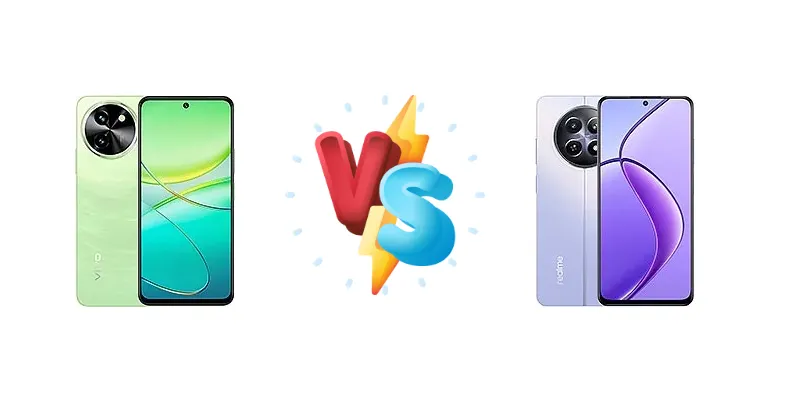
The sub-₹20,000 (approximately $240 USD) smartphone segment in India is fiercely competitive. The vivo T3x and Realme 12x both aim for the top spot, offering compelling specs at aggressive price points. However, they diverge significantly in their core processing power, utilizing chipsets from Qualcomm and MediaTek respectively. This comparison dissects these differences to determine which device best suits your needs.
🏆 Quick Verdict
For most users, the vivo T3x emerges as the stronger contender. Its Snapdragon 6 Gen 1, built on a more efficient 4nm process, provides a noticeable performance edge and potentially better thermal management compared to the Realme 12x’s Dimensity 6100+. While charging speeds are comparable, the T3x’s chipset architecture offers a more future-proof experience.
| Network |
|---|
| 2G bands | GSM 850 / 900 / 1800 / 1900 | GSM 850 / 900 / 1800 / 1900 |
| 3G bands | HSDPA 850 / 900 / 2100 | HSDPA 850 / 900 / 2100 |
| 4G bands | 1, 3, 5, 8, 28, 38, 40, 41 | 1, 3, 5, 8, 28, 40, 41 |
| 5G bands | 1, 3, 5, 8, 28, 40, 77, 78 SA/NSA | 1, 3, 5, 8, 28, 40, 41, 77, 78 SA/NSA |
| Speed | HSPA, LTE, 5G | HSPA, LTE, 5G |
| Technology | GSM / HSPA / LTE / 5G | GSM / HSPA / LTE / 5G |
| Launch |
|---|
| Announced | 2024, April 17 | 2024, April 02 |
| Status | Available. Released 2024, April 24 | Available. Released 2024, April 10 |
| Body |
|---|
| Build | Glass front, plastic frame, plastic back | - |
| Dimensions | 165.7 x 76 x 8 mm (6.52 x 2.99 x 0.31 in) | 165.6 x 76.1 x 7.7 mm (6.52 x 3.00 x 0.30 in) |
| SIM | Nano-SIM + Nano-SIM | Nano-SIM + Nano-SIM |
| Weight | 199 g (7.02 oz) | 188 g (6.63 oz) |
| Display |
|---|
| Resolution | 1080 x 2408 pixels, 20:9 ratio (~393 ppi density) | 1080 x 2400 pixels, 20:9 ratio (~392 ppi density) |
| Size | 6.72 inches, 108.8 cm2 (~86.4% screen-to-body ratio) | 6.72 inches, 109.0 cm2 (~86.5% screen-to-body ratio) |
| Type | IPS LCD, 120Hz, 1000 nits (peak) | IPS LCD, 120Hz, 800 nits (typ), 950 nits (HBM) |
| Platform |
|---|
| CPU | Octa-core (4x2.2 GHz Cortex-A78 & 4x1.8 GHz Cortex-A55) | Octa-core (2x2.2 GHz Cortex-A76 & 6x2.0 GHz Cortex-A55) |
| Chipset | Qualcomm SM6450 Snapdragon 6 Gen 1 (4 nm) | Mediatek Dimensity 6100+ (6 nm) |
| GPU | Adreno 710 | Mali-G57 MC2 |
| OS | Android 14, Funtouch 14 | Android 14, Realme UI 5.0 |
| Memory |
|---|
| Card slot | microSDXC (uses shared SIM slot) | microSDXC (dedicated slot) |
| Internal | 128GB 4GB RAM, 128GB 6GB RAM, 128GB 8GB RAM, 256GB 8GB RAM | 128GB 4GB RAM, 128GB 6GB RAM, 128GB 8GB RAM |
| Main Camera |
|---|
| Dual | 50 MP, f/1.8, (wide), PDAF
Auxiliary lens | 50 MP, f/1.8, 26mm (wide), 1/2.76", 0.64µm, PDAF
Auxiliary lens |
| Features | LED flash, HDR, panorama | LED flash, HDR, panorama |
| Video | 4K@30fps (8GB RAM version only), 1080p@30fps | 1080p@30fps |
| Selfie camera |
|---|
| Single | 8 MP, f/2.1, (wide) | 8 MP, f/2.0, 26mm (wide) |
| Video | 1080p@30fps | 1080p@30fps |
| Sound |
|---|
| 35mm jack | Yes | Yes |
| Loudspeaker | Yes, with stereo speakers | Yes, with stereo speakers |
| Comms |
|---|
| Bluetooth | 5.1, A2DP, LE | 5.3, A2DP, LE, aptX HD, LHDC |
| NFC | No | No |
| Positioning | GPS, GALILEO, GLONASS, BDS, QZSS | GPS, GLONASS, GALILEO, BDS, QZSS |
| Radio | No | Unspecified |
| USB | USB Type-C 2.0, OTG | USB Type-C 2.0 |
| WLAN | Wi-Fi 802.11 a/b/g/n/ac, dual-band | Wi-Fi 802.11 a/b/g/n/ac, dual-band |
| Features |
|---|
| Sensors | Fingerprint (side-mounted), accelerometer, gyro, proximity, compass | Fingerprint (side-mounted), accelerometer, gyro, proximity, compass |
| Battery |
|---|
| Charging | 44W wired | 45W wired, 50% in 30 min |
| Type | 6000 mAh | 5000 mAh |
| Misc |
|---|
| Colors | Crimson Bliss, Celestial Green | Twilight Purple, Woodland Green |
| Models | V2338 | RMX3998 |
| Price | About 150 EUR | About 130 EUR |
vivo T3x
- More efficient Snapdragon 6 Gen 1 chipset
- Potentially better thermal management
- Modern CPU architecture (Cortex-A78)
- Likely plastic build
- Charging speed slightly slower than Realme 12x
Realme 12x (India)
- Slightly faster 45W charging
- Potentially more premium glass back design
- Realme UI software experience
- Less efficient Dimensity 6100+ chipset
- Older CPU architecture (Cortex-A76)
- Potential for more thermal throttling
Display Comparison
Neither device boasts a standout display. Both are expected to feature FHD+ resolution panels, but specifics like peak brightness and color gamut coverage are currently unavailable. However, the Realme 12x’s marketing emphasizes a glass back, potentially indicating a slightly more premium feel compared to the T3x’s likely plastic construction. The absence of high refresh rate panels on either device suggests a focus on battery life over visual fluidity.
Camera Comparison
Without detailed camera specs, a direct comparison is difficult. Both phones are expected to feature a multi-camera setup, but the quality will heavily depend on the primary sensor and image processing algorithms. Given the price bracket, we anticipate a focus on software enhancements to improve image quality. The inclusion of a 2MP macro camera on both devices is largely a marketing tactic, offering limited practical benefit. The aperture and sensor size of the main camera will be the key differentiators, but this information is currently unavailable.
Performance
The core battleground is the chipset. The vivo T3x’s Qualcomm Snapdragon 6 Gen 1 (4nm) utilizes a more modern architecture with four Cortex-A78 cores clocked at 2.2 GHz, alongside four Cortex-A55 cores. This contrasts with the Realme 12x’s MediaTek Dimensity 6100+ (6nm), which employs two Cortex-A76 cores at 2.2 GHz and six Cortex-A55 cores. The 4nm process of the Snapdragon 6 Gen 1 is a significant advantage, promising better power efficiency and potentially lower thermal throttling during extended use. While the Dimensity 6100+ offers a respectable core count, the older Cortex-A76 architecture is less efficient than the A78 found in the T3x. The T3x is likely to deliver superior sustained performance in demanding applications and games.
Battery Life
Both devices offer fast charging, with the vivo T3x at 44W and the Realme 12x at 45W, claiming 50% charge in 30 minutes for the latter. While the Realme 12x has a slight edge in charging speed, the Snapdragon 6 Gen 1’s superior efficiency in the T3x could translate to longer real-world battery life despite potentially having a similar battery capacity. The 4nm process allows for more efficient power management, reducing energy consumption during everyday tasks.
Buying Guide
Buy the vivo T3x if you prioritize sustained performance for gaming and multitasking, and value a chipset built on a more advanced manufacturing process for improved efficiency. Buy the Realme 12x (India) if you prefer a slightly more streamlined software experience (typical of Realme UI) and are looking for a phone with a marginally faster charging speed, accepting a potential trade-off in raw processing power.
Frequently Asked Questions
❓ Will the Dimensity 6100+ in the Realme 12x overheat during prolonged gaming sessions?
The Dimensity 6100+ is a capable chipset, but its 6nm process and older CPU architecture mean it's more prone to thermal throttling under sustained load compared to the Snapdragon 6 Gen 1. Expect some performance dips during extended gaming, especially with graphically demanding titles.
❓ Is the 44W charging on the vivo T3x significantly slower than the 45W on the Realme 12x in real-world use?
The difference of 1W is unlikely to be noticeable in everyday charging. Both phones claim to reach 50% charge in around 30 minutes. The Snapdragon 6 Gen 1’s efficiency might even allow the T3x to maintain a slightly higher charging rate for a longer duration.
❓ Does the Snapdragon 6 Gen 1 in the vivo T3x support advanced gaming features like vapor chamber cooling?
While the Snapdragon 6 Gen 1 itself doesn't dictate cooling solutions, vivo may have implemented a vapor chamber or other thermal management system in the T3x to maximize performance. However, this is not confirmed and would depend on the specific model configuration.
❓ How does the software experience differ between vivo's Funtouch OS and Realme UI on these devices?
Realme UI is generally considered closer to stock Android, offering a cleaner and more customizable experience. Funtouch OS, while improved in recent iterations, often includes more pre-installed apps and a distinct visual style. Preference is subjective, but Realme UI is often favored by users who prefer a less cluttered interface.