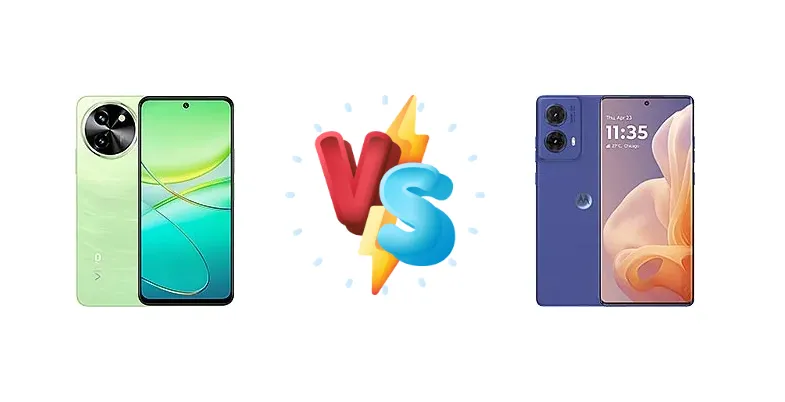
The sub-$250 smartphone market is fiercely competitive. The vivo T3x and Motorola Moto G85 both aim for the sweet spot of affordability and functionality, but they take different approaches. The T3x leverages the newer, 4nm Snapdragon 6 Gen 1, while the Moto G85 opts for the 6nm Snapdragon 6s Gen 3. This comparison dissects these chipset choices and their impact on real-world performance, battery life, and charging speeds.
🏆 Quick Verdict
For most users, the vivo T3x emerges as the slightly stronger choice. Its 4nm Snapdragon 6 Gen 1 offers a performance edge and potentially better thermal management, despite the Moto G85's slightly higher CPU clock speeds. The faster 44W charging also provides a convenience advantage, making it ideal for users prioritizing speed and efficiency.
| Network |
|---|
| 2G bands | GSM 850 / 900 / 1800 / 1900 | GSM 850 / 900 / 1800 / 1900 |
| 3G bands | HSDPA 850 / 900 / 2100 | HSDPA 850 / 900 / 1900 / 2100 |
| 4G bands | 1, 3, 5, 8, 28, 38, 40, 41 | 1, 2, 3, 5, 7, 8, 18, 19, 20, 26, 28, 32, 38, 40, 41, 42 |
| 5G bands | 1, 3, 5, 8, 28, 40, 77, 78 SA/NSA | 1, 3, 5, 7, 8, 20, 26, 28, 38, 40, 41, 77, 78 SA/NSA/Sub6 |
| Speed | HSPA, LTE, 5G | HSPA, LTE, 5G |
| Technology | GSM / HSPA / LTE / 5G | GSM / HSPA / LTE / 5G |
| Launch |
|---|
| Announced | 2024, April 17 | 2024, June 25 |
| Status | Available. Released 2024, April 24 | Available. Released 2024, June 25 |
| Body |
|---|
| Build | Glass front, plastic frame, plastic back | Glass front (Gorilla Glass 5), plastic frame, plastic back or silicone polymer (eco leather) back |
| Dimensions | 165.7 x 76 x 8 mm (6.52 x 2.99 x 0.31 in) | 161.9 x 73.1 x 7.6 mm (6.37 x 2.88 x 0.30 in) |
| SIM | Nano-SIM + Nano-SIM | Nano-SIM + eSIM |
| Weight | 199 g (7.02 oz) | 171 g or 173 g (6.03 oz) |
| Display |
|---|
| Protection | - | Corning Gorilla Glass 5 |
| Resolution | 1080 x 2408 pixels, 20:9 ratio (~393 ppi density) | 1080 x 2400 pixels, 20:9 ratio (~395 ppi density) |
| Size | 6.72 inches, 108.8 cm2 (~86.4% screen-to-body ratio) | 6.67 inches, 107.4 cm2 (~90.8% screen-to-body ratio) |
| Type | IPS LCD, 120Hz, 1000 nits (peak) | P-OLED, 1B colors, 120Hz, 1600 nits (peak) |
| Platform |
|---|
| CPU | Octa-core (4x2.2 GHz Cortex-A78 & 4x1.8 GHz Cortex-A55) | Octa-core (2x2.3 GHz Cortex-A78 & 6x2.0 GHz Cortex-A55) |
| Chipset | Qualcomm SM6450 Snapdragon 6 Gen 1 (4 nm) | Qualcomm SM6375 Snapdragon 6s Gen 3 (6 nm) |
| GPU | Adreno 710 | Adreno 619 |
| OS | Android 14, Funtouch 14 | Android 14 |
| Memory |
|---|
| Card slot | microSDXC (uses shared SIM slot) | microSDXC |
| Internal | 128GB 4GB RAM, 128GB 6GB RAM, 128GB 8GB RAM, 256GB 8GB RAM | 128GB 8GB RAM, 256GB 8GB RAM, 256GB 12GB RAM, 512GB 8GB RAM, 512GB 12GB RAM |
| Main Camera |
|---|
| Dual | 50 MP, f/1.8, (wide), PDAF
Auxiliary lens | 50 MP, f/1.8 (wide), 1/1.95", 0.8µm, PDAF, OIS
8 MP, f/2.2, 118˚ (ultrawide), 1.12µm, AF |
| Features | LED flash, HDR, panorama | LED flash, HDR, panorama |
| Video | 4K@30fps (8GB RAM version only), 1080p@30fps | 1080p@30/60fps |
| Selfie camera |
|---|
| Single | 8 MP, f/2.1, (wide) | 32 MP, f/2.4, (wide), 0.7µm |
| Video | 1080p@30fps | 1080p@30fps |
| Sound |
|---|
| 35mm jack | Yes | No |
| Loudspeaker | Yes, with stereo speakers | Yes, with stereo speakers |
| Comms |
|---|
| Bluetooth | 5.1, A2DP, LE | 5.1, A2DP, LE |
| NFC | No | Yes (market/region dependent) |
| Positioning | GPS, GALILEO, GLONASS, BDS, QZSS | GPS, GALILEO, GLONASS, BDS, QZSS |
| Radio | No | Unspecified |
| USB | USB Type-C 2.0, OTG | USB Type-C 2.0 |
| WLAN | Wi-Fi 802.11 a/b/g/n/ac, dual-band | Wi-Fi 802.11 a/b/g/n/ac, dual-band |
| Features |
|---|
| Sensors | Fingerprint (side-mounted), accelerometer, gyro, proximity, compass | Fingerprint (under display, optical), accelerometer, gyro, proximity, compass |
| Battery |
|---|
| Charging | 44W wired | 30W wired - International
33W wired - India |
| Type | 6000 mAh | 5000 mAh |
| Misc |
|---|
| Colors | Crimson Bliss, Celestial Green | Olive Green, Cobalt Blue, Urban Grey, Magenta |
| Models | V2338 | XT2427-3 |
| Price | About 150 EUR | $ 289.99 / C$ 287.10 / £ 214.58 / € 194.79 |
vivo T3x
- Faster 44W charging for quicker top-ups.
- More efficient 4nm Snapdragon 6 Gen 1 chipset.
- Potentially better sustained performance in demanding tasks.
- Software experience may be less refined than Motorola's.
- Camera image processing may be overly saturated for some users.
Motorola Moto G85
- Near-stock Android experience with fewer bloatware apps.
- Slightly higher CPU clock speeds for burst performance.
- Potentially more affordable pricing depending on region.
- Slower 30/33W charging.
- Less efficient 6nm Snapdragon 6s Gen 3 chipset.
- Potentially lower sustained performance under heavy load.
Display Comparison
Neither device boasts a standout display. Given the context data focuses on chipsets, we can infer both likely feature standard 6.6-6.7 inch LCD panels common in this price bracket. The absence of information regarding refresh rates or panel technology suggests both are likely 60Hz. Bezels are expected to be moderate, and color accuracy will likely be tuned for vibrant, rather than accurate, reproduction. Display differences are unlikely to be a deciding factor.
Camera Comparison
Without specific camera sensor details, a direct comparison is difficult. However, both phones likely feature a primary sensor around 50MP, typical for this segment. The Snapdragon 6 Gen 1’s ISP (Image Signal Processor) is likely more advanced, potentially offering better image processing capabilities, especially in low-light conditions. Motorola’s image processing tends towards natural colors, while vivo often boosts saturation. The absence of OIS on either device suggests reliance on software stabilization. Any 2MP macro or depth sensors are likely present for marketing purposes and offer minimal real-world benefit.
Performance
The core difference lies in the chipsets. The vivo T3x’s Snapdragon 6 Gen 1 (4nm) utilizes a more efficient manufacturing process than the Moto G85’s Snapdragon 6s Gen 3 (6nm). While the Moto G85 has slightly higher peak CPU clock speeds (2x2.3 GHz Cortex-A78 vs 4x2.2 GHz Cortex-A78 on the T3x), the T3x’s architecture and node size should provide better sustained performance and thermal headroom. The 4nm process allows for more transistors in a smaller space, leading to increased efficiency. This benefits gamers and multi-taskers. The T3x's CPU configuration (4+4) is also optimized for a balance of performance and efficiency, while the G85's (2+6) may prioritize efficiency slightly more.
Battery Life
Battery capacity is not specified, but both likely hover around 5000mAh, standard for this price point. The key differentiator is charging speed. The vivo T3x supports 44W wired charging, while the Moto G85 offers 30W (International) or 33W (India). This translates to significantly faster charging times for the T3x – potentially a full charge in under an hour, compared to closer to 1.5-2 hours for the Moto G85. The 4nm process of the T3x’s chipset also contributes to better power efficiency, potentially offsetting any capacity differences.
Buying Guide
Buy the vivo T3x if you prioritize sustained performance during gaming or demanding tasks and value faster charging. Its 4nm process should translate to better efficiency. Buy the Motorola Moto G85 if you prefer a potentially more refined software experience (Motorola's near-stock Android) and are less concerned with pushing the chipset to its absolute limits. The Moto G85 is a solid all-rounder for everyday use.
Frequently Asked Questions
❓ Will the Snapdragon 6 Gen 1 in the vivo T3x handle demanding games like PUBG Mobile at high settings?
The Snapdragon 6 Gen 1 is capable of running PUBG Mobile at high settings, but expect some frame drops during intense firefights. The 4nm process helps with thermal throttling, but it's not a flagship-level chipset. Optimizing game settings and using a game booster app is recommended for a smoother experience.
❓ Does the Motorola Moto G85 support 5G connectivity, and what are its limitations?
Yes, the Snapdragon 6s Gen 3 includes an integrated 5G modem. However, the Moto G85's 5G support may be limited by the specific bands supported by your carrier. Check compatibility with your provider before purchasing to ensure optimal 5G performance.
❓ How does vivo's Funtouch OS compare to Motorola's My UX in terms of bloatware and updates?
Motorola's My UX is known for its near-stock Android experience with minimal bloatware and a commitment to timely security updates. Vivo's Funtouch OS, while improved in recent years, typically includes more pre-installed apps and a heavier skin. Update frequency is generally slower on vivo devices.
❓ Is the difference in charging speed between 33W and 44W really noticeable in everyday use?
Yes, the difference is quite noticeable. 44W charging on the vivo T3x can add a significant amount of charge in just 15-20 minutes, while the Moto G85's 33W charging will take considerably longer for the same amount of charge. This is particularly beneficial for users who frequently need to top up their battery quickly.