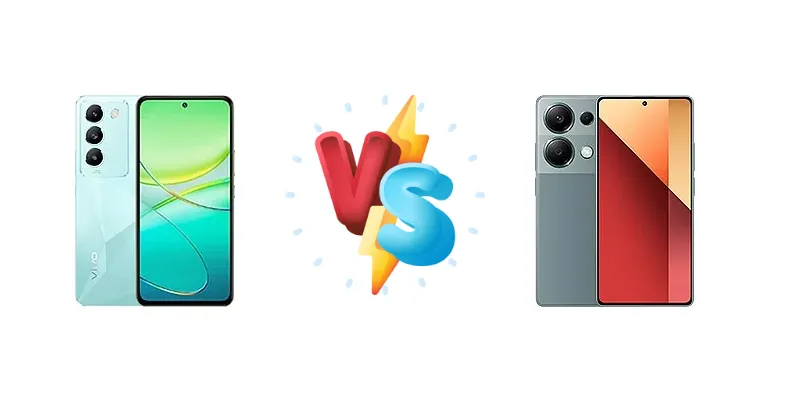
The vivo T3 and Xiaomi Redmi Note 13 Pro 4G represent compelling options in the increasingly competitive mid-range smartphone market. While both aim to deliver a balanced experience, they diverge in their core philosophies: the vivo T3 prioritizes processing power with its Dimensity 7200, while the Redmi Note 13 Pro 4G emphasizes battery life and fast charging with its Helio G99 Ultra. This comparison will dissect their strengths and weaknesses to determine which device best suits your needs.
🏆 Quick Verdict
For users prioritizing raw performance and responsiveness, the vivo T3 is the clear winner thanks to its more modern and efficient Dimensity 7200 chipset. However, the Xiaomi Redmi Note 13 Pro 4G excels in battery endurance, offering over 11 hours of active use, and boasts significantly faster charging speeds, making it ideal for heavy users who value longevity.
| Network |
|---|
| 2G bands | GSM 850 / 900 / 1800 / 1900 | GSM 850 / 900 / 1800 / 1900 |
| 3G bands | HSDPA 850 / 900 / 2100 | HSDPA 850 / 900 / 1700(AWS) / 1900 / 2100 |
| 4G bands | 1, 3, 5, 8, 28, 38, 40, 41 | 1, 2, 3, 4, 5, 7, 8, 12, 13, 17, 18, 19, 20, 26, 28, 38, 40, 41, 66 |
| 5G bands | 1, 3, 28, 40, 77, 78 SA/NSA | - |
| Speed | HSPA, LTE, 5G | HSPA, LTE |
| Technology | GSM / HSPA / LTE / 5G | GSM / HSPA / LTE |
| Launch |
|---|
| Announced | 2024, March 21 | 2024, January 15 |
| Status | Available. Released 2024, March 27 | Available. Released 2024, January 15 |
| Body |
|---|
| Build | Glass front, plastic or silicone polymer (eco leather) back, plastic frame | Glass front (Gorilla Glass 5), plastic frame, plastic back |
| Dimensions | 163.2 x 75.8 x 7.8 mm or 8.0 mm | 161.1 x 75 x 8 mm (6.34 x 2.95 x 0.31 in) |
| SIM | Nano-SIM + Nano-SIM | Nano-SIM + Nano-SIM |
| Weight | 185.5 g or 188 g (6.56 oz) | 188 g (6.63 oz) |
| Display |
|---|
| Protection | - | Corning Gorilla Glass 5 |
| Resolution | 1080 x 2400 pixels, 20:9 ratio (~395 ppi density) | 1080 x 2400 pixels, 20:9 ratio (~395 ppi density) |
| Size | 6.67 inches, 107.4 cm2 (~86.8% screen-to-body ratio) | 6.67 inches, 107.4 cm2 (~88.9% screen-to-body ratio) |
| Type | AMOLED, 120Hz, 1800 nits (peak) | AMOLED, 1B colors, 120Hz, 500 nits (typ), 1000 nits (HBM), 1300 nits (peak) |
| Platform |
|---|
| CPU | Octa-core (2x2.8 GHz Cortex-A715 & 6x 2.0 Cortex-A510) | Octa-core (2x2.2 GHz Cortex-A76 & 6x2.0 GHz Cortex-A55) |
| Chipset | Mediatek Dimensity 7200 (4 nm) | Mediatek Helio G99 Ultra |
| GPU | Mali-G610 MC4 | Mali-G57 MC2 |
| OS | Android 14, Funtouch 14 | Android 13, up to 3 major Android upgrades, HyperOS |
| Memory |
|---|
| Card slot | microSDXC (uses shared SIM slot) | microSDXC (uses shared SIM slot) |
| Internal | 128GB 8GB RAM, 256GB 8GB RAM | 128GB 8GB RAM, 256GB 8GB RAM, 256GB 12GB RAM, 512GB 8GB RAM, 512GB 12GB RAM |
| Main Camera |
|---|
| Dual | 50 MP, f/1.8, (wide), 1/1.95", 0.8µm, PDAF, OIS
Auxiliary lens | - |
| Features | LED flash, panorama, HDR | LED flash, HDR, panorama |
| Triple | - | 200 MP, f/1.7, 23mm (wide), 1/1.4", 0.56µm, multi-directional PDAF, OIS
8 MP, f/2.2, 15mm, 120˚ (ultrawide), 1/4.4", 1.0µm
2 MP (macro) |
| Video | 4K@30fps, 1080p@30fps, OIS | 1080p@30/60fps |
| Selfie camera |
|---|
| Single | 16 MP, f/2.0, (wide), 1/3.1", 1.0µm | 16 MP, f/2.4, (wide), 1/3.0", 1.0µm |
| Video | 1080p@30fps | 1080p@30/60fps |
| Sound |
|---|
| 35mm jack | No | Yes |
| Loudspeaker | Yes, with stereo speakers | Yes, with dual speakers |
| Comms |
|---|
| Bluetooth | 5.3, A2DP, LE | 5.2, A2DP, LE |
| Infrared port | - | Yes |
| NFC | No | Yes (market/region dependent) |
| Positioning | GPS, GLONASS, GALILEO, BDS, QZSS | GPS, GLONASS, GALILEO, BDS |
| Radio | No | FM radio |
| USB | USB Type-C 2.0, OTG | USB Type-C 2.0, OTG |
| WLAN | Wi-Fi 802.11 a/b/g/n/ac, dual-band | Wi-Fi 802.11 a/b/g/n/ac, dual-band |
| Features |
|---|
| Sensors | Fingerprint (under display, optical), accelerometer, gyro, proximity, compass, flicker | Fingerprint (under display, optical), accelerometer, gyro, compass |
| Battery |
|---|
| Charging | 44W wired | 67W wired, 50% in 16 min, 100% in 46 min |
| Type | 5000 mAh | 5000 mAh |
| Misc |
|---|
| Colors | Cosmic Blue, Cystal Flake | Midnight Black, Lavender Purple, Forest Green |
| Models | - | 23117RA68G, 2312FPCA6G |
| Price | About 220 EUR | € 92.00 / $ 269.99 / £ 299.99 |
| SAR | 0.98 W/kg (head) 0.94 W/kg (body) | 1.09 W/kg (head) 1.09 W/kg (body) |
| SAR EU | - | 0.99 W/kg (head) 0.99 W/kg (body) |
vivo T3
- Superior processing power with Dimensity 7200
- More efficient 4nm fabrication process
- Potentially better gaming performance
- Likely shorter battery life
- Slower 44W charging
Xiaomi Redmi Note 13 Pro 4G
- Excellent battery life (11:36h active use)
- Faster 67W charging (100% in 46 min)
- Brighter display (1047 nits)
- Less powerful Helio G99 Ultra chipset
- Potential for throttling under heavy load
Display Comparison
The Xiaomi Redmi Note 13 Pro 4G boasts a significantly brighter display, reaching a measured peak of 1047 nits. This translates to superior visibility outdoors under direct sunlight. While the vivo T3’s display specifications are not provided, it’s likely to be dimmer. The Redmi Note 13 Pro 4G’s brightness advantage is particularly beneficial for users who frequently consume content outdoors or in brightly lit environments. The absence of LTPO technology in either device suggests neither offers adaptive refresh rate capabilities for power saving.
Camera Comparison
Both devices feature camera systems, but detailed sensor information is limited. The Redmi Note 13 Pro 4G’s camera is described as capable of both photo and video, suggesting a versatile setup. However, without knowing sensor sizes or aperture values, a direct comparison is difficult. It’s reasonable to assume the Redmi Note 13 Pro 4G may prioritize a higher megapixel count, while the vivo T3 might focus on image processing algorithms. The prevalence of 2MP macro lenses in this segment suggests both devices likely include one, but their utility is questionable for most users.
Performance
The vivo T3’s Mediatek Dimensity 7200 (4nm) represents a substantial leap in processing power compared to the Redmi Note 13 Pro 4G’s Helio G99 Ultra. The Dimensity 7200’s Cortex-A715 cores, clocked at 2.8 GHz, offer significantly higher single-core performance than the G99 Ultra’s Cortex-A76 cores at 2.2 GHz. The 4nm fabrication process of the Dimensity 7200 also contributes to improved thermal efficiency, reducing the likelihood of throttling during sustained workloads. This means the vivo T3 will handle graphically intensive games and demanding applications with greater ease and consistency. The Redmi Note 13 Pro 4G, while capable for everyday tasks, will likely exhibit more noticeable slowdowns under heavy load.
Battery Life
The Xiaomi Redmi Note 13 Pro 4G clearly wins in battery endurance, achieving an impressive 11 hours and 36 minutes of active use. This is a significant advantage for users who rely heavily on their smartphones throughout the day. While the vivo T3’s battery capacity is unknown, its more powerful processor is likely to consume more power. The Redmi Note 13 Pro 4G also boasts faster charging with 67W wired, reaching 50% charge in just 16 minutes and 100% in 46 minutes. The vivo T3’s 44W charging is slower, making the Redmi Note 13 Pro 4G the more convenient option for quick top-ups.
Buying Guide
Buy the vivo T3 if you need a phone for demanding tasks like gaming, video editing, or multitasking, and appreciate a snappier user experience. Its Dimensity 7200 provides a noticeable performance edge. Buy the Xiaomi Redmi Note 13 Pro 4G if you prioritize all-day battery life, quick top-ups with 67W charging, and a bright, vibrant display for media consumption. It’s the better choice for users who don’t push their phones to the limit.
Frequently Asked Questions
❓ Does the Helio G99 Ultra in the Redmi Note 13 Pro 4G struggle with demanding games like Genshin Impact?
While the Helio G99 Ultra is a capable chipset for everyday tasks, it may struggle to maintain consistent frame rates in graphically intensive games like Genshin Impact, especially at higher settings. Expect to lower graphics settings for a smoother experience. The Dimensity 7200 in the vivo T3 will provide a significantly better gaming experience.
❓ How much faster is the 67W charging on the Redmi Note 13 Pro 4G compared to the 44W charging on the vivo T3 in real-world use?
The Redmi Note 13 Pro 4G’s 67W charging is considerably faster. It can reach 100% charge in 46 minutes, while the vivo T3’s 44W charging will take significantly longer. This difference is particularly noticeable when you need a quick top-up before leaving the house.
❓ Is the camera on the Redmi Note 13 Pro 4G good enough for social media photos and casual snapshots?
The Redmi Note 13 Pro 4G’s camera is likely sufficient for social media and casual photography, but without detailed sensor information, it’s hard to assess its low-light performance or dynamic range. Expect decent results in good lighting conditions.