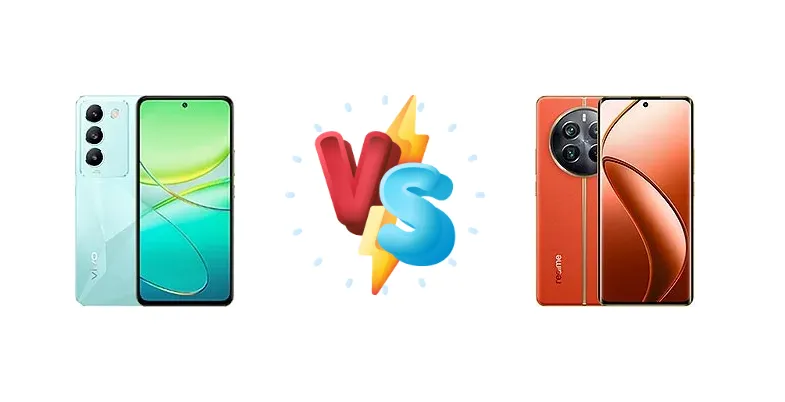
The mid-range smartphone market is fiercely competitive, and the vivo T3 and Realme 12 Pro+ are two contenders vying for attention. The T3 focuses on delivering strong performance with the Dimensity 7200, while the 12 Pro+ prioritizes a premium experience with faster charging and a brighter display. This comparison dissects their key differences to help you choose the right phone for your needs.
🏆 Quick Verdict
For the average user prioritizing all-around usability, the Realme 12 Pro+ emerges as the better choice. Its significantly faster 67W charging and brighter 802 nit display, coupled with a respectable 13:24h active use battery life, offer a more polished daily experience. However, gamers on a budget may find the vivo T3’s Dimensity 7200 a compelling option.
| Network |
|---|
| 2G bands | GSM 850 / 900 / 1800 / 1900 | GSM 850 / 900 / 1800 / 1900 |
| 3G bands | HSDPA 850 / 900 / 2100 | HSDPA 850 / 900 / 2100 |
| 4G bands | 1, 3, 5, 8, 28, 38, 40, 41 | 1, 3, 5, 8, 28, 40, 41 |
| 5G bands | 1, 3, 28, 40, 77, 78 SA/NSA | 1, 3, 5, 8, 28, 40, 41, 77, 78 SA/NSA |
| Speed | HSPA, LTE, 5G | HSPA, LTE, 5G |
| Technology | GSM / HSPA / LTE / 5G | GSM / HSPA / LTE / 5G |
| Launch |
|---|
| Announced | 2024, March 21 | 2024, January 29 |
| Status | Available. Released 2024, March 27 | Available. Released 2024, January 29 |
| Body |
|---|
| Build | Glass front, plastic or silicone polymer (eco leather) back, plastic frame | - |
| Dimensions | 163.2 x 75.8 x 7.8 mm or 8.0 mm | 161.5 x 74 x 8.8 mm (6.36 x 2.91 x 0.35 in) |
| SIM | Nano-SIM + Nano-SIM | Nano-SIM + Nano-SIM |
| Weight | 185.5 g or 188 g (6.56 oz) | 196 g (6.91 oz) |
| Display |
|---|
| Resolution | 1080 x 2400 pixels, 20:9 ratio (~395 ppi density) | 1080 x 2412 pixels, 20:9 ratio (~394 ppi density) |
| Size | 6.67 inches, 107.4 cm2 (~86.8% screen-to-body ratio) | 6.7 inches, 108.0 cm2 (~90.4% screen-to-body ratio) |
| Type | AMOLED, 120Hz, 1800 nits (peak) | AMOLED, 1B colors, 120Hz, 800 nits (HBM), 950 nits (peak) |
| Platform |
|---|
| CPU | Octa-core (2x2.8 GHz Cortex-A715 & 6x 2.0 Cortex-A510) | Octa-core (4x2.40 GHz Cortex-A78 & 4x1.95 GHz Cortex-A55) |
| Chipset | Mediatek Dimensity 7200 (4 nm) | Qualcomm SM7435-AB Snapdragon 7s Gen 2 (4 nm) |
| GPU | Mali-G610 MC4 | Adreno 710 |
| OS | Android 14, Funtouch 14 | Android 14, Realme UI 5.0 |
| Memory |
|---|
| Card slot | microSDXC (uses shared SIM slot) | No |
| Internal | 128GB 8GB RAM, 256GB 8GB RAM | 128GB 8GB RAM, 256GB 8GB RAM, 256GB 12GB RAM, 512GB 12GB RAM |
| Main Camera |
|---|
| Dual | 50 MP, f/1.8, (wide), 1/1.95", 0.8µm, PDAF, OIS
Auxiliary lens | - |
| Features | LED flash, panorama, HDR | LED flash, HDR, panorama |
| Triple | - | 50 MP, f/1.8, 24mm (wide), 1/1.56", 1.0µm, multi-directional PDAF, OIS
64 MP, f/2.8, 71mm, (periscope telephoto), 1/2.0", 0.7µm, PDAF, OIS, 3x optical zoom
8 MP, f/2.2, 16mm, 112˚ (ultrawide), 1/4.0", 1.12µm |
| Video | 4K@30fps, 1080p@30fps, OIS | 4K@30fps, 1080p@30/60/120fps, gyro-EIS |
| Selfie camera |
|---|
| Single | 16 MP, f/2.0, (wide), 1/3.1", 1.0µm | 32 MP, f/2.4, 22mm (wide) |
| Video | 1080p@30fps | 1080p@30fps |
| Sound |
|---|
| 35mm jack | No | No |
| Loudspeaker | Yes, with stereo speakers | Yes, with stereo speakers |
| Comms |
|---|
| Bluetooth | 5.3, A2DP, LE | 5.2, A2DP, LE |
| NFC | No | Yes (market/region dependent) |
| Positioning | GPS, GLONASS, GALILEO, BDS, QZSS | GPS, GLONASS, GALILEO, BDS, QZSS |
| Radio | No | No |
| USB | USB Type-C 2.0, OTG | USB Type-C 2.0 |
| WLAN | Wi-Fi 802.11 a/b/g/n/ac, dual-band | Wi-Fi 802.11 a/b/g/n/ac/6, dual-band |
| Features |
|---|
| Sensors | Fingerprint (under display, optical), accelerometer, gyro, proximity, compass, flicker | Fingerprint (under display, optical), accelerometer, gyro, proximity, compass |
| Battery |
|---|
| Charging | 44W wired | 67W wired, 50% in 19 min |
| Type | 5000 mAh | 5000 mAh |
| Misc |
|---|
| Colors | Cosmic Blue, Cystal Flake | Submarine Blue, Navigator Beige, Explorer Red |
| Models | - | RMX3840, RMX3841 |
| Price | About 220 EUR | $ 465.00 / £ 299.00 / € 344.26 / ₹ 28,400 |
| SAR | 0.98 W/kg (head) 0.94 W/kg (body) | - |
vivo T3
- Potentially stronger single-core performance with Dimensity 7200
- Competitive price point likely offers better value for CPU power
- 4nm chipset ensures good efficiency
- Slower 44W charging
- Likely less bright display
- Potentially less refined camera system
Realme 12 Pro+
- Faster 67W charging with quick 50% charge time
- Brighter 802 nit display for better outdoor visibility
- Longer 13:24h active use battery life
- Snapdragon 7s Gen 2 may offer slightly less peak CPU performance
- Potentially higher price tag
- Image processing may be overly saturated for some users
Display Comparison
The Realme 12 Pro+ boasts a significantly brighter display, reaching a measured 802 nits, compared to an unspecified brightness for the vivo T3. This higher peak brightness translates to better outdoor visibility, a crucial advantage for users frequently exposed to sunlight. While panel technology isn't specified for either, the Realme’s brightness suggests a higher-quality panel. Bezels are likely comparable given the market segment, but the Realme’s brighter screen is a clear win for media consumption and everyday use.
Camera Comparison
Camera details beyond the main sensors are limited. The Realme 12 Pro+ likely features a more sophisticated camera system, given its positioning as a 'Pro+' model. While sensor sizes aren't provided, the Realme’s marketing often emphasizes camera capabilities. The vivo T3’s camera is likely competent but geared towards everyday photography. The presence of a 2MP macro camera on either device is largely irrelevant, as image quality is typically poor. Image processing styles will also differ; Realme tends towards vibrant, saturated colors, while vivo often aims for more natural tones.
Performance
Both phones utilize 4nm chipsets, but their architectures differ significantly. The Realme 12 Pro+ features the Qualcomm Snapdragon 7s Gen 2, employing four Cortex-A78 cores clocked at 2.40 GHz alongside four Cortex-A55 cores. The vivo T3, conversely, uses the MediaTek Dimensity 7200, with two high-performance Cortex-A715 cores at 2.8 GHz and six Cortex-A510 cores at 2.0 GHz. The Dimensity 7200’s higher clock speeds on its prime cores suggest a potential advantage in single-core tasks and burst performance, beneficial for gaming. However, the Snapdragon 7s Gen 2’s Cortex-A78 cores are generally more efficient, potentially leading to better sustained performance and thermal management. RAM speed is not specified, but both likely utilize LPDDR4x or LPDDR5 to balance performance and cost.
Battery Life
The Realme 12 Pro+ demonstrates a clear advantage in battery and charging. Its active use score of 13:24h indicates excellent real-world stamina. Crucially, it supports 67W wired charging, capable of reaching 50% charge in just 19 minutes. The vivo T3 is limited to 44W charging, meaning slower top-ups. While the T3’s battery capacity isn’t specified, the faster charging of the Realme 12 Pro+ mitigates any potential capacity difference, offering a more convenient charging experience.
Buying Guide
Buy the vivo T3 if you need a phone primarily for gaming and demand strong CPU performance within a tighter budget. The Dimensity 7200’s Cortex-A715 cores provide a noticeable edge in demanding titles. Buy the Realme 12 Pro+ if you prioritize a more refined user experience, faster charging, and a brighter, more visible display, even if it means sacrificing a small amount of raw CPU power.
Frequently Asked Questions
❓ Will the Snapdragon 7s Gen 2 in the Realme 12 Pro+ overheat during prolonged gaming sessions?
The Snapdragon 7s Gen 2 is known for its relatively efficient thermal management. While some throttling is inevitable during extended gaming, the 4nm process and Qualcomm’s optimizations should keep temperatures within acceptable limits, providing a consistently playable experience. The Cortex-A78 cores are more efficient than the A715 in the vivo T3, potentially leading to less heat buildup.
❓ How significant is the charging speed difference between 44W and 67W, and will I notice it in daily use?
The difference is substantial. The Realme 12 Pro+'s 67W charging can add 50% battery in 19 minutes, while the vivo T3’s 44W will take considerably longer. This translates to less downtime and more convenience, especially for users who frequently need to top up their battery throughout the day. The Realme’s faster charging is a key advantage for busy individuals.
❓ Is the Dimensity 7200 in the vivo T3 capable of running demanding games like Genshin Impact or PUBG Mobile at high settings?
Yes, the Dimensity 7200 is capable of running demanding games, but you may need to make some compromises in graphics settings. Expect playable frame rates at medium to high settings in Genshin Impact and PUBG Mobile. However, sustained performance may be limited by thermal throttling, so prolonged gaming sessions might require lowering settings to maintain consistent frame rates.