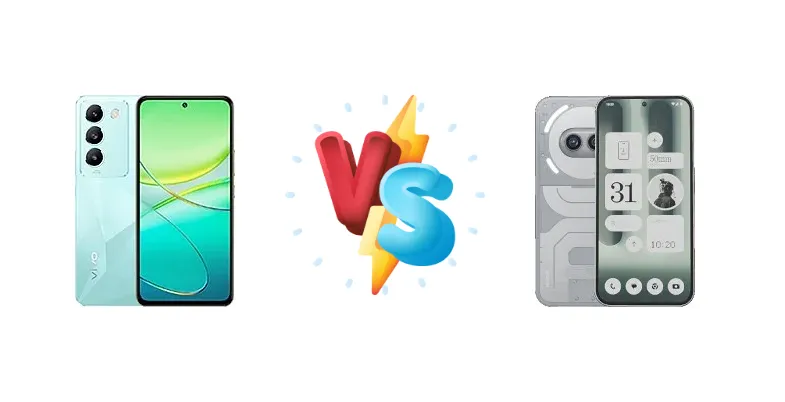
The mid-range smartphone market is fiercely competitive, and the vivo T3 and Nothing Phone (2a) Plus are two compelling contenders. The T3 aims for aggressive value, while the Nothing Phone (2a) Plus builds on the brand's unique design and software experience. This comparison dissects their key specifications to determine which device delivers the most for your money.
🏆 Quick Verdict
For the average user prioritizing all-around performance and faster charging, the Nothing Phone (2a) Plus emerges as the stronger choice. Its Dimensity 7350 Pro chipset and impressive 16:34h active use battery life provide a noticeable edge, justifying its slightly higher price point.
| Network |
|---|
| 2G bands | GSM 850 / 900 / 1800 / 1900 | GSM 850 / 900 / 1800 / 1900 |
| 3G bands | HSDPA 850 / 900 / 2100 | HSDPA 800 / 850 / 900 / 1700(AWS) / 1900 / 2100 |
| 4G bands | 1, 3, 5, 8, 28, 38, 40, 41 | 1, 3, 4, 5, 7, 8, 18, 19, 20, 26, 28, 38, 39, 40, 41, 42, 66 |
| 5G bands | 1, 3, 28, 40, 77, 78 SA/NSA | 1, 3, 5, 7, 8, 20, 28, 38, 40, 41, 66, 77, 78 SA/NSA |
| Speed | HSPA, LTE, 5G | HSPA, LTE, 5G |
| Technology | GSM / HSPA / LTE / 5G | GSM / HSPA / LTE / 5G |
| Launch |
|---|
| Announced | 2024, March 21 | 2024, July 31 |
| Status | Available. Released 2024, March 27 | Available. Released 2024, August 03 |
| Body |
|---|
| Build | Glass front, plastic or silicone polymer (eco leather) back, plastic frame | Glass front (Gorilla Glass 5), plastic frame, plastic back |
| Dimensions | 163.2 x 75.8 x 7.8 mm or 8.0 mm | 161.7 x 76.3 x 8.5 mm (6.37 x 3.00 x 0.33 in) |
| SIM | Nano-SIM + Nano-SIM | Nano-SIM + Nano-SIM |
| Weight | 185.5 g or 188 g (6.56 oz) | 190 g (6.70 oz) |
| Display |
|---|
| Protection | - | Corning Gorilla Glass 5 |
| Resolution | 1080 x 2400 pixels, 20:9 ratio (~395 ppi density) | 1080 x 2412 pixels, 20:9 ratio (~395 ppi density) |
| Size | 6.67 inches, 107.4 cm2 (~86.8% screen-to-body ratio) | 6.7 inches, 107.5 cm2 (~87.1% screen-to-body ratio) |
| Type | AMOLED, 120Hz, 1800 nits (peak) | AMOLED, 1B colors, 120Hz, 2160Hz PWM, HDR10+, 700 nits (typ), 1100 nits (HBM), 1300 nits (peak) |
| Platform |
|---|
| CPU | Octa-core (2x2.8 GHz Cortex-A715 & 6x 2.0 Cortex-A510) | Octa-core (2x3.0 GHz Cortex-A715 & 6x 2.0 GHz Cortex-A510) |
| Chipset | Mediatek Dimensity 7200 (4 nm) | Mediatek Dimensity 7350 Pro (4 nm) |
| GPU | Mali-G610 MC4 | Mali-G610 MC4 |
| OS | Android 14, Funtouch 14 | Android 14, up to 3 major Android upgrades, Nothing OS 3.0 |
| Memory |
|---|
| Card slot | microSDXC (uses shared SIM slot) | No |
| Internal | 128GB 8GB RAM, 256GB 8GB RAM | 256GB 8GB RAM, 256GB 12GB RAM |
| Main Camera |
|---|
| Dual | 50 MP, f/1.8, (wide), 1/1.95", 0.8µm, PDAF, OIS
Auxiliary lens | 50 MP, f/1.9, 24mm (wide), 1/1.57", 1.0µm, PDAF, OIS
50 MP, f/2.2, 114˚ (ultrawide), 1/2.76", 0.64µm |
| Features | LED flash, panorama, HDR | LED flash, panorama, HDR |
| Video | 4K@30fps, 1080p@30fps, OIS | 4K@30fps, 1080p@60/120fps, gyro-EIS |
| Selfie camera |
|---|
| Features | - | HDR |
| Single | 16 MP, f/2.0, (wide), 1/3.1", 1.0µm | 50 MP, f/2.2, (wide), 1/2.76" |
| Video | 1080p@30fps | 4K@30fps |
| Sound |
|---|
| 35mm jack | No | No |
| Loudspeaker | Yes, with stereo speakers | Yes, with stereo speakers |
| Comms |
|---|
| Bluetooth | 5.3, A2DP, LE | 5.3, A2DP, LE |
| NFC | No | Yes, 360˚ |
| Positioning | GPS, GLONASS, GALILEO, BDS, QZSS | GPS, GALILEO, GLONASS, BDS, QZSS |
| Radio | No | No |
| USB | USB Type-C 2.0, OTG | USB Type-C 2.0, OTG |
| WLAN | Wi-Fi 802.11 a/b/g/n/ac, dual-band | Wi-Fi 802.11 a/b/g/n/ac/6, dual-band, Wi-Fi Direct |
| Features |
|---|
| Sensors | Fingerprint (under display, optical), accelerometer, gyro, proximity, compass, flicker | Fingerprint (under display, optical), accelerometer, gyro, proximity, compass |
| Battery |
|---|
| Charging | 44W wired | 50W wired, 50% in 21 min, 100% in 56 min |
| Type | 5000 mAh | 5000 mAh |
| Misc |
|---|
| Colors | Cosmic Blue, Cystal Flake | Black, Grey |
| Models | - | A142P |
| Price | About 220 EUR | € 269.90 / ₹ 22,599 |
| SAR | 0.98 W/kg (head) 0.94 W/kg (body) | - |
vivo T3
- Potentially more affordable price point
- Decent performance for everyday tasks
- 44W fast charging is still respectable
- Likely lower display brightness
- Potentially less refined camera system
- Slower charging compared to the competition
Nothing Phone (2a) Plus
- Brighter display for better outdoor visibility
- Faster Dimensity 7350 Pro chipset
- Impressive 16:34h active use battery life
- Faster 50W charging
- Higher price compared to the vivo T3
- Software experience may not appeal to all users
- Design may be polarizing
Display Comparison
The Nothing Phone (2a) Plus boasts a significantly brighter display, reaching a measured peak of 1097 nits. This translates to superior visibility outdoors under direct sunlight compared to the vivo T3, which lacks published brightness data but is expected to be lower. While both likely utilize AMOLED panels for vibrant colors, the Nothing Phone (2a) Plus’s higher brightness is a clear advantage for media consumption and general usability. The absence of LTPO technology on either device suggests both will rely on adaptive refresh rates to conserve battery, but the brighter panel on the Nothing Phone (2a) Plus will be more impactful in bright environments.
Camera Comparison
Without detailed camera specs for the vivo T3, a direct comparison is limited. However, the Nothing Phone (2a) Plus is expected to feature a more sophisticated camera system, likely with a larger main sensor and potentially optical image stabilization (OIS). The focus should be on the primary sensor's megapixel count and aperture, as these directly impact low-light performance and image detail. The inclusion of OIS on the Nothing Phone (2a) Plus would further enhance image stability, particularly in video recording. It's reasonable to assume the Nothing Phone (2a) Plus will offer a more versatile and higher-quality camera experience.
Performance
Both phones are powered by Mediatek Dimensity chips built on a 4nm process, ensuring good efficiency. However, the Nothing Phone (2a) Plus’s Dimensity 7350 Pro has a slight edge with its 3.0 GHz Cortex-A715 cores, compared to the 2.8 GHz cores in the vivo T3’s Dimensity 7200. This clock speed difference, combined with potential optimizations in the 7350 Pro, should result in marginally faster application loading and smoother multitasking. Both utilize the same Cortex-A510 efficiency cores, meaning background tasks and standby power consumption should be comparable. The impact of RAM speed (likely LPDDR4X on both) is less significant than the chipset difference.
Battery Life
The Nothing Phone (2a) Plus demonstrates a clear advantage in battery life, achieving an impressive 16:34h of active use. While the vivo T3’s battery capacity is unknown, the Nothing Phone (2a) Plus’s longevity is a significant benefit for power users. Furthermore, the Nothing Phone (2a) Plus supports 50W wired charging, reaching 50% charge in just 21 minutes and a full charge in 56 minutes. The vivo T3’s 44W charging is slower, making the Nothing Phone (2a) Plus more convenient for users who frequently need to top up their battery quickly.
Buying Guide
Buy the vivo T3 if you need a highly affordable 5G phone with decent performance for everyday tasks and prioritize value above all else. Buy the Nothing Phone (2a) Plus if you prefer a more refined software experience, a brighter display, and longer battery life, and are willing to spend a bit more for those enhancements.
Frequently Asked Questions
❓ Does the Dimensity 7350 Pro in the Nothing Phone (2a) Plus get noticeably warmer during extended gaming sessions?
While the 4nm process helps with thermal efficiency, demanding games will inevitably generate heat. The Nothing Phone (2a) Plus incorporates a vapor chamber cooling system, which should mitigate throttling and maintain consistent performance for longer periods. However, sustained peak performance may still result in some warming, which is typical for smartphones.
❓ How does Nothing's Glyph Interface impact battery life on the (2a) Plus?
The Glyph Interface, while visually distinctive, has a minimal impact on battery life. The LEDs consume a small amount of power, but the effect is negligible during typical usage. Users can customize the Glyph Interface to only activate for essential notifications, further minimizing any potential battery drain.
❓ Is the 44W charging on the vivo T3 sufficient for overnight charging, or will I need to charge it during the day?
44W charging is adequate for overnight charging, especially if you're not starting from a completely depleted battery. However, if you're a heavy user, you might find yourself needing to top up the battery during the day, as it won't recharge as quickly as the Nothing Phone (2a) Plus.