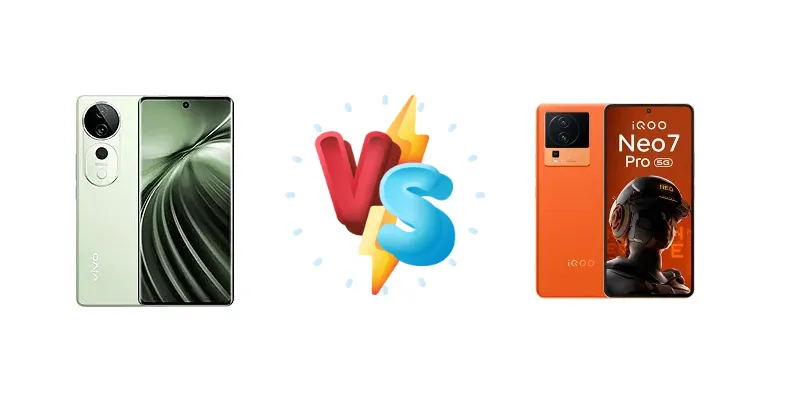
The vivo T3 Ultra and iQOO Neo 7 Pro represent compelling options in the mid-to-high range smartphone market. The T3 Ultra brings the newer Mediatek Dimensity 9200+ to the table, while the iQOO Neo 7 Pro leverages the established Qualcomm Snapdragon 8+ Gen 1. This comparison dissects their key differences, focusing on performance, charging speed, and overall user experience to determine which device offers the best value.
🏆 Quick Verdict
For most users, the iQOO Neo 7 Pro emerges as the stronger choice. Its 120W charging significantly reduces downtime, and the Snapdragon 8+ Gen 1, while older, remains a potent performer. While the Dimensity 9200+ in the T3 Ultra is powerful, the charging advantage of the iQOO Neo 7 Pro is a decisive factor for power users.
| Network |
|---|
| 2G bands | GSM 850 / 900 / 1800 / 1900 | GSM 850 / 900 / 1800 / 1900 |
| 3G bands | HSDPA 850 / 900 / 1900 / 2100 | HSDPA 800 / 850 / 900 / 1700(AWS) / 1900 / 2100 |
| 4G bands | 1, 3, 4, 5, 7, 8, 18, 19, 26, 28, 38, 39, 40, 41 | 1, 2, 3, 4, 5, 8, 28, 34, 38, 39, 40, 41 |
| 5G bands | 1, 3, 5, 8, 28, 40, 77, 78 SA/NSA | 1, 3, 5, 8, 28, 40, 77, 78 SA/NSA |
| Speed | HSPA, LTE, 5G | HSPA, LTE, 5G |
| Technology | GSM / HSPA / LTE / 5G | GSM / HSPA / LTE / 5G |
| Launch |
|---|
| Announced | 2024, September 12 | 2023, July 04 |
| Status | Available. Released 2024, September 19 | Available. Released 2023, July 15 |
| Body |
|---|
| Build | Glass front, glass back | Glass front, plastic frame, glass or leather back |
| Dimensions | 164.2 x 74.9 x 7.6 mm (6.46 x 2.95 x 0.30 in) | 164.8 x 76.9 x 8.5 mm or 8.9 mm |
| SIM | Nano-SIM + Nano-SIM | Nano-SIM + Nano-SIM |
| Weight | 192 g (6.77 oz) | 197 g or 202 g (6.95 oz) |
| Display |
|---|
| Protection | Schott Xensation Alpha | - |
| Resolution | 1260 x 2800 pixels, 20:9 ratio (~453 ppi density) | 1080 x 2400 pixels, 20:9 ratio (~388 ppi density) |
| Size | 6.78 inches, 111.0 cm2 (~90.2% screen-to-body ratio) | 6.78 inches, 111.0 cm2 (~87.6% screen-to-body ratio) |
| Type | AMOLED, 1B colors, HDR10+, 120Hz, 4500 nits (peak) | AMOLED, 1B colors, 120Hz, HDR10+, 1300 nits (peak) |
| Platform |
|---|
| CPU | Octa-core (1x3.35 GHz Cortex-X3 & 3x3.0 GHz Cortex-A715 & 4x2.0 GHz Cortex-A510) | Octa-core (1x3.19 GHz Cortex-X2 & 3x2.75 GHz Cortex-A710 & 4x2.0 GHz Cortex-A510) |
| Chipset | Mediatek Dimensity 9200+ (4 nm) | Qualcomm SM8475 Snapdragon 8+ Gen 1 (4 nm) |
| GPU | Immortalis-G715 MC11 | Adreno 730 |
| OS | Android 14, Funtouch 14 | Android 13, Funtouch 13 |
| Memory |
|---|
| Card slot | No | No |
| Internal | 128GB 8GB RAM, 256GB 8GB RAM, 256GB 12GB RAM | 128GB 8GB RAM, 256GB 12GB RAM |
| Main Camera |
|---|
| Dual | 50 MP, f/1.9, 24mm (wide), 1/1.56", 1.0µm, PDAF, OIS
8 MP, f/2.2, 120˚ (ultrawide), 1/4.0", 1.12µm | - |
| Features | Ring-LED flash, panorama, HDR | LED flash, HDR, panorama |
| Triple | - | 50 MP, f/1.9, 24mm (wide), 1/1.57", 1.0µm, PDAF, OIS
8 MP, f/2.2, 16mm (ultrawide), 1/4.0", 1.12µm
2 MP (macro) |
| Video | 4K@30/60fps, 1080p@30fps, gyro-EIS, OIS | 4K@30fps, 1080p@30fps |
| Selfie camera |
|---|
| Features | HDR | HDR |
| Single | 50 MP, f/2.0, 21mm (wide), 1/2.76", 0.64µm, AF | 16 MP, f/2.5, (wide), 1/3.1", 1.0µm |
| Video | 4K@30/60fps, 1080p@30fps | 1080p@30fps |
| Sound |
|---|
| 35mm jack | No | No |
| Loudspeaker | Yes, with stereo speakers | Yes, with stereo speakers |
| Comms |
|---|
| Bluetooth | 5.3, A2DP, LE | 5.3, A2DP, LE, aptX HD, aptX Adaptive |
| Infrared port | - | Yes |
| NFC | No | No |
| Positioning | GPS, GALILEO, GLONASS, QZSS, BDS, NavIC | GPS, GLONASS, GALILEO, BDS, QZSS, NavIC |
| Radio | No | No |
| USB | USB Type-C 2.0, OTG | USB Type-C 2.0, OTG |
| WLAN | Wi-Fi 802.11 a/b/g/n/ac, dual-band | Wi-Fi 802.11 a/b/g/n/ac/6, dual-band, Wi-Fi Direct |
| Features |
|---|
| Sensors | Fingerprint (under display, optical), accelerometer, gyro, proximity, compass | Fingerprint (under display, optical), accelerometer, gyro, proximity, compass |
| Battery |
|---|
| Charging | 80W wired, PD, 100% in 56 min
Reverse wired | 120W wired, 50% in 8 min |
| Type | Li-Ion 5500 mAh | 5000 mAh |
| Misc |
|---|
| Colors | Lunar Gray, Frost Green | Fearless Flame, Dark Storm |
| Models | V2426 | I2217 |
| Price | About 350 EUR | About 380 EUR |
| SAR | 0.99 W/kg (head) 0.99 W/kg (body) | - |
vivo T3 Ultra
- Latest Dimensity 9200+ chipset for potentially higher peak performance.
- 4nm process for improved power efficiency.
- 80W fast charging with reverse wired charging capability.
- Slower charging speed compared to the iQOO Neo 7 Pro.
- Dimensity chipset may have less software optimization compared to Snapdragon.
vivo iQOO Neo 7 Pro
- Ultra-fast 120W charging for minimal downtime.
- Snapdragon 8+ Gen 1 offers excellent thermal management and gaming performance.
- Mature software ecosystem and optimization for Snapdragon.
- Older chipset architecture compared to the Dimensity 9200+.
- Potentially lower single-core performance compared to the T3 Ultra.
Display Comparison
Both devices utilize 4nm chipsets, suggesting a focus on efficiency. However, display specifications are not provided in the context data. Given the iQOO Neo 7 Pro's positioning, it likely features a higher refresh rate panel (120Hz or higher) optimized for gaming. The T3 Ultra, while capable, may prioritize battery life with a slightly more conservative display configuration. Color accuracy and peak brightness will be key differentiators, but require further testing.
Camera Comparison
Camera details are absent from the provided data. However, considering the iQOO brand's focus on performance, it's reasonable to assume the Neo 7 Pro prioritizes image processing speed and potentially features a larger main sensor. The T3 Ultra, positioned as a more balanced device, might emphasize versatility. Without sensor size or aperture information, a definitive comparison is impossible, but the iQOO Neo 7 Pro likely has a more aggressive camera tuning for vibrant, shareable photos.
Performance
The core difference lies in the chipsets: the vivo T3 Ultra’s Mediatek Dimensity 9200+ and the iQOO Neo 7 Pro’s Qualcomm Snapdragon 8+ Gen 1. The Dimensity 9200+ boasts a higher peak CPU clock speed (3.35 GHz vs 3.19 GHz) and utilizes the newer Cortex-X3 core, potentially offering a slight edge in single-core performance. However, the Snapdragon 8+ Gen 1 benefits from Qualcomm’s mature software optimization and a well-established track record for gaming. Both are built on a 4nm process, but the Snapdragon 8+ Gen 1 is known for its excellent thermal management, minimizing throttling during sustained workloads. The T3 Ultra's newer architecture *could* close the gap, but real-world testing is crucial.
Battery Life
The iQOO Neo 7 Pro’s 120W charging is a game-changer, promising a 50% charge in just 8 minutes. This drastically reduces downtime compared to the vivo T3 Ultra’s 80W charging, which takes 56 minutes for a full charge. While battery capacity isn’t specified, the faster charging of the iQOO Neo 7 Pro effectively mitigates any potential capacity disadvantage. For users who frequently top up their phones throughout the day, the iQOO Neo 7 Pro offers a significantly more convenient experience.
Buying Guide
Buy the vivo T3 Ultra if you prioritize the latest chipset architecture and anticipate benefiting from future software optimizations tailored to the Dimensity 9200+. Buy the iQOO Neo 7 Pro if you value incredibly fast charging, a proven and thermally managed platform, and a more established gaming ecosystem around the Snapdragon 8+ Gen 1. The iQOO is the better pick for those who frequently game or rely heavily on their phone throughout the day.
Frequently Asked Questions
❓ Will the Dimensity 9200+ in the vivo T3 Ultra overheat during prolonged gaming sessions?
While the Dimensity 9200+ is a powerful chip, its thermal performance is unknown without testing. The Snapdragon 8+ Gen 1 in the iQOO Neo 7 Pro is well-regarded for its thermal efficiency. The T3 Ultra's cooling system will be critical in preventing throttling during extended gaming.
❓ How much faster is the 120W charging on the iQOO Neo 7 Pro compared to the 80W charging on the vivo T3 Ultra in real-world use?
The iQOO Neo 7 Pro can reach 50% charge in just 8 minutes, while the T3 Ultra requires significantly longer. This translates to a much quicker top-up during short breaks, making the iQOO Neo 7 Pro ideal for users who need to recharge rapidly.
❓ Does the Snapdragon 8+ Gen 1 in the iQOO Neo 7 Pro still hold up against newer chipsets like the Dimensity 9200+ in demanding games?
Yes, the Snapdragon 8+ Gen 1 remains a very capable gaming chip. While the Dimensity 9200+ may offer a slight theoretical advantage, the Snapdragon 8+ Gen 1's optimized drivers and thermal management often result in a smoother and more consistent gaming experience.