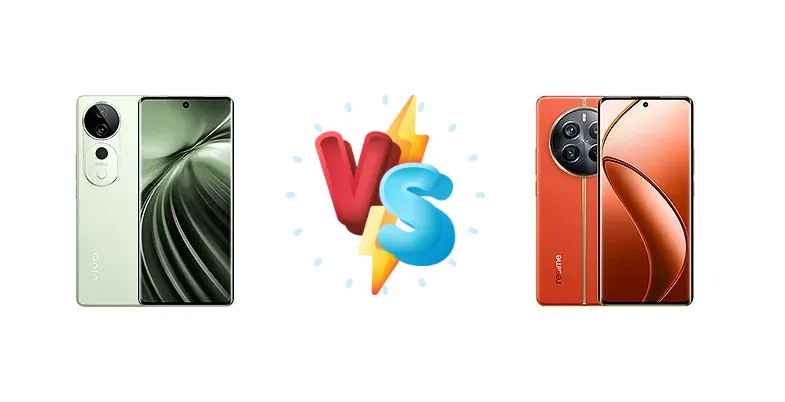
The mid-range smartphone market is fiercely competitive, and the vivo T3 Ultra and Realme 12 Pro+ represent compelling options for users seeking premium features without the flagship price tag. The T3 Ultra boasts the powerful Mediatek Dimensity 9200+ chipset, while the Realme 12 Pro+ prioritizes battery life and a bright display. This comparison dissects their key differences to help you choose the right device.
🏆 Quick Verdict
For users prioritizing raw performance and faster charging, the vivo T3 Ultra is the clear winner. Its Dimensity 9200+ chipset offers a significant performance leap over the Snapdragon 7s Gen 2 in the Realme 12 Pro+. However, the Realme 12 Pro+ excels in battery endurance, making it a better choice for those who value all-day usability.
| Network |
|---|
| 2G bands | GSM 850 / 900 / 1800 / 1900 | GSM 850 / 900 / 1800 / 1900 |
| 3G bands | HSDPA 850 / 900 / 1900 / 2100 | HSDPA 850 / 900 / 2100 |
| 4G bands | 1, 3, 4, 5, 7, 8, 18, 19, 26, 28, 38, 39, 40, 41 | 1, 3, 5, 8, 28, 40, 41 |
| 5G bands | 1, 3, 5, 8, 28, 40, 77, 78 SA/NSA | 1, 3, 5, 8, 28, 40, 41, 77, 78 SA/NSA |
| Speed | HSPA, LTE, 5G | HSPA, LTE, 5G |
| Technology | GSM / HSPA / LTE / 5G | GSM / HSPA / LTE / 5G |
| Launch |
|---|
| Announced | 2024, September 12 | 2024, January 29 |
| Status | Available. Released 2024, September 19 | Available. Released 2024, January 29 |
| Body |
|---|
| Build | Glass front, glass back | - |
| Dimensions | 164.2 x 74.9 x 7.6 mm (6.46 x 2.95 x 0.30 in) | 161.5 x 74 x 8.8 mm (6.36 x 2.91 x 0.35 in) |
| SIM | Nano-SIM + Nano-SIM | Nano-SIM + Nano-SIM |
| Weight | 192 g (6.77 oz) | 196 g (6.91 oz) |
| Display |
|---|
| Protection | Schott Xensation Alpha | - |
| Resolution | 1260 x 2800 pixels, 20:9 ratio (~453 ppi density) | 1080 x 2412 pixels, 20:9 ratio (~394 ppi density) |
| Size | 6.78 inches, 111.0 cm2 (~90.2% screen-to-body ratio) | 6.7 inches, 108.0 cm2 (~90.4% screen-to-body ratio) |
| Type | AMOLED, 1B colors, HDR10+, 120Hz, 4500 nits (peak) | AMOLED, 1B colors, 120Hz, 800 nits (HBM), 950 nits (peak) |
| Platform |
|---|
| CPU | Octa-core (1x3.35 GHz Cortex-X3 & 3x3.0 GHz Cortex-A715 & 4x2.0 GHz Cortex-A510) | Octa-core (4x2.40 GHz Cortex-A78 & 4x1.95 GHz Cortex-A55) |
| Chipset | Mediatek Dimensity 9200+ (4 nm) | Qualcomm SM7435-AB Snapdragon 7s Gen 2 (4 nm) |
| GPU | Immortalis-G715 MC11 | Adreno 710 |
| OS | Android 14, Funtouch 14 | Android 14, Realme UI 5.0 |
| Memory |
|---|
| Card slot | No | No |
| Internal | 128GB 8GB RAM, 256GB 8GB RAM, 256GB 12GB RAM | 128GB 8GB RAM, 256GB 8GB RAM, 256GB 12GB RAM, 512GB 12GB RAM |
| Main Camera |
|---|
| Dual | 50 MP, f/1.9, 24mm (wide), 1/1.56", 1.0µm, PDAF, OIS
8 MP, f/2.2, 120˚ (ultrawide), 1/4.0", 1.12µm | - |
| Features | Ring-LED flash, panorama, HDR | LED flash, HDR, panorama |
| Triple | - | 50 MP, f/1.8, 24mm (wide), 1/1.56", 1.0µm, multi-directional PDAF, OIS
64 MP, f/2.8, 71mm, (periscope telephoto), 1/2.0", 0.7µm, PDAF, OIS, 3x optical zoom
8 MP, f/2.2, 16mm, 112˚ (ultrawide), 1/4.0", 1.12µm |
| Video | 4K@30/60fps, 1080p@30fps, gyro-EIS, OIS | 4K@30fps, 1080p@30/60/120fps, gyro-EIS |
| Selfie camera |
|---|
| Features | HDR | - |
| Single | 50 MP, f/2.0, 21mm (wide), 1/2.76", 0.64µm, AF | 32 MP, f/2.4, 22mm (wide) |
| Video | 4K@30/60fps, 1080p@30fps | 1080p@30fps |
| Sound |
|---|
| 35mm jack | No | No |
| Loudspeaker | Yes, with stereo speakers | Yes, with stereo speakers |
| Comms |
|---|
| Bluetooth | 5.3, A2DP, LE | 5.2, A2DP, LE |
| NFC | No | Yes (market/region dependent) |
| Positioning | GPS, GALILEO, GLONASS, QZSS, BDS, NavIC | GPS, GLONASS, GALILEO, BDS, QZSS |
| Radio | No | No |
| USB | USB Type-C 2.0, OTG | USB Type-C 2.0 |
| WLAN | Wi-Fi 802.11 a/b/g/n/ac, dual-band | Wi-Fi 802.11 a/b/g/n/ac/6, dual-band |
| Features |
|---|
| Sensors | Fingerprint (under display, optical), accelerometer, gyro, proximity, compass | Fingerprint (under display, optical), accelerometer, gyro, proximity, compass |
| Battery |
|---|
| Charging | 80W wired, PD, 100% in 56 min
Reverse wired | 67W wired, 50% in 19 min |
| Type | Li-Ion 5500 mAh | 5000 mAh |
| Misc |
|---|
| Colors | Lunar Gray, Frost Green | Submarine Blue, Navigator Beige, Explorer Red |
| Models | V2426 | RMX3840, RMX3841 |
| Price | About 350 EUR | $ 465.00 / £ 299.00 / € 344.26 / ₹ 28,400 |
| SAR | 0.99 W/kg (head) 0.99 W/kg (body) | - |
vivo T3 Ultra
- Significantly faster processor (Dimensity 9200+)
- Faster charging speed (80W)
- Potentially better gaming performance
- Battery life potentially shorter than Realme 12 Pro+
- Camera specs currently unknown
Realme 12 Pro+
- Excellent battery life (13:24h active use)
- Bright display (802 nits)
- Optical Image Stabilization (OIS)
- Slower processor (Snapdragon 7s Gen 2)
- Slower charging speed (67W)
Display Comparison
The Realme 12 Pro+ features a display capable of reaching 802 nits of peak brightness, ensuring excellent visibility even in direct sunlight. While the vivo T3 Ultra’s display specs are not provided, Realme’s measured brightness is a significant advantage. The Realme 12 Pro+ likely utilizes an AMOLED panel, common in this price range, offering vibrant colors and deep blacks. Without knowing the panel technology of the T3 Ultra, it’s difficult to assess color accuracy or refresh rate capabilities, but the Realme’s brightness is a clear win.
Camera Comparison
Both phones are expected to feature multi-camera systems, but detailed sensor information is limited. The Realme 12 Pro+ is known for its 50MP main camera with OIS, but the T3 Ultra’s camera specs are currently unknown. Without knowing the sensor size and aperture of the T3 Ultra’s main camera, it’s difficult to make a direct comparison. However, the presence of OIS on the Realme 12 Pro+ is a significant benefit for capturing sharp, stable images and videos, especially in low-light conditions. The 2MP macro cameras often found on both devices offer limited utility due to their low resolution.
Performance
The vivo T3 Ultra’s Mediatek Dimensity 9200+ (4nm) is a substantial upgrade over the Qualcomm Snapdragon 7s Gen 2 (4nm) found in the Realme 12 Pro+. The Dimensity 9200+ features a Cortex-X3 prime core clocked at 3.35 GHz, alongside three Cortex-A715 cores at 3.0 GHz and four Cortex-A510 cores at 2.0 GHz. This contrasts with the Snapdragon 7s Gen 2’s configuration of four Cortex-A78 cores at 2.40 GHz and four Cortex-A55 cores at 1.95 GHz. The architectural differences translate to significantly faster CPU and GPU performance on the T3 Ultra, making it ideal for demanding tasks and gaming. The 4nm process node on both chips contributes to efficiency, but the Dimensity 9200+'s superior core configuration provides a clear performance advantage.
Battery Life
The Realme 12 Pro+ boasts an impressive active use battery score of 13:24 hours, indicating excellent endurance. While the T3 Ultra’s battery capacity is not specified, the Realme’s longevity is a strong point. The Realme 12 Pro+ supports 67W wired charging, reaching 50% charge in 19 minutes. The vivo T3 Ultra, with its 80W wired charging, is significantly faster, achieving a full charge in just 56 minutes. This faster charging speed is a major convenience factor for users who frequently need to top up their battery quickly.
Buying Guide
Buy the vivo T3 Ultra if you need uncompromising performance for gaming, demanding apps, or content creation, and appreciate the convenience of 80W fast charging. Buy the Realme 12 Pro+ if you prioritize extended battery life for all-day use, a bright and vibrant display for media consumption, and a more balanced overall experience.
Frequently Asked Questions
❓ Is the Dimensity 9200+ in the vivo T3 Ultra prone to overheating during extended gaming sessions?
The Dimensity 9200+ is a highly efficient chipset built on a 4nm process. While demanding games will generate heat, the chipset's architecture and the T3 Ultra's cooling system (details not provided) should mitigate significant throttling. However, sustained peak performance over very long periods may result in some temperature increase.
❓ How does the Snapdragon 7s Gen 2 in the Realme 12 Pro+ handle graphically intensive games like PUBG Mobile?
The Snapdragon 7s Gen 2 is capable of running PUBG Mobile at high settings, but you may need to lower the graphics settings for consistently smooth frame rates, especially during intense firefights. It's unlikely to achieve the same level of sustained performance as the Dimensity 9200+ in the vivo T3 Ultra.
❓ Does the Realme 12 Pro+ support 90fps or 120fps gameplay in PUBG Mobile?
The Realme 12 Pro+ likely supports 60fps gameplay in PUBG Mobile. Achieving 90fps or 120fps would require a more powerful chipset and a display with a higher refresh rate, neither of which are confirmed for this device.
❓ Is the 67W charging on the Realme 12 Pro+ sufficient for quick top-ups throughout the day?
While 67W charging isn't the fastest available, it's still reasonably quick, reaching 50% charge in 19 minutes. This is sufficient for a quick boost during a lunch break or before heading out for the evening, but the vivo T3 Ultra's 80W charging is noticeably faster.