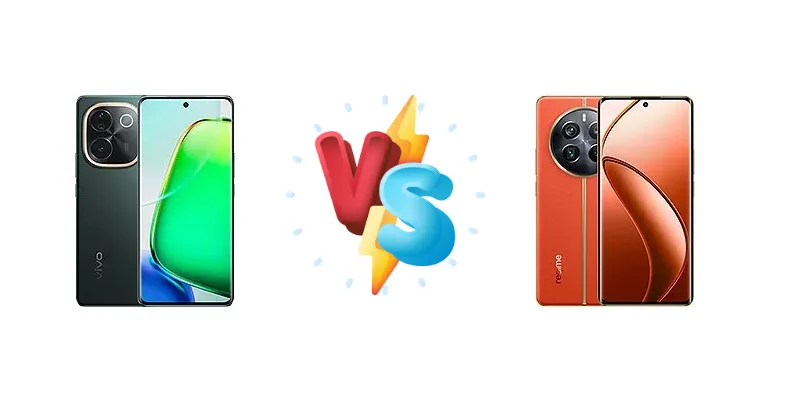
The mid-range smartphone market is fiercely competitive, and the vivo T3 Pro and Realme 12 Pro+ are two strong contenders vying for your attention. The T3 Pro brings the newer Snapdragon 7 Gen 3, while the 12 Pro+ focuses on a strong battery life and a bright display. This comparison dissects their key differences to help you choose the right device.
🏆 Quick Verdict
For most users, the vivo T3 Pro emerges as the stronger choice. Its Snapdragon 7 Gen 3 chipset offers a noticeable performance uplift over the Realme 12 Pro+'s Snapdragon 7s Gen 2, making it better suited for demanding tasks and gaming. While the Realme 12 Pro+ boasts excellent battery endurance, the T3 Pro’s faster 80W charging mitigates any significant disadvantage.
| Network |
|---|
| 2G bands | GSM 850 / 900 / 1800 / 1900 | GSM 850 / 900 / 1800 / 1900 |
| 3G bands | HSDPA 850 / 900 / 2100 | HSDPA 850 / 900 / 2100 |
| 4G bands | 1, 3, 5, 8, 28, 38, 40, 41 | 1, 3, 5, 8, 28, 40, 41 |
| 5G bands | 1, 3, 5, 8, 28, 40, 77, 78 SA/NSA | 1, 3, 5, 8, 28, 40, 41, 77, 78 SA/NSA |
| Speed | HSPA, LTE, 5G | HSPA, LTE, 5G |
| Technology | GSM / HSPA / LTE / 5G | GSM / HSPA / LTE / 5G |
| Launch |
|---|
| Announced | 2024, August 27 | 2024, January 29 |
| Status | Available. Released 2024, September 03 | Available. Released 2024, January 29 |
| Body |
|---|
| Dimensions | 163.7 x 75 x 7.5 or 8.0 mm | 161.5 x 74 x 8.8 mm (6.36 x 2.91 x 0.35 in) |
| SIM | Nano-SIM + Nano-SIM | Nano-SIM + Nano-SIM |
| Weight | 184 g or 190 g (6.49 oz) | 196 g (6.91 oz) |
| Display |
|---|
| Protection | Schott Xensation | - |
| Resolution | 1080 x 2392 pixels (~388 ppi density) | 1080 x 2412 pixels, 20:9 ratio (~394 ppi density) |
| Size | 6.77 inches, 110.9 cm2 (~90.3% screen-to-body ratio) | 6.7 inches, 108.0 cm2 (~90.4% screen-to-body ratio) |
| Type | AMOLED, 1B colors, 120Hz, 4500 nits (peak) | AMOLED, 1B colors, 120Hz, 800 nits (HBM), 950 nits (peak) |
| Platform |
|---|
| CPU | Octa-core (1x2.63 GHz Cortex-A715 & 3x2.4 GHz Cortex-A715 & 4x1.8 GHz Cortex-A510) | Octa-core (4x2.40 GHz Cortex-A78 & 4x1.95 GHz Cortex-A55) |
| Chipset | Qualcomm SM7550-AB Snapdragon 7 Gen 3 (4 nm) | Qualcomm SM7435-AB Snapdragon 7s Gen 2 (4 nm) |
| GPU | Adreno 720 | Adreno 710 |
| OS | Android 14, up to 2 major Android upgrades, Funtouch 14 | Android 14, Realme UI 5.0 |
| Memory |
|---|
| Card slot | No | No |
| Internal | 128GB 8GB RAM, 256GB 8GB RAM | 128GB 8GB RAM, 256GB 8GB RAM, 256GB 12GB RAM, 512GB 12GB RAM |
| Main Camera |
|---|
| Dual | 50 MP, f/1.8, (wide), 1/1.95", 0.8µm, PDAF, OIS
8 MP, f/2.2, 120˚ (ultrawide) | - |
| Features | LED flash, panorama, HDR | LED flash, HDR, panorama |
| Triple | - | 50 MP, f/1.8, 24mm (wide), 1/1.56", 1.0µm, multi-directional PDAF, OIS
64 MP, f/2.8, 71mm, (periscope telephoto), 1/2.0", 0.7µm, PDAF, OIS, 3x optical zoom
8 MP, f/2.2, 16mm, 112˚ (ultrawide), 1/4.0", 1.12µm |
| Video | 4K@30/60fps, 1080p, gyro-EIS, OIS | 4K@30fps, 1080p@30/60/120fps, gyro-EIS |
| Selfie camera |
|---|
| Single | 16 MP, f/2.5, (wide), 1/3.0", 1.0µm | 32 MP, f/2.4, 22mm (wide) |
| Video | 1080p@30fps | 1080p@30fps |
| Sound |
|---|
| 35mm jack | No | No |
| Loudspeaker | Yes, with stereo speakers | Yes, with stereo speakers |
| Comms |
|---|
| Bluetooth | 5.4, A2DP, LE | 5.2, A2DP, LE |
| NFC | No | Yes (market/region dependent) |
| Positioning | GPS, GALILEO, GLONASS, BDS, QZSS | GPS, GLONASS, GALILEO, BDS, QZSS |
| Radio | No | No |
| USB | USB Type-C 2.0, OTG | USB Type-C 2.0 |
| WLAN | Wi-Fi 802.11 a/b/g/n/ac, dual-band | Wi-Fi 802.11 a/b/g/n/ac/6, dual-band |
| Features |
|---|
| Sensors | Fingerprint (under display, optical), accelerometer, gyro, proximity, compass | Fingerprint (under display, optical), accelerometer, gyro, proximity, compass |
| Battery |
|---|
| Charging | 80W wired, 50% in 21 min
7.5W reverse wired | 67W wired, 50% in 19 min |
| Type | Li-Ion 5500 mAh | 5000 mAh |
| Misc |
|---|
| Colors | Sandstone Orange, Emerald Green | Submarine Blue, Navigator Beige, Explorer Red |
| Models | V2404 | RMX3840, RMX3841 |
| Price | ₹ 31,999 | $ 465.00 / £ 299.00 / € 344.26 / ₹ 28,400 |
vivo T3 Pro
- Faster Snapdragon 7 Gen 3 processor
- 80W fast charging for quicker top-ups
- Potentially better gaming performance
- Battery life details are currently unknown
- Camera specs are less emphasized in marketing
Realme 12 Pro+
- Excellent 13:24h battery life in active use
- Bright 802 nits display for outdoor visibility
- Potentially strong camera system (based on marketing)
- Slower Snapdragon 7s Gen 2 processor
- 67W charging is slower than the T3 Pro
Display Comparison
The Realme 12 Pro+ features a display capable of reaching 802 nits of peak brightness, providing excellent visibility in direct sunlight. While the vivo T3 Pro’s display specs aren’t provided, Realme’s brightness figure suggests a strong outdoor viewing experience. Both devices utilize 4nm chipsets, which contribute to improved power efficiency and potentially better display performance. However, without knowing the T3 Pro’s panel technology (LTPO, AMOLED) or refresh rate, it’s difficult to definitively declare a winner based on display quality alone.
Camera Comparison
Without detailed camera specifications beyond the presence of sensors, a direct comparison is limited. However, the Realme 12 Pro+ is marketed heavily on its camera capabilities, suggesting a focus on image quality and features. The absence of detailed camera specs for the T3 Pro implies a more balanced approach. Users prioritizing photography should investigate detailed camera reviews for both devices, focusing on image processing style and low-light performance. Ignoring the typical 2MP macro lens found on both devices, the main sensor and its accompanying optics will be the key differentiators.
Performance
The vivo T3 Pro’s Qualcomm Snapdragon 7 Gen 3 (4nm) represents a significant architectural leap over the Realme 12 Pro+'s Snapdragon 7s Gen 2 (4nm). The T3 Pro utilizes Cortex-A715 cores in its CPU configuration, offering a performance advantage over the 12 Pro+'s Cortex-A78 cores. This translates to faster app loading times, smoother multitasking, and improved gaming performance. The Snapdragon 7 Gen 3’s more modern GPU will also deliver a better graphical experience. While both chips are built on a 4nm process for efficiency, the architectural improvements in the 7 Gen 3 give the T3 Pro a clear edge.
Battery Life
The Realme 12 Pro+ shines with an active use battery score of 13:24h, indicating excellent endurance. The vivo T3 Pro, while lacking a specific battery life figure, compensates with significantly faster 80W wired charging, achieving 50% charge in just 21 minutes. The Realme 12 Pro+ takes 19 minutes to reach 50%, a marginal difference. This faster charging speed on the T3 Pro reduces the inconvenience of frequent charging, effectively mitigating any potential battery capacity disadvantage.
Buying Guide
Buy the vivo T3 Pro if you prioritize raw performance and faster charging speeds, especially if you're a mobile gamer or frequently use resource-intensive applications. Buy the Realme 12 Pro+ if maximizing battery life is your top concern, and you prefer a consistently bright display for outdoor visibility, even if it means sacrificing some processing power.
Frequently Asked Questions
❓ Will the Snapdragon 7 Gen 3 in the vivo T3 Pro handle demanding games like Genshin Impact at high settings?
The Snapdragon 7 Gen 3 is a capable chipset and should handle Genshin Impact at medium to high settings with playable frame rates. However, sustained performance will depend on the phone's thermal management. Expect some frame drops during extended gaming sessions, but overall, it offers a better gaming experience than the Snapdragon 7s Gen 2.
❓ How does the 80W charging on the vivo T3 Pro compare to other phones in this price range?
80W charging is relatively fast for the mid-range segment. Many competitors offer 67W or even 33W charging. The T3 Pro’s 80W charging will significantly reduce charging times, allowing you to quickly top up the battery when needed, even if the battery capacity is slightly smaller than the Realme 12 Pro+.
❓ Is the Realme 12 Pro+'s camera system particularly strong in low-light conditions?
Realme has been heavily marketing the 12 Pro+'s camera, and it likely features optimizations for low-light photography. However, without detailed sensor information and image samples, it's difficult to assess its true low-light performance. Look for independent reviews that specifically test the camera in challenging lighting conditions.