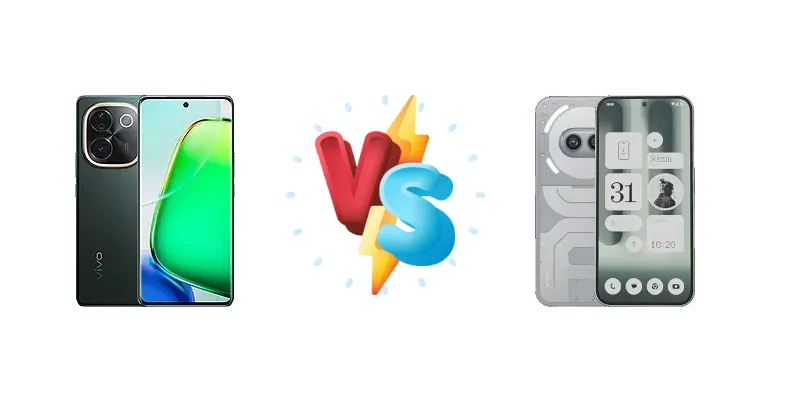
The mid-range smartphone market is fiercely competitive, and the vivo T3 Pro and Nothing Phone (2a) Plus represent compelling options. The T3 Pro aims to deliver strong performance with Qualcomm's Snapdragon 7 Gen 3, while the Nothing Phone (2a) Plus focuses on a balanced experience with the MediaTek Dimensity 7350 Pro and a bright display. This comparison dissects their key differences to determine which device best suits your needs.
🏆 Quick Verdict
For users prioritizing raw processing power and faster charging, the vivo T3 Pro emerges as the winner. Its Snapdragon 7 Gen 3 chipset offers a slight edge in performance, and the 80W charging is significantly faster. However, the Nothing Phone (2a) Plus counters with excellent battery life and a brighter display, making it ideal for media consumption.
| Network |
|---|
| 2G bands | GSM 850 / 900 / 1800 / 1900 | GSM 850 / 900 / 1800 / 1900 |
| 3G bands | HSDPA 850 / 900 / 2100 | HSDPA 800 / 850 / 900 / 1700(AWS) / 1900 / 2100 |
| 4G bands | 1, 3, 5, 8, 28, 38, 40, 41 | 1, 3, 4, 5, 7, 8, 18, 19, 20, 26, 28, 38, 39, 40, 41, 42, 66 |
| 5G bands | 1, 3, 5, 8, 28, 40, 77, 78 SA/NSA | 1, 3, 5, 7, 8, 20, 28, 38, 40, 41, 66, 77, 78 SA/NSA |
| Speed | HSPA, LTE, 5G | HSPA, LTE, 5G |
| Technology | GSM / HSPA / LTE / 5G | GSM / HSPA / LTE / 5G |
| Launch |
|---|
| Announced | 2024, August 27 | 2024, July 31 |
| Status | Available. Released 2024, September 03 | Available. Released 2024, August 03 |
| Body |
|---|
| Build | - | Glass front (Gorilla Glass 5), plastic frame, plastic back |
| Dimensions | 163.7 x 75 x 7.5 or 8.0 mm | 161.7 x 76.3 x 8.5 mm (6.37 x 3.00 x 0.33 in) |
| SIM | Nano-SIM + Nano-SIM | Nano-SIM + Nano-SIM |
| Weight | 184 g or 190 g (6.49 oz) | 190 g (6.70 oz) |
| Display |
|---|
| Protection | Schott Xensation | Corning Gorilla Glass 5 |
| Resolution | 1080 x 2392 pixels (~388 ppi density) | 1080 x 2412 pixels, 20:9 ratio (~395 ppi density) |
| Size | 6.77 inches, 110.9 cm2 (~90.3% screen-to-body ratio) | 6.7 inches, 107.5 cm2 (~87.1% screen-to-body ratio) |
| Type | AMOLED, 1B colors, 120Hz, 4500 nits (peak) | AMOLED, 1B colors, 120Hz, 2160Hz PWM, HDR10+, 700 nits (typ), 1100 nits (HBM), 1300 nits (peak) |
| Platform |
|---|
| CPU | Octa-core (1x2.63 GHz Cortex-A715 & 3x2.4 GHz Cortex-A715 & 4x1.8 GHz Cortex-A510) | Octa-core (2x3.0 GHz Cortex-A715 & 6x 2.0 GHz Cortex-A510) |
| Chipset | Qualcomm SM7550-AB Snapdragon 7 Gen 3 (4 nm) | Mediatek Dimensity 7350 Pro (4 nm) |
| GPU | Adreno 720 | Mali-G610 MC4 |
| OS | Android 14, up to 2 major Android upgrades, Funtouch 14 | Android 14, up to 3 major Android upgrades, Nothing OS 3.0 |
| Memory |
|---|
| Card slot | No | No |
| Internal | 128GB 8GB RAM, 256GB 8GB RAM | 256GB 8GB RAM, 256GB 12GB RAM |
| Main Camera |
|---|
| Dual | 50 MP, f/1.8, (wide), 1/1.95", 0.8µm, PDAF, OIS
8 MP, f/2.2, 120˚ (ultrawide) | 50 MP, f/1.9, 24mm (wide), 1/1.57", 1.0µm, PDAF, OIS
50 MP, f/2.2, 114˚ (ultrawide), 1/2.76", 0.64µm |
| Features | LED flash, panorama, HDR | LED flash, panorama, HDR |
| Video | 4K@30/60fps, 1080p, gyro-EIS, OIS | 4K@30fps, 1080p@60/120fps, gyro-EIS |
| Selfie camera |
|---|
| Features | - | HDR |
| Single | 16 MP, f/2.5, (wide), 1/3.0", 1.0µm | 50 MP, f/2.2, (wide), 1/2.76" |
| Video | 1080p@30fps | 4K@30fps |
| Sound |
|---|
| 35mm jack | No | No |
| Loudspeaker | Yes, with stereo speakers | Yes, with stereo speakers |
| Comms |
|---|
| Bluetooth | 5.4, A2DP, LE | 5.3, A2DP, LE |
| NFC | No | Yes, 360˚ |
| Positioning | GPS, GALILEO, GLONASS, BDS, QZSS | GPS, GALILEO, GLONASS, BDS, QZSS |
| Radio | No | No |
| USB | USB Type-C 2.0, OTG | USB Type-C 2.0, OTG |
| WLAN | Wi-Fi 802.11 a/b/g/n/ac, dual-band | Wi-Fi 802.11 a/b/g/n/ac/6, dual-band, Wi-Fi Direct |
| Features |
|---|
| Sensors | Fingerprint (under display, optical), accelerometer, gyro, proximity, compass | Fingerprint (under display, optical), accelerometer, gyro, proximity, compass |
| Battery |
|---|
| Charging | 80W wired, 50% in 21 min
7.5W reverse wired | 50W wired, 50% in 21 min, 100% in 56 min |
| Type | Li-Ion 5500 mAh | 5000 mAh |
| Misc |
|---|
| Colors | Sandstone Orange, Emerald Green | Black, Grey |
| Models | V2404 | A142P |
| Price | ₹ 31,999 | € 269.90 / ₹ 22,599 |
vivo T3 Pro
- Faster 80W charging
- Potentially better gaming performance with Snapdragon 7 Gen 3
- Stronger multi-core performance due to core configuration
- Likely lower peak display brightness
- Battery life details are missing
Nothing Phone (2a) Plus
- Excellent 16:34 hour battery life
- Very bright 1097 nit display
- Clean software experience
- Slower 50W charging (full charge takes 56 minutes)
- Potentially weaker gaming performance
Display Comparison
The Nothing Phone (2a) Plus boasts a significantly brighter display, reaching a measured peak of 1097 nits. This is a substantial advantage for outdoor visibility compared to the vivo T3 Pro, whose brightness is not specified but is likely lower. While both utilize 4nm chipsets, the display’s brightness impacts battery drain; the Nothing Phone (2a) Plus’s brightness will consume more power. Panel technology details are missing for the T3 Pro, but the Nothing Phone (2a) Plus’s brightness and color accuracy will appeal to users who consume a lot of video content.
Camera Comparison
Camera specifications are limited, but the focus should be on the main sensors. Without detailed information on sensor size and aperture, it’s difficult to definitively declare a winner. However, the image processing style will likely differ; vivo typically favors vibrant, saturated colors, while Nothing aims for a more natural look. The absence of details on OIS (Optical Image Stabilization) is a significant omission for both devices, impacting low-light performance and video stabilization.
Performance
Both phones employ 4nm chipsets, but their architectures differ. The vivo T3 Pro’s Snapdragon 7 Gen 3 features a 1x2.63 GHz Cortex-A715 prime core, alongside 3x2.4 GHz Cortex-A715 cores and 4x1.8 GHz Cortex-A510 cores. The Nothing Phone (2a) Plus utilizes the Dimensity 7350 Pro with 2x3.0 GHz Cortex-A715 cores and 6x2.0 GHz Cortex-A510 cores. The Dimensity 7350 Pro’s higher clock speeds on its prime cores suggest a potential advantage in single-core tasks, while the Snapdragon 7 Gen 3’s core configuration may offer better multi-core performance. The Snapdragon’s Adreno GPU is generally considered superior for gaming compared to the Mali-G615 MP4 in the Dimensity 7350 Pro.
Battery Life
The Nothing Phone (2a) Plus shines in battery life, achieving an active use score of 16:34 hours. While the vivo T3 Pro’s battery capacity is not specified, its 80W wired charging is a major advantage, reaching 50% charge in just 21 minutes. The Nothing Phone (2a) Plus also reaches 50% in 21 minutes, but takes a full 56 minutes for a complete charge. This faster charging speed on the T3 Pro is crucial for users who need to quickly top up their battery.
Buying Guide
Buy the vivo T3 Pro if you need a phone for demanding tasks like mobile gaming or video editing, and value quick charging speeds. Its Snapdragon 7 Gen 3 provides a performance boost for power users. Buy the Nothing Phone (2a) Plus if you prioritize all-day battery life, a vibrant display for media consumption, and a clean software experience. It’s the better choice for everyday users who don’t push their phones to the limit.
Frequently Asked Questions
❓ Does the Snapdragon 7 Gen 3 in the vivo T3 Pro throttle under sustained gaming loads?
While the Snapdragon 7 Gen 3 is a capable chipset, throttling is always a possibility with mid-range phones. The 4nm process helps mitigate this, but prolonged gaming sessions at maximum settings may lead to some performance reduction. Detailed thermal testing is needed to confirm the extent of throttling.
❓ How does the Dimensity 7350 Pro's Mali-G615 MP4 GPU compare to the Snapdragon 7 Gen 3's Adreno GPU for graphically intensive games?
Generally, Qualcomm's Adreno GPUs outperform Mali GPUs in the same price bracket. The Adreno GPU in the Snapdragon 7 Gen 3 is expected to deliver higher frame rates and smoother gameplay in demanding titles compared to the Mali-G615 MP4 in the Nothing Phone (2a) Plus. However, software optimization plays a crucial role.
❓ Is the 50W charging on the Nothing Phone (2a) Plus slow compared to the 80W on the vivo T3 Pro?
While 50W is slower than 80W, both phones reach 50% charge in the same 21 minutes. The significant difference lies in the full charge time: 56 minutes for the Nothing Phone (2a) Plus versus an unspecified but likely shorter time for the T3 Pro. For users who frequently need a full charge quickly, the T3 Pro’s 80W charging is a clear advantage.