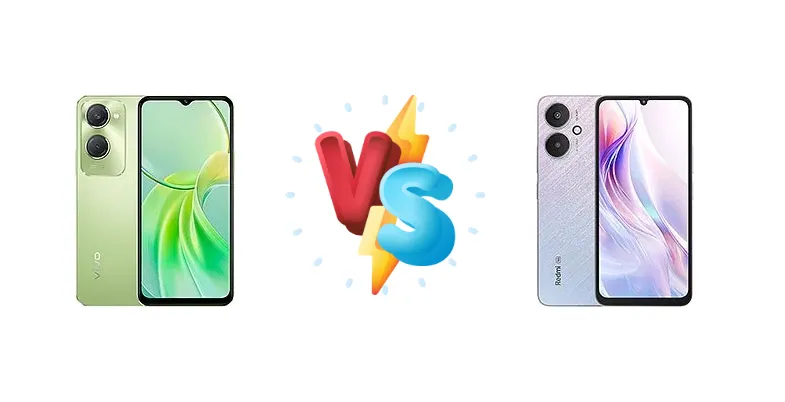
The sub-$200 5G smartphone market is fiercely competitive. Both the vivo T3 Lite and Xiaomi Redmi 13C 5G aim to deliver 5G connectivity and a smooth user experience without breaking the bank. This comparison dissects their key specifications, focusing on the nuances of their Mediatek Dimensity chipsets and charging capabilities to determine which device offers the best value.
🏆 Quick Verdict
For most users, the vivo T3 Lite emerges as the slightly stronger choice. Its Mediatek Dimensity 6300 chipset, with its higher clocked Cortex-A76 cores, provides a noticeable performance edge in demanding tasks. While the Redmi 13C 5G counters with 18W charging and PD support, the T3 Lite’s overall processing power makes it the better all-rounder.
| Network |
|---|
| 2G bands | GSM 850 / 900 / 1800 / 1900 | GSM 850 / 900 / 1800 / 1900 |
| 3G bands | HSDPA 850 / 900 / 2100 | HSDPA 800 / 850 / 900 / 1700(AWS) / 1900 / 2100 - International |
| 4G bands | 1, 3, 5, 8, 28, 38, 40, 41 | 1, 2, 3, 4, 5, 7, 8, 12, 13, 17, 18, 19, 20, 26, 28, 32, 38, 40, 41, 66 - International |
| 5G bands | 1, 3, 5, 8, 28, 40, 77, 78 SA/NSA | 1, 3, 5, 7, 8, 20, 28, 38, 40, 41, 66, 77, 78 SA/NSA - International |
| Speed | HSPA, LTE, 5G | HSPA, LTE, 5G |
| Technology | GSM / HSPA / LTE / 5G | GSM / HSPA / LTE / 5G |
| Launch |
|---|
| Announced | 2024, June 27 | 2023, December 06 |
| Status | Available. Released 2024, July 04 | Available. Released 2023, December 16 |
| Body |
|---|
| Build | Glass front, plastic frame, plastic back | Glass front (Gorilla Glass 3), plastic frame, plastic back |
| Dimensions | 163.6 x 75.6 x 8.4 mm (6.44 x 2.98 x 0.33 in) | 168.1 x 77.9 x 8.2 mm (6.62 x 3.07 x 0.32 in) |
| SIM | Nano-SIM + Nano-SIM | Nano-SIM + Nano-SIM |
| Weight | 185 g (6.53 oz) | 192 g or 195 g (6.77 oz) |
| Display |
|---|
| Protection | - | Corning Gorilla Glass 3 |
| Resolution | 720 x 1612 pixels, 20:9 ratio (~269 ppi density) | 720 x 1600 pixels, 20:9 ratio (~260 ppi density) |
| Size | 6.56 inches, 103.4 cm2 (~83.6% screen-to-body ratio) | 6.74 inches, 109.7 cm2 (~83.8% screen-to-body ratio) |
| Type | IPS LCD, 90Hz, 840 nits (HBM) | IPS LCD, 90Hz, 450 nits (typ), 600 nits (HBM) |
| Platform |
|---|
| CPU | Octa-core (2x2.4 GHz Cortex-A76 & 6x2.0 GHz Cortex-A55) | Octa-core (2x2.2 GHz Cortex-A76 & 6x2.0 GHz Cortex-A55) |
| Chipset | Mediatek Dimensity 6300 (6 nm) | Mediatek Dimensity 6100+ (6 nm) |
| GPU | Mali-G57 MC2 | Mali-G57 MC2 |
| OS | Android 14, Funtouch 14 | Android 13, MIUI 14 |
| Memory |
|---|
| Card slot | microSDXC (uses shared SIM slot) | microSDXC (dedicated slot) |
| Internal | 128GB 4GB RAM, 128GB 6GB RAM | 64GB 4GB RAM, 128GB 4GB RAM, 128GB 6GB RAM, 256GB 8GB RAM |
| Main Camera |
|---|
| Dual | 50 MP, f/1.8, (wide), PDAF
Auxiliary lens | - |
| Features | LED flash, panorama | LED flash, HDR |
| Single | - | 50 MP, f/1.8, 28mm (wide), 1/2.76", 1.12µm, PDAF
Auxiliary lens |
| Video | 1080p@30fps | 1080p@30fps |
| Selfie camera |
|---|
| Features | - | HDR |
| Single | 8 MP, f/2.0, (wide) | 5 MP, f/2.2, (wide) |
| Video | 1080p@30fps | 1080p@30fps |
| Sound |
|---|
| 35mm jack | Yes | Yes |
| Loudspeaker | Yes | Yes |
| Comms |
|---|
| Bluetooth | 5.4, A2DP, LE | 5.3, A2DP, LE |
| NFC | No | Yes (market/region dependent) |
| Positioning | GPS, GALILEO, GLONASS, BDS, QZSS | GPS, GLONASS, GALILEO, BDS |
| Radio | FM radio | FM radio |
| USB | USB Type-C 2.0, OTG | USB Type-C 2.0, OTG |
| WLAN | Wi-Fi 802.11 a/b/g/n/ac, dual-band | Wi-Fi 802.11 a/b/g/n/ac, dual-band |
| Features |
|---|
| Sensors | Fingerprint (side-mounted), accelerometer, proximity, compass | Fingerprint (side-mounted), accelerometer, compass |
| Battery |
|---|
| Charging | 15W wired
Reverse wired | 18W wired, PD |
| Type | Li-Ion 5000 mAh | 5000 mAh |
| Misc |
|---|
| Colors | Vibrant Green, Majestic Black | Starry Black, Twilight Blue, Starry Silver, Starlight Black, Startrail Green, Startrail Silver |
| Models | V2356 | 23124RN87G, 23124RN87I, 23124RN87C |
| Price | About 120 EUR | $ 198.99 / £ 119.00 / € 116.99 / ₹ 10,895 |
| SAR | 0.99 W/kg (head) 0.74 W/kg (body) | 1.09 W/kg (head) 1.09 W/kg (body) |
| SAR EU | - | 0.98 W/kg (head) 0.98 W/kg (body) |
vivo T3 Lite
- Faster CPU performance due to higher clocked cores
- Potentially better image processing with Dimensity 6300 ISP
- Reverse wired charging for accessory top-ups
- Slower charging speed (15W)
- Lacks Power Delivery (PD) support
Xiaomi Redmi 13C 5G
- Faster 18W charging with Power Delivery (PD)
- Likely larger display size for media consumption
- Potentially more affordable pricing
- Slightly slower CPU performance
- Image processing may be less refined
Display Comparison
Neither device boasts a standout display. Both likely utilize LCD panels, common in this price bracket. The focus here is on efficiency rather than visual fidelity. Without specific brightness or color gamut data, it’s difficult to declare a clear winner. However, the Redmi 13C 5G’s larger screen size (typically found in this series) might appeal to users who consume more video content, though this comes at the cost of potentially lower pixel density.
Camera Comparison
Without detailed camera specs, a direct comparison is challenging. Both phones likely feature a primary camera alongside depth and macro sensors (the latter often being of limited utility). The Redmi 13C 5G has historically focused on larger megapixel counts, but sensor size and image processing algorithms are more crucial than megapixels alone. The Dimensity 6300’s ISP (Image Signal Processor) might offer slightly better image processing capabilities, but this is speculative without further data. Expect both phones to perform adequately in well-lit conditions, but struggle in low-light scenarios.
Performance
The core difference lies in the chipsets. The vivo T3 Lite’s Mediatek Dimensity 6300 features two Cortex-A76 cores clocked at 2.4 GHz, compared to the Redmi 13C 5G’s Dimensity 6100+ with 2.2 GHz Cortex-A76 cores. This 200 MHz clock speed difference, while seemingly small, translates to a tangible performance boost in CPU-bound tasks. Both chips utilize the same Cortex-A55 efficiency cores at 2.0 GHz. The Dimensity 6300’s 6nm process node is identical to the 6100+, meaning thermal efficiency should be comparable, but the higher clock speeds could lead to slightly more heat generation under sustained load. Both devices will likely pair the chipsets with 8GB of RAM, ensuring adequate multitasking capabilities.
Battery Life
The Xiaomi Redmi 13C 5G has a clear advantage in charging with its 18W wired charging and Power Delivery (PD) support. PD allows for faster charging with compatible chargers and the ability to charge other devices. The vivo T3 Lite is limited to 15W wired charging and offers reverse wired charging, a useful feature for topping up accessories. Battery capacity is not specified, but both devices likely house batteries in the 5000mAh range. The Redmi 13C 5G’s faster charging will result in significantly quicker top-up times, a benefit for users who frequently find themselves with low battery levels.
Buying Guide
Buy the vivo T3 Lite if you prioritize responsiveness and smoother multitasking, especially if you occasionally engage in mobile gaming or resource-intensive applications. Buy the Xiaomi Redmi 13C 5G if faster charging is a critical requirement and you primarily use your phone for basic tasks like social media, calls, and light browsing. The Redmi 13C 5G’s PD support also adds versatility for charging other devices.
Frequently Asked Questions
❓ Will the Dimensity 6300 in the vivo T3 Lite handle demanding games like PUBG Mobile smoothly?
The Dimensity 6300 is capable of running PUBG Mobile, but you'll likely need to lower graphics settings to achieve consistently smooth frame rates. The higher clocked CPU cores provide an advantage over the Dimensity 6100+, but it's still a budget chipset. Expect playable performance at medium settings.
❓ Does the Redmi 13C 5G’s 18W charging with PD mean I can use any USB-C charger to fast charge it?
Yes, the Power Delivery (PD) support on the Redmi 13C 5G means it will negotiate the fastest possible charging speed with any USB-C PD charger. However, to achieve the full 18W, you'll need a charger that specifically supports the PD protocol.
❓ Is the reverse wired charging on the vivo T3 Lite useful for charging accessories like earbuds?
Yes, the reverse wired charging feature allows you to use the vivo T3 Lite as a power bank for smaller accessories like wireless earbuds or smartwatches. While the charging speed won't be incredibly fast, it's a convenient feature to have in a pinch.