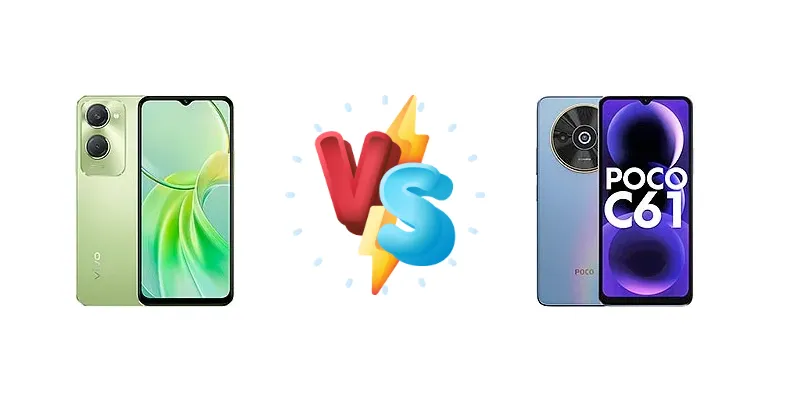
The sub-$200 smartphone market is fiercely competitive. The vivo T3 Lite and Xiaomi Poco C61 both aim to deliver essential smartphone functionality at an accessible price point, but they take different approaches. The T3 Lite leverages a newer, more efficient chipset, while the Poco C61 opts for a more established, albeit less powerful, processor. This comparison will dissect their key differences to help you choose the right device.
🏆 Quick Verdict
For most users, the vivo T3 Lite emerges as the better choice. Its Mediatek Dimensity 6300 chipset, built on a 6nm process, provides a significant performance advantage over the Poco C61’s 12nm Helio G36, translating to smoother multitasking and a more responsive user experience. While the Poco C61 is cheaper, the T3 Lite’s efficiency and performance justify the slight price premium.
| Network |
|---|
| 2G bands | GSM 850 / 900 / 1800 / 1900 | GSM 850 / 900 / 1800 / 1900 |
| 3G bands | HSDPA 850 / 900 / 2100 | HSDPA 850 / 900 / 2100 |
| 4G bands | 1, 3, 5, 8, 28, 38, 40, 41 | 1, 3, 5, 8, 28, 40, 41 |
| 5G bands | 1, 3, 5, 8, 28, 40, 77, 78 SA/NSA | - |
| Speed | HSPA, LTE, 5G | HSPA, LTE |
| Technology | GSM / HSPA / LTE / 5G | GSM / HSPA / LTE |
| Launch |
|---|
| Announced | 2024, June 27 | 2024, March 26 |
| Status | Available. Released 2024, July 04 | Available. Released 2024, March 28 |
| Body |
|---|
| Build | Glass front, plastic frame, plastic back | - |
| Dimensions | 163.6 x 75.6 x 8.4 mm (6.44 x 2.98 x 0.33 in) | 168.4 x 76.3 x 8.3 mm (6.63 x 3.00 x 0.33 in) |
| SIM | Nano-SIM + Nano-SIM | Nano-SIM + Nano-SIM |
| Weight | 185 g (6.53 oz) | 199 g (7.05 oz) |
| Display |
|---|
| Protection | - | Corning Gorilla Glass 3 |
| Resolution | 720 x 1612 pixels, 20:9 ratio (~269 ppi density) | 720 x 1650 pixels (~268 ppi density) |
| Size | 6.56 inches, 103.4 cm2 (~83.6% screen-to-body ratio) | 6.71 inches, 106.5 cm2 (~82.9% screen-to-body ratio) |
| Type | IPS LCD, 90Hz, 840 nits (HBM) | IPS LCD, 90Hz, 500 nits |
| Platform |
|---|
| CPU | Octa-core (2x2.4 GHz Cortex-A76 & 6x2.0 GHz Cortex-A55) | Octa-core (4x2.2 GHz Cortex-A53 & 4x1.6 GHz Cortex-A53) |
| Chipset | Mediatek Dimensity 6300 (6 nm) | Mediatek Helio G36 (12 nm) |
| GPU | Mali-G57 MC2 | PowerVR GE8320 |
| OS | Android 14, Funtouch 14 | Android 14, MIUI |
| Memory |
|---|
| Card slot | microSDXC (uses shared SIM slot) | microSDXC (dedicated slot) |
| Internal | 128GB 4GB RAM, 128GB 6GB RAM | 64GB 3GB RAM, 64GB 4GB RAM, 128GB 4GB RAM, 128GB 6GB RAM |
| Main Camera |
|---|
| Dual | 50 MP, f/1.8, (wide), PDAF
Auxiliary lens | - |
| Features | LED flash, panorama | Dual-LED flash, HDR |
| Single | - | 8 MP, f/2.0, (wide)
Auxiliary lens |
| Video | 1080p@30fps | 1080p@30fps |
| Selfie camera |
|---|
| Single | 8 MP, f/2.0, (wide) | 5 MP |
| Video | 1080p@30fps | 1080p@30fps |
| Sound |
|---|
| 35mm jack | Yes | Yes |
| Loudspeaker | Yes | Yes |
| Comms |
|---|
| Bluetooth | 5.4, A2DP, LE | 5.4, A2DP, LE |
| NFC | No | No |
| Positioning | GPS, GALILEO, GLONASS, BDS, QZSS | GPS, GLONASS, GALILEO, BDS |
| Radio | FM radio | FM radio, recording |
| USB | USB Type-C 2.0, OTG | USB Type-C 2.0, OTG |
| WLAN | Wi-Fi 802.11 a/b/g/n/ac, dual-band | Wi-Fi 802.11 a/b/g/n/ac |
| Features |
|---|
| Sensors | Fingerprint (side-mounted), accelerometer, proximity, compass | Fingerprint (side-mounted), accelerometer, compass |
| Battery |
|---|
| Charging | 15W wired
Reverse wired | 10W wired |
| Type | Li-Ion 5000 mAh | Li-Po 5000 mAh |
| Misc |
|---|
| Colors | Vibrant Green, Majestic Black | Black, Blue, Green |
| Models | V2356 | 2312BPC51H, 2312BPC51X |
| Price | About 120 EUR | ₹ 6,819 |
| SAR | 0.99 W/kg (head) 0.74 W/kg (body) | 0.84 W/kg (head) 0.77 W/kg (body) |
vivo T3 Lite
- Superior performance with the Dimensity 6300 chipset
- More efficient 6nm process for longer battery life
- Faster 15W charging
- Likely smoother multitasking experience
- Potentially slightly higher price
- May not have significant camera improvements over the Poco C61
Xiaomi Poco C61
- Lower price point
- Adequate for basic smartphone tasks
- Likely similar battery capacity to the T3 Lite
- Familiar Xiaomi MIUI software experience
- Significantly weaker performance with the Helio G36
- Slower 10W charging
- Less efficient 12nm process
- Potential for lag and stuttering with demanding apps
Display Comparison
Neither device boasts a standout display. Given the context data focuses on processing power, we can infer both likely utilize LCD panels, common in this price bracket. The absence of specifications like resolution or refresh rate suggests both are targeting the baseline for affordability. Bezels are likely to be substantial on both, prioritizing cost reduction over premium aesthetics. Color accuracy will likely be standard for the segment, leaning towards warmer tones for wider appeal.
Camera Comparison
Without detailed camera specifications, it’s safe to assume both phones feature basic camera setups geared towards casual photography. The absence of information regarding sensor size or optical image stabilization (OIS) suggests both rely on software processing to enhance image quality. The inclusion of a 2MP macro camera on either device is likely a marketing tactic, offering limited practical benefit due to the small sensor size and low resolution. Image processing will likely differ, with vivo often favoring brighter, more saturated images, while Xiaomi tends towards a more natural look.
Performance
The core difference lies in the chipsets. The vivo T3 Lite’s Mediatek Dimensity 6300 (6nm) is a clear upgrade over the Poco C61’s Helio G36 (12nm). The 6nm fabrication process inherently offers better power efficiency and thermal performance. The Dimensity 6300’s CPU configuration – 2x2.4 GHz Cortex-A76 & 6x2.0 GHz Cortex-A55 – is architecturally superior to the Poco C61’s 4x2.2 GHz Cortex-A53 & 4x1.6 GHz Cortex-A53. The Cortex-A76 cores in the T3 Lite provide a substantial boost in single-core performance, crucial for app launch speeds and general responsiveness. The Helio G36, while capable, will struggle with demanding tasks and multitasking. The T3 Lite will offer a noticeably smoother experience.
Battery Life
The battery capacity isn’t specified for either device, but given the price point, we can estimate both likely house around a 5000mAh battery. However, the charging speeds differ significantly. The vivo T3 Lite supports 15W wired charging, while the Poco C61 is limited to 10W. This translates to a faster 0-100% charge time for the T3 Lite. More importantly, the Dimensity 6300’s superior power efficiency will likely result in longer battery life for the T3 Lite, even with a similar capacity battery, as it consumes less power during everyday use.
Buying Guide
Buy the vivo T3 Lite if you prioritize a smoother, more responsive user experience, especially if you engage in moderate multitasking or light gaming. The Dimensity 6300’s architecture offers a noticeable step up in performance. Buy the Xiaomi Poco C61 if your primary needs are basic communication – calls, texts, and light social media – and you are on an extremely tight budget. The Poco C61 will handle these tasks adequately, but expect compromises in speed and responsiveness.
Frequently Asked Questions
❓ Will the Poco C61 struggle with popular apps like Facebook or WhatsApp?
While the Poco C61 can run these apps, the Helio G36’s limited processing power may result in slower loading times and occasional lag, especially when multitasking. The vivo T3 Lite’s Dimensity 6300 will provide a much smoother experience with these and other commonly used applications.
❓ Is the 15W charging on the vivo T3 Lite a significant improvement over the Poco C61’s 10W charging?
Yes, 15W charging is noticeably faster than 10W. While neither is exceptionally fast by modern standards, the T3 Lite will replenish its battery approximately 30-40% quicker, reducing downtime and keeping you connected for longer.
❓ Can either of these phones handle mobile gaming?
The Poco C61 is only suitable for very light gaming at low settings. The Helio G36 will struggle with most modern titles. The vivo T3 Lite, with its Dimensity 6300, can handle less demanding games at medium settings, but don’t expect a high-framerate experience in graphically intensive games.