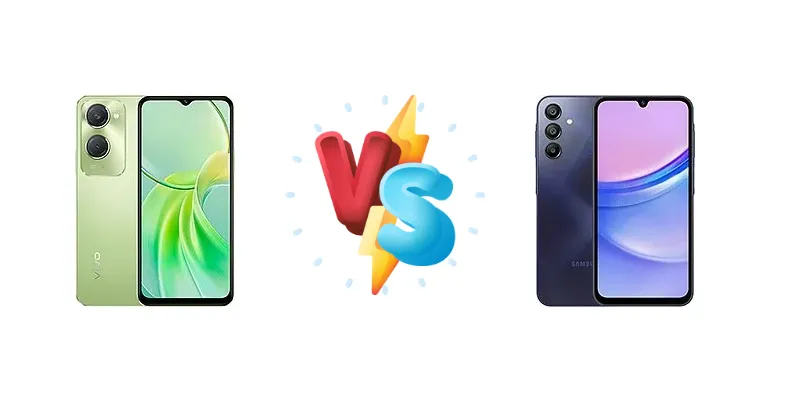
The sub-$200 smartphone market is fiercely competitive. The vivo T3 Lite and Samsung Galaxy A15 both aim to deliver essential features at an accessible price point, but they take different approaches. The T3 Lite prioritizes a newer chipset, while the A15 focuses on maximizing battery life and display visibility. This comparison dissects their strengths and weaknesses to determine which device offers the best value.
🏆 Quick Verdict
For the average user prioritizing longevity and a brighter viewing experience, the Samsung Galaxy A15 is the better choice. Its significantly longer battery life (15:28h active use) and 808 nits peak brightness outweigh the T3 Lite’s slightly newer processor. However, the T3 Lite offers a compelling alternative for those seeking a more modern chipset.
| Network |
|---|
| 2G bands | GSM 850 / 900 / 1800 / 1900 | GSM 850 / 900 / 1800 / 1900 |
| 3G bands | HSDPA 850 / 900 / 2100 | HSDPA 850 / 900 / 2100 |
| 4G bands | 1, 3, 5, 8, 28, 38, 40, 41 | 1, 3, 5, 7, 8, 20, 28, 38, 40, 41 |
| 5G bands | 1, 3, 5, 8, 28, 40, 77, 78 SA/NSA | - |
| Speed | HSPA, LTE, 5G | HSPA, LTE |
| Technology | GSM / HSPA / LTE / 5G | GSM / HSPA / LTE |
| Launch |
|---|
| Announced | 2024, June 27 | 2023, December 11 |
| Status | Available. Released 2024, July 04 | Available. Released 2023, December 16 |
| Body |
|---|
| Build | Glass front, plastic frame, plastic back | Glass front, plastic back, plastic frame |
| Dimensions | 163.6 x 75.6 x 8.4 mm (6.44 x 2.98 x 0.33 in) | 160.1 x 76.8 x 8.4 mm (6.30 x 3.02 x 0.33 in) |
| SIM | Nano-SIM + Nano-SIM | · Nano-SIM· Nano-SIM + Nano-SIM |
| Weight | 185 g (6.53 oz) | 200 g (7.05 oz) |
| Display |
|---|
| Resolution | 720 x 1612 pixels, 20:9 ratio (~269 ppi density) | 1080 x 2340 pixels, 19.5:9 ratio (~396 ppi density) |
| Size | 6.56 inches, 103.4 cm2 (~83.6% screen-to-body ratio) | 6.5 inches, 103.7 cm2 (~84.3% screen-to-body ratio) |
| Type | IPS LCD, 90Hz, 840 nits (HBM) | Super AMOLED, 90Hz, 800 nits (HBM) |
| Platform |
|---|
| CPU | Octa-core (2x2.4 GHz Cortex-A76 & 6x2.0 GHz Cortex-A55) | Octa-core (2x2.2 GHz Cortex-A76 & 6x2.0 GHz Cortex-A55) |
| Chipset | Mediatek Dimensity 6300 (6 nm) | Mediatek Helio G99 (6 nm) |
| GPU | Mali-G57 MC2 | Mali-G57 MC2 |
| OS | Android 14, Funtouch 14 | Android 14, up to 4 major Android upgrades, One UI 7 |
| Memory |
|---|
| Card slot | microSDXC (uses shared SIM slot) | microSDXC (uses shared SIM slot) |
| Internal | 128GB 4GB RAM, 128GB 6GB RAM | 128GB 4GB RAM, 128GB 6GB RAM, 128GB 8GB RAM, 256GB 6GB RAM, 256GB 8GB RAM |
| Main Camera |
|---|
| Dual | 50 MP, f/1.8, (wide), PDAF
Auxiliary lens | - |
| Features | LED flash, panorama | LED flash, panorama, HDR |
| Triple | - | 50 MP, f/1.8, 26mm (wide), 1/2.8", 0.64µm, PDAF
5 MP, f/2.2, 17mm (ultrawide), 1/5.0", 1.12µm
2 MP (macro) |
| Video | 1080p@30fps | 1080p@30fps |
| Selfie camera |
|---|
| Single | 8 MP, f/2.0, (wide) | 13 MP, f/2.0, 26mm (wide), 1/3.06", 1.12µm |
| Video | 1080p@30fps | 1080p@30fps |
| Sound |
|---|
| 35mm jack | Yes | Yes |
| Loudspeaker | Yes | Yes |
| Comms |
|---|
| Bluetooth | 5.4, A2DP, LE | 5.3, A2DP, LE |
| NFC | No | Yes (market/region dependent) |
| Positioning | GPS, GALILEO, GLONASS, BDS, QZSS | GPS, GALILEO, GLONASS, BDS, QZSS |
| Radio | FM radio | FM radio (market/region dependent) |
| USB | USB Type-C 2.0, OTG | USB Type-C 2.0 |
| WLAN | Wi-Fi 802.11 a/b/g/n/ac, dual-band | Wi-Fi 802.11 a/b/g/n/ac, dual-band, Wi-Fi Direct |
| Features |
|---|
| Sensors | Fingerprint (side-mounted), accelerometer, proximity, compass | Fingerprint (side-mounted), accelerometer, compass |
| Battery |
|---|
| Charging | 15W wired
Reverse wired | 25W wired |
| Type | Li-Ion 5000 mAh | 5000 mAh |
| Misc |
|---|
| Colors | Vibrant Green, Majestic Black | Brave Black, Optimistic Blue, Magical Blue, Personality Yellow |
| Models | V2356 | SM-A155F, SM-A155F/DSN, SM-A155M, SM-A155M/DS, SM-A155P, SM-A155R |
| Price | About 120 EUR | € 168.99 / $ 125.00 / £ 113.00 |
| SAR | 0.99 W/kg (head) 0.74 W/kg (body) | - |
| SAR EU | - | 0.42 W/kg (head) 1.29 W/kg (body) |
vivo T3 Lite
- More recent Mediatek Dimensity 6300 chipset
- Potentially better long-term software support
- Reverse wired charging capability
- Slower 15W charging
- Likely lower peak display brightness
- Battery life is unknown and potentially shorter
Samsung Galaxy A15
- Excellent 15:28h active use battery life
- Bright 808 nits display for outdoor visibility
- Faster 25W wired charging
- Older Mediatek Helio G99 chipset
- Potentially less future-proof
- Samsung’s One UI can be resource intensive
Display Comparison
The Samsung Galaxy A15 boasts a clear advantage in display quality with a measured peak brightness of 808 nits. This is crucial for outdoor visibility, a common pain point in this price segment. While the vivo T3 Lite’s display specifications are not provided, it’s likely to fall short of this brightness level. Samsung’s panel technology, while not specified as AMOLED, generally delivers accurate colors and wide viewing angles. The lack of detailed display specs for the T3 Lite makes a direct comparison difficult, but the A15’s brightness is a significant win.
Camera Comparison
Without detailed camera specifications for either device, a definitive comparison is challenging. Both phones likely feature a primary camera paired with auxiliary lenses (often a depth or macro sensor). The absence of information regarding sensor size, aperture, or optical image stabilization (OIS) makes it difficult to assess image quality. Given Samsung’s generally strong image processing algorithms, the A15 likely delivers more consistent and pleasing results, especially in challenging lighting conditions. The T3 Lite’s newer chipset *could* offer improved image signal processing capabilities, but this is speculative without further data.
Performance
Both the vivo T3 Lite and Samsung Galaxy A15 utilize Mediatek chipsets fabricated on a 6nm process, indicating similar efficiency. However, the vivo T3 Lite’s Dimensity 6300 features a slightly higher clocked Cortex-A76 core (2.4 GHz vs 2.2 GHz on the Helio G99). While both CPUs have the same core configuration (2x A76 + 6x A55), the clock speed difference *could* translate to marginally faster performance in CPU-bound tasks. The Helio G99 in the A15 is a proven performer, but the Dimensity 6300 represents a newer architecture, potentially offering better software optimization and future-proofing. Neither chipset is designed for demanding gaming, but the T3 Lite might handle lighter titles slightly better.
Battery Life
The Samsung Galaxy A15 clearly wins in battery performance. The reported 15:28 hours of active use demonstrates excellent endurance. While the vivo T3 Lite’s battery capacity is unknown, the A15’s longevity is a significant advantage for users who rely heavily on their phones throughout the day. The A15 also supports 25W wired charging, considerably faster than the T3 Lite’s 15W charging. This translates to quicker top-ups, minimizing downtime. The faster charging speed of the A15 offsets any potential battery capacity difference.
Buying Guide
Buy the vivo T3 Lite if you need a phone with a more recent processor for potentially better long-term software support and slightly improved app loading times. Buy the Samsung Galaxy A15 if you prioritize all-day battery life, a brighter and more visible display in outdoor conditions, and the established Samsung ecosystem. The A15 is ideal for media consumption and users who don't heavily game.
Frequently Asked Questions
❓ Does the Mediatek Helio G99 in the Samsung Galaxy A15 struggle with multitasking?
The Helio G99 is a capable chipset for everyday tasks like browsing, social media, and light gaming. While it may exhibit some slowdowns with *heavy* multitasking (running many apps simultaneously), it generally provides a smooth experience for typical usage scenarios. Optimizing app usage and clearing background processes can further improve performance.
❓ Is the 15W charging on the vivo T3 Lite noticeably slower than the 25W charging on the Samsung Galaxy A15?
Yes, the difference in charging speed is significant. 25W charging will replenish the Galaxy A15’s battery much faster than the T3 Lite’s 15W charging. Expect a considerably longer time to reach 100% on the T3 Lite, potentially adding an hour or more to the charging cycle.
❓ Will either phone receive major Android updates beyond the initial release?
Software update support in this price segment is often limited. Samsung generally provides better software support than many other brands, potentially offering one major Android update and several years of security patches for the A15. The T3 Lite’s update schedule is less certain, but the newer Dimensity 6300 chipset *could* indicate a longer support lifespan.