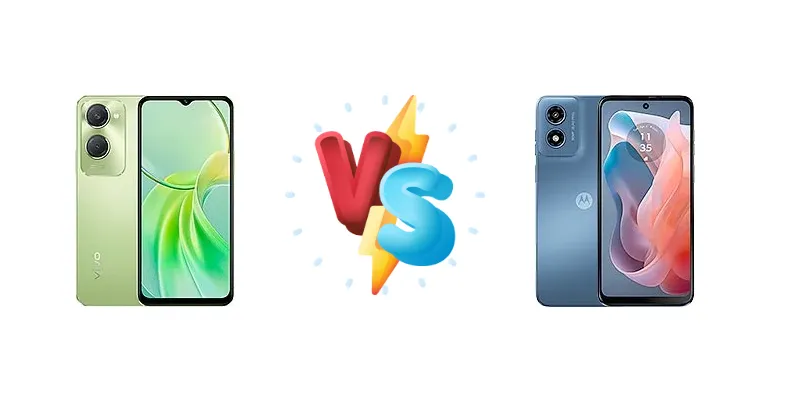
The sub-$200 smartphone market is fiercely competitive, and the vivo T3 Lite and Motorola Moto G Play (2024) are two contenders vying for your attention. Both aim to deliver essential smartphone functionality without breaking the bank, but they take different approaches to achieving this. The vivo leverages MediaTek's Dimensity 6300, while Motorola opts for the Qualcomm Snapdragon 680. This comparison dissects their key differences to help you choose the right device.
🏆 Quick Verdict
For most users, the vivo T3 Lite emerges as the stronger choice. Its Mediatek Dimensity 6300 chipset offers a noticeable performance edge over the Snapdragon 680 in the Moto G Play, translating to smoother multitasking and a more responsive user experience. While both offer similar 15W charging, the T3 Lite’s processor provides better future-proofing.
| Network |
|---|
| 2G bands | GSM 850 / 900 / 1800 / 1900 | GSM 850 / 900 / 1800 / 1900 |
| 3G bands | HSDPA 850 / 900 / 2100 | HSDPA 850 / 900 / 1700(AWS) / 1900 / 2100 |
| 4G bands | 1, 3, 5, 8, 28, 38, 40, 41 | 1, 2, 3, 4, 5, 7, 8, 12, 13, 17, 25, 26, 28, 38, 41, 66, 71 - USA |
| 5G bands | 1, 3, 5, 8, 28, 40, 77, 78 SA/NSA | - |
| Speed | HSPA, LTE, 5G | HSPA, LTE |
| Technology | GSM / HSPA / LTE / 5G | GSM / HSPA / LTE |
| Launch |
|---|
| Announced | 2024, June 27 | 2024, January 16 |
| Status | Available. Released 2024, July 04 | Available. Released 2024, January 26 |
| Body |
|---|
| Build | Glass front, plastic frame, plastic back | Glass front, plastic frame, plastic back |
| Dimensions | 163.6 x 75.6 x 8.4 mm (6.44 x 2.98 x 0.33 in) | 163.8 x 75 x 8.3 mm (6.45 x 2.95 x 0.33 in) |
| SIM | Nano-SIM + Nano-SIM | Nano-SIM |
| Weight | 185 g (6.53 oz) | 185 g (6.53 oz) |
| Display |
|---|
| Protection | - | Corning Gorilla Glass 3 |
| Resolution | 720 x 1612 pixels, 20:9 ratio (~269 ppi density) | 720 x 1600 pixels, 20:9 ratio (~270 ppi density) |
| Size | 6.56 inches, 103.4 cm2 (~83.6% screen-to-body ratio) | 6.5 inches, 102.0 cm2 (~83.0% screen-to-body ratio) |
| Type | IPS LCD, 90Hz, 840 nits (HBM) | IPS LCD, 90Hz, 500 nits (typ) |
| Platform |
|---|
| CPU | Octa-core (2x2.4 GHz Cortex-A76 & 6x2.0 GHz Cortex-A55) | Octa-core (4x2.4 GHz Kryo 265 Gold & 4x1.9 GHz Kryo 265 Silver) |
| Chipset | Mediatek Dimensity 6300 (6 nm) | Qualcomm SM6225 Snapdragon 680 4G (6 nm) |
| GPU | Mali-G57 MC2 | Adreno 610 |
| OS | Android 14, Funtouch 14 | Android 13, upgradable to Android 14 |
| Memory |
|---|
| Card slot | microSDXC (uses shared SIM slot) | microSDXC (dedicated slot) |
| Internal | 128GB 4GB RAM, 128GB 6GB RAM | 64GB 4GB RAM, 128GB 4GB RAM |
| Main Camera |
|---|
| Dual | 50 MP, f/1.8, (wide), PDAF
Auxiliary lens | - |
| Features | LED flash, panorama | LED flash, HDR, panorama |
| Single | - | 50 MP, f/1.8, (wide), 0.64µm, PDAF |
| Video | 1080p@30fps | 1080p@30fps |
| Selfie camera |
|---|
| Features | - | HDR |
| Single | 8 MP, f/2.0, (wide) | 8 MP, f/2.0, (wide), 1.12µm |
| Video | 1080p@30fps | 1080p@30fps |
| Sound |
|---|
| 35mm jack | Yes | Yes |
| Loudspeaker | Yes | Yes, with stereo speakers |
| Comms |
|---|
| Bluetooth | 5.4, A2DP, LE | 5.1, A2DP, LE |
| NFC | No | No |
| Positioning | GPS, GALILEO, GLONASS, BDS, QZSS | GPS, GALILEO, GLONASS |
| Radio | FM radio | No |
| USB | USB Type-C 2.0, OTG | USB Type-C 2.0 |
| WLAN | Wi-Fi 802.11 a/b/g/n/ac, dual-band | Wi-Fi 802.11 a/b/g/n/ac, dual-band |
| Features |
|---|
| Sensors | Fingerprint (side-mounted), accelerometer, proximity, compass | Fingerprint (side-mounted), accelerometer, proximity, compass, barometer |
| Battery |
|---|
| Charging | 15W wired
Reverse wired | 15W wired |
| Type | Li-Ion 5000 mAh | 5000 mAh |
| Misc |
|---|
| Colors | Vibrant Green, Majestic Black | Sapphire Blue |
| Models | V2356 | XT2413-1, XT2413 |
| Price | About 120 EUR | $ 55.00 |
| SAR | 0.99 W/kg (head) 0.74 W/kg (body) | - |
vivo T3 Lite
- Superior CPU performance with the Dimensity 6300
- Potentially better color accuracy and viewing angles
- More modern chipset architecture for future-proofing
- Software experience may be less clean than Motorola
- Limited information on display quality
Motorola Moto G Play (2024)
- Clean Android experience with minimal bloatware
- Established brand reputation for software updates
- Reliable and predictable performance for basic tasks
- Inferior CPU performance compared to the Dimensity 6300
- Potentially lower display quality
- Less future-proofing due to older chipset
Display Comparison
Neither device boasts a standout display. Both are likely to feature LCD panels, typical for this price bracket. The absence of detailed display specs necessitates relying on brand tendencies; Motorola often prioritizes affordability over display quality, while vivo sometimes includes slightly better panels. The real difference will likely be in color calibration and viewing angles, areas where vivo may have a slight edge. Expect both to have 60Hz refresh rates, limiting smoothness compared to higher-end devices.
Camera Comparison
Camera performance is likely to be similar, with both phones focusing on basic photography. The absence of detailed sensor information suggests both will feature a primary camera around 13-50MP, paired with a depth or macro sensor of minimal utility. Image processing will be the key differentiator. Motorola’s image processing tends towards natural colors, while vivo often boosts saturation for more vibrant, social media-ready photos. Expect limited low-light performance from both devices. The 15W charging will likely be the same for both devices.
Performance
The core battleground is the chipset. The vivo T3 Lite’s Mediatek Dimensity 6300 (6nm) features a dual-core Cortex-A76 setup alongside six Cortex-A55 cores, peaking at 2.4 GHz. This contrasts with the Motorola Moto G Play (2024)’s Qualcomm Snapdragon 680 (6nm) which uses a quad-core Kryo 265 Gold and quad-core Kryo 265 Silver configuration, also peaking at 2.4 GHz. While peak clock speeds are identical, the Cortex-A76 cores in the Dimensity 6300 offer significantly better single-core performance than the Kryo 265 Gold cores, resulting in snappier app launches and overall system responsiveness. The Dimensity 6300’s architecture is more modern, offering a performance advantage in CPU-intensive tasks. Both devices likely utilize LPDDR4X RAM, limiting memory bandwidth.
Battery Life
Both the vivo T3 Lite and Motorola Moto G Play (2024) feature 15W wired charging. While the battery capacity isn’t specified, both are likely to be in the 5000mAh range. The 15W charging will result in a roughly 2.5-3 hour charge time from 0-100%. The Dimensity 6300’s 6nm process *may* offer slightly better power efficiency, potentially translating to marginally longer battery life, but the difference will likely be minimal in real-world usage.
Buying Guide
Buy the vivo T3 Lite if you prioritize a smoother, more responsive user experience, especially if you engage in moderate multitasking or light gaming. Its Dimensity 6300 chipset provides a performance advantage. Buy the Motorola Moto G Play (2024) if you value a clean Android experience and a well-established brand reputation for software updates, and if your smartphone usage is primarily focused on basic tasks like calls, texts, and social media.
Frequently Asked Questions
❓ Will the Dimensity 6300 in the vivo T3 Lite handle demanding games like PUBG Mobile?
While not a gaming powerhouse, the Dimensity 6300 can run PUBG Mobile at medium settings with acceptable frame rates. Expect some frame drops during intense action. The Snapdragon 680 in the Moto G Play will likely struggle more with consistent performance in demanding titles.
❓ How long will software updates be supported on the Motorola Moto G Play (2024)?
Motorola typically provides at least one major Android update and 3 years of security patches for its G Play series. However, given its budget positioning, the Moto G Play (2024) may receive fewer updates than Motorola’s higher-end devices.
❓ Does the vivo T3 Lite support fast charging beyond 15W?
No, the vivo T3 Lite supports only 15W wired charging. While it also supports reverse wired charging, it is also limited to 15W. This is standard for phones in this price range.