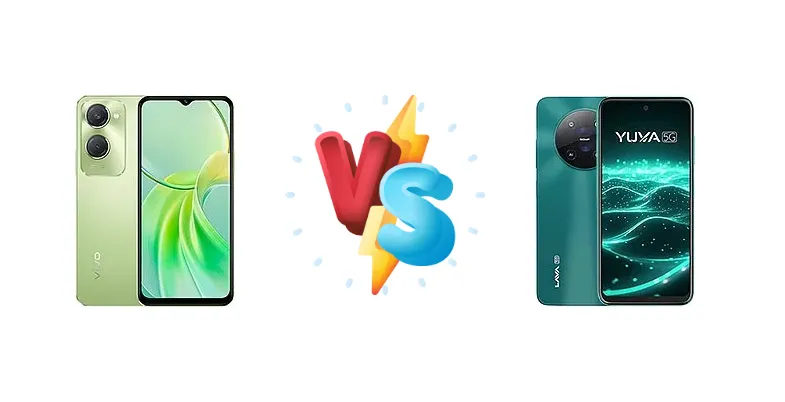
The sub-$200 5G smartphone market is heating up, with the vivo T3 Lite and Lava Yuva 5G vying for dominance. Both devices aim to deliver 5G connectivity without breaking the bank, but they take different approaches to achieving this. This comparison dissects their core components to determine which phone offers the best balance of performance, features, and value.
🏆 Quick Verdict
For most users, the vivo T3 Lite emerges as the stronger contender. Its Mediatek Dimensity 6300 chipset, built on a more efficient architecture with higher clocked Cortex-A76 cores, provides a noticeable performance edge over the Lava Yuva 5G’s Unisoc T750. While the Lava Yuva 5G offers slightly faster 18W charging, the overall performance advantage tips the scales in vivo’s favor.
| Network |
|---|
| 2G bands | GSM 850 / 900 / 1800 / 1900 | GSM 900 / 1800 |
| 3G bands | HSDPA 850 / 900 / 2100 | HSDPA 900 / 2100 |
| 4G bands | 1, 3, 5, 8, 28, 38, 40, 41 | 1, 3, 5, 8, 28, 40, 41 |
| 5G bands | 1, 3, 5, 8, 28, 40, 77, 78 SA/NSA | 1, 3, 5, 8, 28, 40, 77, 78 SA/NSA |
| Speed | HSPA, LTE, 5G | HSPA, LTE, 5G |
| Technology | GSM / HSPA / LTE / 5G | GSM / HSPA / LTE / 5G |
| Launch |
|---|
| Announced | 2024, June 27 | 2024, March 30 |
| Status | Available. Released 2024, July 04 | Available. Released 2024, June 06 |
| Body |
|---|
| Build | Glass front, plastic frame, plastic back | - |
| Dimensions | 163.6 x 75.6 x 8.4 mm (6.44 x 2.98 x 0.33 in) | 163.4 x 76.2 x 9.1 mm (6.43 x 3.00 x 0.36 in) |
| SIM | Nano-SIM + Nano-SIM | Nano-SIM + Nano-SIM |
| Weight | 185 g (6.53 oz) | 208 g (7.34 oz) |
| Display |
|---|
| Resolution | 720 x 1612 pixels, 20:9 ratio (~269 ppi density) | 720 x 1600 pixels, 20:9 ratio (~269 ppi density) |
| Size | 6.56 inches, 103.4 cm2 (~83.6% screen-to-body ratio) | 6.53 inches, 102.9 cm2 (~82.7% screen-to-body ratio) |
| Type | IPS LCD, 90Hz, 840 nits (HBM) | IPS LCD, 90Hz |
| Platform |
|---|
| CPU | Octa-core (2x2.4 GHz Cortex-A76 & 6x2.0 GHz Cortex-A55) | Octa-core (2x2.0 GHz Cortex-A76 & 6x1.8 GHz Cortex-A55) |
| Chipset | Mediatek Dimensity 6300 (6 nm) | Unisoc T750 (6 nm) |
| GPU | Mali-G57 MC2 | Mali-G57 MC2 |
| OS | Android 14, Funtouch 14 | Android 13 |
| Memory |
|---|
| Card slot | microSDXC (uses shared SIM slot) | microSDXC |
| Internal | 128GB 4GB RAM, 128GB 6GB RAM | 64GB 4GB RAM, 128GB 4GB RAM |
| Main Camera |
|---|
| Dual | 50 MP, f/1.8, (wide), PDAF
Auxiliary lens | 50 MP, (wide), AF
2 MP (macro) |
| Features | LED flash, panorama | LED flash, HDR, panorama |
| Video | 1080p@30fps | 1080p@30fps |
| Selfie camera |
|---|
| Single | 8 MP, f/2.0, (wide) | 8 MP |
| Video | 1080p@30fps | 1080p@30fps |
| Sound |
|---|
| 35mm jack | Yes | Yes |
| Loudspeaker | Yes | Yes |
| Comms |
|---|
| Bluetooth | 5.4, A2DP, LE | 5.0, A2DP, LE |
| NFC | No | No |
| Positioning | GPS, GALILEO, GLONASS, BDS, QZSS | GPS |
| Radio | FM radio | FM radio |
| USB | USB Type-C 2.0, OTG | USB Type-C 2.0, OTG |
| WLAN | Wi-Fi 802.11 a/b/g/n/ac, dual-band | Wi-Fi 802.11 b/g/n/ac |
| Features |
|---|
| Sensors | Fingerprint (side-mounted), accelerometer, proximity, compass | Fingerprint (side-mounted), accelerometer, proximity, compass |
| Battery |
|---|
| Charging | 15W wired
Reverse wired | 18W wired |
| Type | Li-Ion 5000 mAh | Li-Po 5000 mAh |
| Misc |
|---|
| Colors | Vibrant Green, Majestic Black | Green, Blue |
| Models | V2356 | - |
| Price | About 120 EUR | About 110 EUR |
| SAR | 0.99 W/kg (head) 0.74 W/kg (body) | - |
vivo T3 Lite
- Superior CPU performance with the Dimensity 6300
- More efficient chipset for potentially better battery life
- Potentially better image processing thanks to the Dimensity 6300’s ISP
- Slower 15W charging compared to the Lava Yuva 5G
- Display specifications are unknown
Lava Yuva 5G
- Faster 18W wired charging
- Competitive price point
- Solid option for basic smartphone usage
- Less powerful Unisoc T750 chipset
- Potentially lower performance in demanding tasks
- Image processing may be less refined
Display Comparison
Neither vivo nor Lava provide display specifications beyond resolution. However, given the price point, both likely utilize LCD panels. The real difference lies under the hood. The chipset’s ability to drive the display smoothly is key. The Dimensity 6300’s more powerful GPU will likely translate to a more fluid scrolling experience and better graphics rendering, even if the panels themselves are similar. Bezels are expected to be comparable, reflecting the budget nature of both devices.
Camera Comparison
Without detailed camera specs, it’s difficult to make a definitive judgment. Both phones likely feature a primary camera and depth/macro sensors. However, the image signal processor (ISP) within the Dimensity 6300 is generally more advanced than that found in the Unisoc T750, potentially leading to better image processing, noise reduction, and dynamic range in photos and videos captured with the vivo T3 Lite. The absence of OIS on either device suggests reliance on software stabilization, where the Dimensity 6300’s ISP could again provide an edge.
Performance
The core differentiator here is the chipset. The vivo T3 Lite’s Mediatek Dimensity 6300, fabricated on a 6nm process, features two Cortex-A76 cores clocked at 2.4 GHz, paired with six Cortex-A55 cores at 2.0 GHz. The Lava Yuva 5G utilizes the Unisoc T750, also on 6nm, but with slower 2.0 GHz Cortex-A76 cores and 1.8 GHz Cortex-A55 cores. This clock speed difference, combined with architectural refinements in the Dimensity 6300, results in a tangible performance advantage for the vivo phone in CPU-intensive tasks and gaming. While both phones likely feature similar RAM configurations, the Dimensity 6300’s superior processing power will better utilize available memory.
Battery Life
The Lava Yuva 5G boasts 18W wired charging, slightly faster than the vivo T3 Lite’s 15W charging. However, the Dimensity 6300’s 6nm efficiency could offset this difference. A more efficient chipset consumes less power, potentially resulting in comparable real-world battery life despite the slower charging speed. The actual 0-100% charge times will depend on battery capacity (unspecified for both devices), but the Lava Yuva 5G will likely achieve a full charge marginally faster.
Buying Guide
Buy the vivo T3 Lite if you prioritize smoother multitasking, a more responsive user experience, and potentially better gaming performance. This phone is ideal for users who frequently switch between apps, enjoy mobile games, or simply want a phone that feels snappy. Buy the Lava Yuva 5G if you value slightly faster charging speeds and are primarily focused on basic smartphone tasks like calling, texting, and light social media use. It’s a solid option for those on a very tight budget who don’t demand high performance.
Frequently Asked Questions
❓ Will the Unisoc T750 in the Lava Yuva 5G struggle with graphically intensive games like PUBG Mobile?
The Unisoc T750 is capable of running PUBG Mobile, but you’ll likely need to lower the graphics settings to achieve a smooth frame rate. The Dimensity 6300 in the vivo T3 Lite offers a more comfortable gaming experience with higher settings and more consistent performance.
❓ How significant is the difference in CPU performance between the Dimensity 6300 and the Unisoc T750 for everyday tasks?
For basic tasks like browsing, social media, and messaging, the difference may not be immediately noticeable. However, when multitasking, opening multiple apps, or performing more demanding operations, the Dimensity 6300’s faster cores and improved architecture will result in a snappier and more responsive experience.
❓ Does the 18W charging on the Lava Yuva 5G translate to a substantial time saving compared to the vivo T3 Lite’s 15W charging?
The difference in charging speed will likely be moderate, perhaps 15-20 minutes for a full charge, depending on battery capacity. The Dimensity 6300’s efficiency could minimize the impact of the slower charging speed on overall usability.
❓ Are either of these phones likely to overheat during prolonged gaming sessions?
Both phones utilize 6nm chipsets, which generally offer good thermal efficiency. However, the Unisoc T750 may be more prone to throttling under sustained load due to its lower peak performance. The vivo T3 Lite, with its more efficient chipset, is likely to maintain higher sustained performance for longer periods.