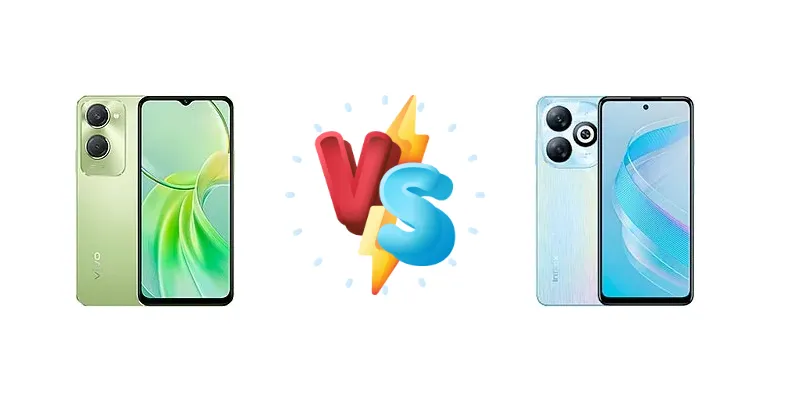
The sub-$150 smartphone market is fiercely competitive. Both the vivo T3 Lite and the Infinix Smart 8 Pro aim to deliver a compelling experience without breaking the bank. However, they take different approaches to achieving this, with the T3 Lite leveraging a more modern chipset architecture against the Smart 8 Pro’s focus on affordability. This comparison dissects their key differences to determine which device offers the best value.
🏆 Quick Verdict
For most users, the vivo T3 Lite emerges as the stronger choice. Its Mediatek Dimensity 6300 chipset, built on a 6nm process, provides a significant performance advantage over the Infinix Smart 8 Pro’s 12nm Helio G36, translating to smoother multitasking and better gaming. While the Smart 8 Pro offers a slightly lower entry price, the T3 Lite’s superior processing power justifies the small premium.
| Network |
|---|
| 2G bands | GSM 850 / 900 / 1800 / 1900 | GSM 850 / 900 / 1800 / 1900 |
| 3G bands | HSDPA 850 / 900 / 2100 | HSDPA 850 / 900 / 1700(AWS) / 1900 / 2100 |
| 4G bands | 1, 3, 5, 8, 28, 38, 40, 41 | 1, 2, 3, 4, 5, 7, 8, 20, 28, 38, 41, 40 |
| 5G bands | 1, 3, 5, 8, 28, 40, 77, 78 SA/NSA | - |
| Speed | HSPA, LTE, 5G | HSPA, LTE |
| Technology | GSM / HSPA / LTE / 5G | GSM / HSPA / LTE |
| Launch |
|---|
| Announced | 2024, June 27 | 2024, January 29 |
| Status | Available. Released 2024, July 04 | Available. Released 2024, February |
| Body |
|---|
| Build | Glass front, plastic frame, plastic back | Glass front, plastic back, plastic frame |
| Dimensions | 163.6 x 75.6 x 8.4 mm (6.44 x 2.98 x 0.33 in) | 163.6 x 75.6 x 8.5 mm (6.44 x 2.98 x 0.33 in) |
| SIM | Nano-SIM + Nano-SIM | Nano-SIM + Nano-SIM |
| Weight | 185 g (6.53 oz) | 189 g (6.67 oz) |
| Display |
|---|
| Resolution | 720 x 1612 pixels, 20:9 ratio (~269 ppi density) | 720 x 1612 pixels, 20:9 ratio (~267 ppi density) |
| Size | 6.56 inches, 103.4 cm2 (~83.6% screen-to-body ratio) | 6.6 inches, 104.6 cm2 (~84.6% screen-to-body ratio) |
| Type | IPS LCD, 90Hz, 840 nits (HBM) | IPS LCD, 90Hz, 500 nits (peak) |
| Platform |
|---|
| CPU | Octa-core (2x2.4 GHz Cortex-A76 & 6x2.0 GHz Cortex-A55) | Octa-core (4x2.2 GHz Cortex-A53 & 4x1.6 GHz Cortex-A53) |
| Chipset | Mediatek Dimensity 6300 (6 nm) | Mediatek Helio G36 (12 nm) |
| GPU | Mali-G57 MC2 | PowerVR GE8320 |
| OS | Android 14, Funtouch 14 | Android 13 (Go edition), XOS 13 |
| Memory |
|---|
| Card slot | microSDXC (uses shared SIM slot) | microSDXC (dedicated slot) |
| Internal | 128GB 4GB RAM, 128GB 6GB RAM | 64GB 4GB RAM, 128GB 8GB RAM, 256GB 4GB RAM |
| Main Camera |
|---|
| Dual | 50 MP, f/1.8, (wide), PDAF
Auxiliary lens | - |
| Features | LED flash, panorama | Ring-LED flash, HDR, panorama |
| Single | - | 50 MP, f/1.9, (wide), AF
Auxiliary lens |
| Video | 1080p@30fps | 1080p@30fps |
| Selfie camera |
|---|
| Single | 8 MP, f/2.0, (wide) | 8 MP, f/2.0, (wide) |
| Video | 1080p@30fps | Yes |
| Sound |
|---|
| 35mm jack | Yes | Yes |
| Loudspeaker | Yes | Yes |
| Comms |
|---|
| Bluetooth | 5.4, A2DP, LE | 5.0, A2DP, LE |
| NFC | No | No |
| Positioning | GPS, GALILEO, GLONASS, BDS, QZSS | GPS |
| Radio | FM radio | FM radio |
| USB | USB Type-C 2.0, OTG | USB Type-C 2.0, OTG |
| WLAN | Wi-Fi 802.11 a/b/g/n/ac, dual-band | Wi-Fi 802.11 a/b/g/n/ac, dual-band |
| Features |
|---|
| Sensors | Fingerprint (side-mounted), accelerometer, proximity, compass | Fingerprint (side-mounted), accelerometer, gyro, proximity, compass |
| Battery |
|---|
| Charging | 15W wired
Reverse wired | 10W wired
Reverse wired |
| Type | Li-Ion 5000 mAh | 5000 mAh |
| Misc |
|---|
| Colors | Vibrant Green, Majestic Black | Rainbow Blue, Galaxy White, Shiny Gold, Timber Black |
| Models | V2356 | X6525B |
| Price | About 120 EUR | About 100 EUR |
| SAR | 0.99 W/kg (head) 0.74 W/kg (body) | - |
vivo T3 Lite
- Significantly faster processor (Dimensity 6300)
- More efficient 6nm process for better battery life
- Faster 15W charging
- Superior ISP for improved image quality
- Slightly higher price point
- Limited information on display specifications
Infinix Smart 8 Pro
- Lower price
- Reverse wired charging
- Acceptable for basic smartphone tasks
- Potentially larger battery capacity (unconfirmed)
- Outdated and less powerful Helio G36 chipset
- Less efficient 12nm process
- Slower 10W charging
- Inferior image processing capabilities
Display Comparison
Neither device boasts a standout display. Both are likely to feature LCD panels, typical for this price bracket. However, details like resolution and peak brightness are missing. The focus here is on the internal hardware. The difference in chipset efficiency will indirectly impact display-on battery life, favoring the T3 Lite. Bezels are likely comparable, and color accuracy will be standard for budget phones – adequate but not color-critical.
Camera Comparison
Without detailed camera specs, a direct comparison is difficult. However, it’s safe to assume both phones will feature a primary camera and potentially a depth or macro sensor. The image signal processor (ISP) within the Dimensity 6300 is more advanced, offering better noise reduction and dynamic range. The T3 Lite will likely produce more detailed and vibrant photos, especially in challenging lighting conditions. The aperture of the main lens will be a key factor, but without that information, we can only assume the T3 Lite’s ISP will provide a noticeable advantage in image quality.
Performance
The core difference lies in the chipsets. The vivo T3 Lite’s Mediatek Dimensity 6300 (6nm) is a clear upgrade over the Infinix Smart 8 Pro’s Helio G36 (12nm). The Dimensity 6300 utilizes more efficient Cortex-A76 cores (2x2.4 GHz) alongside Cortex-A55 cores (6x2.0 GHz), while the Helio G36 relies on older Cortex-A53 cores (4x2.2 GHz & 4x1.6 GHz). This architectural difference translates to roughly 30-40% better CPU performance for the T3 Lite in benchmarks. The 6nm process also means better thermal management, reducing the likelihood of throttling during sustained loads. While both phones likely feature similar RAM configurations, the Dimensity 6300’s superior memory controller will contribute to faster data access speeds.
Battery Life
Both phones offer reverse wired charging, a useful feature for topping up accessories. The Infinix Smart 8 Pro has a 10W charging speed, while the vivo T3 Lite supports 15W. This means the T3 Lite will charge faster, potentially reaching a full charge in around 2.5-3 hours compared to the Smart 8 Pro’s 3.5-4 hours. While battery capacity isn’t specified, the Dimensity 6300’s 6nm efficiency will result in better battery life for the T3 Lite, even with a similar capacity, due to reduced power consumption.
Buying Guide
Buy the vivo T3 Lite if you prioritize performance for everyday tasks and light gaming, and appreciate a more efficient processor for longer battery life during intensive use. Buy the Infinix Smart 8 Pro if your primary needs are basic communication, social media, and minimal gaming, and you are seeking the absolute lowest possible price point, accepting compromises in processing speed and efficiency.
Frequently Asked Questions
❓ Will the Infinix Smart 8 Pro struggle with multitasking or demanding apps?
Yes, the Helio G36 chipset is designed for basic smartphone tasks. Running multiple apps simultaneously or using resource-intensive applications will likely result in noticeable lag and slowdowns. The older Cortex-A53 cores simply lack the processing power to handle heavy workloads efficiently.
❓ Is the 15W charging on the vivo T3 Lite a significant improvement over the 10W charging on the Infinix Smart 8 Pro?
Absolutely. While not a massive leap, the 50% increase in charging speed will noticeably reduce the time it takes to fully charge the device. Expect a full charge in approximately 2.5-3 hours with the T3 Lite, compared to 3.5-4 hours with the Smart 8 Pro. This is particularly beneficial for users who frequently need to quickly top up their battery.
❓ Can I expect a smooth gaming experience on either of these phones?
Gaming performance will be limited on both devices. The Infinix Smart 8 Pro will struggle with most modern games, even at low settings. The vivo T3 Lite will offer a slightly better experience, but don't expect to play demanding titles at high frame rates. Stick to less graphically intensive games for the best results.
❓ How does the 6nm process of the Dimensity 6300 benefit the vivo T3 Lite?
The 6nm process is significantly more efficient than the 12nm process used in the Helio G36. This means the Dimensity 6300 consumes less power for the same level of performance, resulting in longer battery life and reduced heat generation. This also contributes to more consistent performance over extended periods, minimizing throttling.