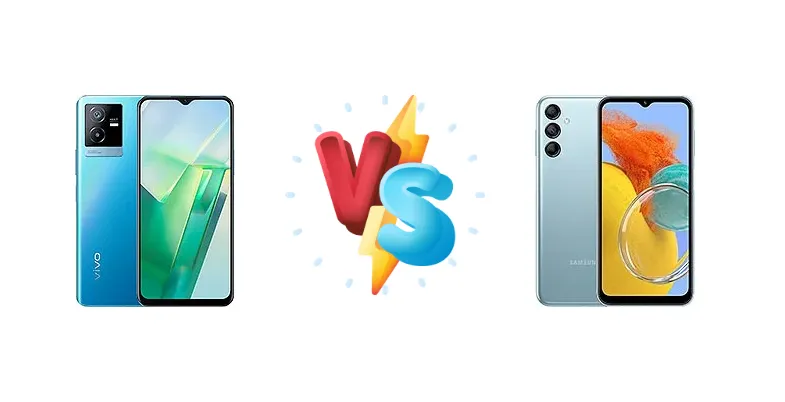
The budget smartphone market is fiercely competitive, and the vivo T2x and Samsung Galaxy M14 are two strong contenders. Both offer compelling features at an affordable price, but which one reigns supreme? This comprehensive comparison will delve into their specs, performance, and overall value to help you make an informed decision.
🏆 Quick Verdict
The Samsung Galaxy M14 edges out the vivo T2x thanks to its more efficient 5nm Exynos chipset, larger battery, and Samsung's reliable software support. While the T2x boasts faster charging, the M14's overall package provides a better long-term experience.
| Network |
|---|
| 2G bands | GSM 850 / 900 / 1800 / 1900 | GSM 850 / 900 / 1800 / 1900 |
| 3G bands | HSDPA 850 / 900 / 2100 | HSDPA 850 / 900 / 1700(AWS) / 1900 / 2100 |
| 4G bands | 1, 3, 5, 8, 28, 34, 38, 39, 40, 41 | 1, 2, 3, 4, 5, 7, 8, 12, 17, 20, 26, 28, 38, 40, 41, 66 |
| 5G bands | 1, 5, 8, 28, 41, 77, 78 SA/NSA | 1, 3, 5, 7, 8, 20, 28, 38, 40, 41, 66, 77, 78 SA/NSA |
| Speed | HSPA, LTE, 5G | HSPA, LTE, 5G |
| Technology | GSM / CDMA / HSPA / CDMA2000 / LTE / 5G | GSM / HSPA / LTE / 5G |
| | CDMA2000 1x | - |
| Launch |
|---|
| Announced | 2022, May 30 | 2023, March 08 |
| Status | Available. Released 2022, May 31 | Available. Released 2023, March 08 |
| Body |
|---|
| Build | Glass front, plastic frame, plastic back | Glass front (Gorilla Glass 5), plastic back, plastic frame |
| Dimensions | 163.9 x 75.3 x 9.2 mm (6.45 x 2.96 x 0.36 in) | 166.8 x 77.2 x 9.4 mm (6.57 x 3.04 x 0.37 in) |
| SIM | Nano-SIM + Nano-SIM | · Nano-SIM· Nano-SIM + Nano-SIM |
| Weight | 202.8 g (7.16 oz) | 206 g (7.27 oz) |
| Display |
|---|
| Protection | - | Corning Gorilla Glass 5 |
| Resolution | 1080 x 2408 pixels, 20:9 ratio (~401 ppi density) | 1080 x 2408 pixels, 20:9 ratio (~400 ppi density) |
| Size | 6.58 inches, 104.3 cm2 (~84.5% screen-to-body ratio) | 6.6 inches, 104.9 cm2 (~81.5% screen-to-body ratio) |
| Type | IPS LCD, 144Hz, 650 nits (HBM) | PLS LCD, 90Hz |
| Platform |
|---|
| CPU | Octa-core (1x3.0 GHz Cortex-A78 & 3x2.6 GHz Cortex-A78 & 4x2.0 GHz Cortex-A55) | Octa-core (2x2.4 GHz Cortex-A78 & 6x2.0 GHz Cortex-A55) |
| Chipset | Mediatek Dimensity 1300 (6 nm) | Exynos 1330 (5 nm) |
| GPU | Mali-G77 MC9 | Mali-G68 MP2 |
| OS | Android 12, OriginOS 2.0 | Android 13, One UI core 5.1 |
| Memory |
|---|
| Card slot | No | microSDHC (dedicated slot) |
| Internal | 128GB 6GB RAM, 128GB 8GB RAM, 256GB 8GB RAM | 64GB 4GB RAM, 128GB 4GB RAM, 128GB 6GB RAM |
| | UFS 3.1 | - |
| Main Camera |
|---|
| Dual | 50 MP, f/1.8, 26mm (wide), PDAF
2 MP (macro) | - |
| Features | Dual-LED dual-tone flash, HDR, panorama | LED flash, panorama, HDR |
| Single | 16 MP, f/2.0, (wide) | 13 MP, f/2.0, (wide) |
| Triple | - | 50 MP, f/1.8, (wide), PDAF
2 MP (macro)
Auxiliary lens |
| Video | 4K@30fps, 1080p@30/60fps, gyro-EIS | 1080p@30fps |
| Selfie camera |
|---|
| Single | 16 MP, f/2.0, (wide) | 13 MP, f/2.0, (wide) |
| Video | 1080p@30fps | 1080p@30fps |
| Sound |
|---|
| 3.5mm jack | Yes | Yes |
| 35mm jack | Yes | Yes |
| Loudspeaker | Yes | Yes |
| Comms |
|---|
| Bluetooth | 5.2, A2DP, LE, aptX HD | 5.2, A2DP, LE |
| NFC | Yes | Yes |
| Positioning | GPS, GLONASS, GALILEO, BDS, QZSS | GPS, GLONASS, GALILEO, BDS, QZSS, NavIC |
| Radio | No | Unspecified |
| USB | USB Type-C, OTG | USB Type-C 2.0 |
| WLAN | Wi-Fi 802.11 a/b/g/n/ac, dual-band, Wi-Fi Direct | Wi-Fi 802.11 a/b/g/n/ac, dual-band, Wi-Fi Direct |
| Features |
|---|
| Sensors | Fingerprint (side-mounted), accelerometer, gyro, proximity, compass | Fingerprint (side-mounted), accelerometer, gyro, proximity, compass |
| Battery |
|---|
| Charging | 44W wired | 15W wired - international
25W wired - India |
| Type | 6000 mAh | Li-Po 6000 mAh |
| Misc |
|---|
| Colors | Black, Blue | Navy Blue, Light Blue, Silver |
| Models | - | SM-M146B, SM-M146B/DS, SM-M146B/DSN |
| Price | About 220 EUR | ₹ 10,990 |
| SAR EU | - | 0.48 W/kg (head) 1.53 W/kg (body) |
vivo T2x
- Faster Charging (44W)
- Potentially slightly faster CPU performance
- Competitive price
- Likely LCD display
- Smaller battery
- Less versatile camera system
- Software support may be less extensive
Samsung Galaxy M14
- Excellent battery life (6000mAh)
- Super AMOLED display (typically)
- Efficient Exynos 1330 chipset
- Reliable Samsung software support
- Versatile camera system
- Slower charging (15W/25W)
- Performance may not be as raw as T2x in some benchmarks
Display Comparison
Both phones feature large 6.67-inch displays, but the Galaxy M14 typically uses a Super AMOLED panel, offering vibrant colors and deeper blacks compared to the T2x's likely LCD panel. Resolution is generally FHD+ on both, but viewing angles and color accuracy favor the M14.
Camera Comparison
The Galaxy M14 generally offers a more versatile camera system, often including a higher resolution main sensor (typically 50MP) and potentially an ultrawide lens. The vivo T2x's camera is decent, but may lack the same level of detail and features. Low-light performance is also typically better on the M14.
Performance
The vivo T2x's Dimensity 1300 has a theoretical edge in raw CPU power due to its Cortex-A78 core clock speed. However, the Galaxy M14's Exynos 1330, built on a more efficient 5nm process, often delivers better real-world performance and thermal management, resulting in smoother multitasking and sustained performance. Gaming performance is comparable, but the M14's efficiency can prevent throttling.
Battery Life
The Samsung Galaxy M14 shines in this category, typically featuring a massive 6000mAh battery, providing exceptional battery life. The vivo T2x has a smaller battery (around 5000mAh) and, while still good, doesn't match the M14's endurance. The M14's slower charging (15W/25W) is offset by its longer battery life.
Buying Guide
The vivo T2x is ideal for users prioritizing fast charging and a slightly more powerful chipset for gaming. The Samsung Galaxy M14 is a better choice for those seeking exceptional battery life, a smoother user experience, and the reliability of the Samsung ecosystem.
Frequently Asked Questions
❓ Which phone is better for gaming?
While the vivo T2x has a slightly faster CPU, the Samsung Galaxy M14's efficient chipset and better thermal management often lead to a smoother gaming experience over extended periods.
❓ Does the Samsung Galaxy M14 get software updates regularly?
Yes, Samsung is known for providing consistent software updates and security patches for its Galaxy M series devices.