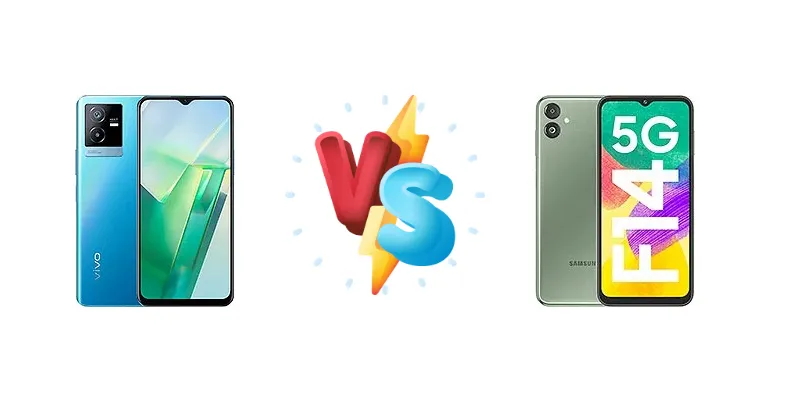
The budget smartphone market is fiercely competitive, and the vivo T2x and Samsung Galaxy F14 are two strong contenders. Both offer compelling features at an attractive price point, but which one reigns supreme? Let's dive into a detailed comparison to help you decide.
🏆 Quick Verdict
The Samsung Galaxy F14 edges out the vivo T2x thanks to its more efficient 5nm Exynos chipset, better camera performance, and Samsung's reliable software. While the T2x boasts faster charging, the F14's overall package provides a more polished experience.
| Network |
|---|
| 2G bands | GSM 850 / 900 / 1800 / 1900 | GSM 850 / 900 / 1800 / 1900 |
| 3G bands | HSDPA 850 / 900 / 2100 | HSDPA 850 / 900 / 1700(AWS) / 1900 / 2100 |
| 4G bands | 1, 3, 5, 8, 28, 34, 38, 39, 40, 41 | 1, 2, 3, 4, 5, 7, 8, 12, 17, 20, 26, 28, 38, 40, 41, 66 |
| 5G bands | 1, 5, 8, 28, 41, 77, 78 SA/NSA | 1, 3, 5, 7, 8, 20, 28, 38, 40, 41, 66, 77, 78 SA/NSA/Sub6 |
| Speed | HSPA, LTE, 5G | HSPA, LTE-А, 5G |
| Technology | GSM / CDMA / HSPA / CDMA2000 / LTE / 5G | GSM / HSPA / LTE / 5G |
| | CDMA2000 1x | - |
| Launch |
|---|
| Announced | 2022, May 30 | 2023, March 24 |
| Status | Available. Released 2022, May 31 | Available. Released 2023, March 30 |
| Body |
|---|
| Build | Glass front, plastic frame, plastic back | Glass front (Gorilla Glass 5), plastic back, plastic frame |
| Dimensions | 163.9 x 75.3 x 9.2 mm (6.45 x 2.96 x 0.36 in) | 166.8 x 77.2 x 9.4 mm (6.57 x 3.04 x 0.37 in) |
| SIM | Nano-SIM + Nano-SIM | Nano-SIM + Nano-SIM |
| Weight | 202.8 g (7.16 oz) | 206 g (7.27 oz) |
| Display |
|---|
| Protection | - | Corning Gorilla Glass 5 |
| Resolution | 1080 x 2408 pixels, 20:9 ratio (~401 ppi density) | 1080 x 2408 pixels, 20:9 ratio (~400 ppi density) |
| Size | 6.58 inches, 104.3 cm2 (~84.5% screen-to-body ratio) | 6.6 inches, 104.9 cm2 (~81.5% screen-to-body ratio) |
| Type | IPS LCD, 144Hz, 650 nits (HBM) | PLS LCD, 90Hz |
| Platform |
|---|
| CPU | Octa-core (1x3.0 GHz Cortex-A78 & 3x2.6 GHz Cortex-A78 & 4x2.0 GHz Cortex-A55) | Octa-core (2x2.4 GHz Cortex-A78 & 6x2.0 GHz Cortex-A55) |
| Chipset | Mediatek Dimensity 1300 (6 nm) | Exynos 1330 (5 nm) |
| GPU | Mali-G77 MC9 | Mali-G68 MP2 |
| OS | Android 12, OriginOS 2.0 | Android 13, One UI Core 5.1 |
| Memory |
|---|
| Card slot | No | microSDXC (dedicated slot) |
| Internal | 128GB 6GB RAM, 128GB 8GB RAM, 256GB 8GB RAM | 64GB 4GB RAM, 128GB 4GB RAM, 128GB 6GB RAM |
| | UFS 3.1 | - |
| Main Camera |
|---|
| Dual | 50 MP, f/1.8, 26mm (wide), PDAF
2 MP (macro) | 50 MP, f/1.8, (wide), PDAF
2 MP (macro) |
| Features | Dual-LED dual-tone flash, HDR, panorama | LED flash, panorama, HDR |
| Single | 16 MP, f/2.0, (wide) | - |
| Video | 4K@30fps, 1080p@30/60fps, gyro-EIS | 1080p@30fps |
| Selfie camera |
|---|
| Single | 16 MP, f/2.0, (wide) | 13 MP, f/2.0, (wide) |
| Video | 1080p@30fps | 1080p@30fps |
| Sound |
|---|
| 3.5mm jack | Yes | Yes |
| 35mm jack | Yes | Yes |
| Loudspeaker | Yes | Yes |
| Comms |
|---|
| Bluetooth | 5.2, A2DP, LE, aptX HD | 5.2, A2DP, LE |
| NFC | Yes | No |
| Positioning | GPS, GLONASS, GALILEO, BDS, QZSS | GPS, GLONASS, GALILEO, BDS, QZSS, NavIC |
| Radio | No | FM radio, recording |
| USB | USB Type-C, OTG | USB Type-C 2.0 |
| WLAN | Wi-Fi 802.11 a/b/g/n/ac, dual-band, Wi-Fi Direct | Wi-Fi 802.11 a/b/g/n/ac, dual-band, Wi-Fi Direct |
| Features |
|---|
| Sensors | Fingerprint (side-mounted), accelerometer, gyro, proximity, compass | Fingerprint (side-mounted), accelerometer, gyro, proximity, compass |
| Battery |
|---|
| Charging | 44W wired | 25W wired |
| Type | 6000 mAh | Li-Po 6000 mAh |
| Misc |
|---|
| Colors | Black, Blue | Black, Green, Purple |
| Models | - | SM-E146B, SM-E146B/DS |
| Price | About 220 EUR | About 150 EUR |
| SAR | - | 0.69 W/kg (head) |
vivo T2x
- Faster Charging (44W)
- Potentially Stronger Raw CPU Performance
- Aggressive Pricing
- Likely Inferior Camera Performance
- Less Refined Software
- May Struggle with Sustained Performance
Samsung Galaxy F14
- Better Camera System (Likely OIS)
- More Efficient Chipset (Exynos 1330)
- Samsung's Software and Ecosystem
- Potentially Better Display Quality
- Slower Charging (25W)
- Slightly Lower Raw CPU Performance
Display Comparison
Both phones feature a 6.6-inch FHD+ display, likely with a 90Hz refresh rate. The Samsung Galaxy F14 may offer slightly better color accuracy and viewing angles due to Samsung's display technology, but both provide a decent viewing experience for the price.
Camera Comparison
The Samsung Galaxy F14 is expected to have a more versatile and higher-quality camera system. While specific megapixel counts are similar, Samsung's image processing and software optimization typically result in better photos, especially in low light. The F14 likely includes features like optical image stabilization (OIS) which the T2x may lack.
Performance
The vivo T2x's Dimensity 1300 (6nm) offers a theoretical performance advantage over the Exynos 1330 (5nm) in raw CPU power. However, the Exynos 1330's efficiency often translates to better real-world performance and sustained speeds, especially in demanding tasks. Gaming performance is likely comparable, but the F14 might handle prolonged gaming sessions better due to thermal management.
Battery Life
The vivo T2x has a clear advantage with 44W wired charging, allowing for faster top-ups. Both phones likely feature a 6000mAh battery, suggesting excellent battery life. However, the Exynos 1330's efficiency in the F14 could lead to slightly better overall battery endurance despite the slower charging speed.
Buying Guide
Who should buy the vivo T2x? Gamers on a tight budget might appreciate the Dimensity 1300's raw power. Who should buy the Samsung Galaxy F14? Users prioritizing camera quality, a smoother user experience, and the Samsung ecosystem will find the F14 a better fit.
Frequently Asked Questions
❓ Which phone is better for gaming?
The vivo T2x might offer a slight edge in raw CPU power, but the Samsung Galaxy F14's better thermal management could lead to more consistent performance during extended gaming sessions.
❓ Is the Samsung Galaxy F14 worth the extra money?
If camera quality and a smoother user experience are priorities, then yes. The F14's overall package is more polished and offers a better long-term value.