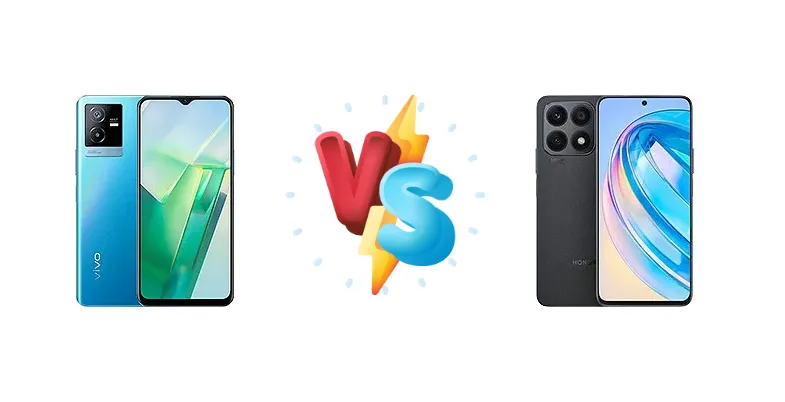
The vivo T2x and Honor X8a represent compelling options in the crowded budget and mid-range smartphone market. While both aim to deliver a solid experience without breaking the bank, they take drastically different approaches to achieving that goal, primarily through their chipset choices. This comparison dissects those differences, revealing which phone offers the best balance of power, features, and price.
🏆 Quick Verdict
For the average user prioritizing performance and future-proofing, the vivo T2x is the clear winner. Its Dimensity 1300 chipset offers significantly more processing power and efficiency than the Honor X8a’s Helio G88, translating to smoother multitasking, faster app loading, and a better gaming experience. While the X8a offers respectable battery life, the T2x’s faster charging mitigates any potential downsides.
| Network |
|---|
| 2G bands | GSM 850 / 900 / 1800 / 1900 | GSM 850 / 900 / 1800 / 1900 |
| 3G bands | HSDPA 850 / 900 / 2100 | HSDPA 850 / 900 / 2100 |
| 4G bands | 1, 3, 5, 8, 28, 34, 38, 39, 40, 41 | LTE |
| 5G bands | 1, 5, 8, 28, 41, 77, 78 SA/NSA | - |
| Speed | HSPA, LTE, 5G | HSPA, LTE |
| Technology | GSM / CDMA / HSPA / CDMA2000 / LTE / 5G | GSM / HSPA / LTE |
| | CDMA2000 1x | Virtual proximity sensing |
| Launch |
|---|
| Announced | 2022, May 30 | 2023, February 08 |
| Status | Available. Released 2022, May 31 | Available. Released 2023, February 11 |
| Body |
|---|
| Build | Glass front, plastic frame, plastic back | Glass front, plastic frame, plastic back |
| Dimensions | 163.9 x 75.3 x 9.2 mm (6.45 x 2.96 x 0.36 in) | 162.9 x 74.5 x 7.5 mm (6.41 x 2.93 x 0.30 in) |
| SIM | Nano-SIM + Nano-SIM | Nano-SIM + Nano-SIM |
| Weight | 202.8 g (7.16 oz) | 179 g (6.31 oz) |
| Display |
|---|
| Resolution | 1080 x 2408 pixels, 20:9 ratio (~401 ppi density) | 1080 x 2388 pixels (~391 ppi density) |
| Size | 6.58 inches, 104.3 cm2 (~84.5% screen-to-body ratio) | 6.7 inches, 108.7 cm2 (~89.6% screen-to-body ratio) |
| Type | IPS LCD, 144Hz, 650 nits (HBM) | IPS LCD, 90Hz |
| Platform |
|---|
| CPU | Octa-core (1x3.0 GHz Cortex-A78 & 3x2.6 GHz Cortex-A78 & 4x2.0 GHz Cortex-A55) | Octa-core (2x2.0 GHz Cortex-A75 & 6x1.8 GHz Cortex-A55) |
| Chipset | Mediatek Dimensity 1300 (6 nm) | Mediatek MT6769H Helio G88 (12 nm) |
| GPU | Mali-G77 MC9 | Mali-G52 MC2 |
| OS | Android 12, OriginOS 2.0 | Android 12, Magic UI 6.1 |
| Memory |
|---|
| Card slot | No | No |
| Internal | 128GB 6GB RAM, 128GB 8GB RAM, 256GB 8GB RAM | 128GB 4GB RAM, 128GB 6GB RAM, 128GB 8GB RAM, 128GB 12GB RAM, 256GB 4GB RAM, 256GB 8GB RAM |
| | UFS 3.1 | - |
| Main Camera |
|---|
| Dual | 50 MP, f/1.8, 26mm (wide), PDAF
2 MP (macro) | - |
| Features | Dual-LED dual-tone flash, HDR, panorama | LED flash, panorama, HDR |
| Single | 16 MP, f/2.0, (wide) | 16 MP, f/2.5 |
| Triple | - | 100 MP, f/1.9, (wide), AF
5 MP, f/2.2, (ultrawide)
2 MP (macro) |
| Video | 4K@30fps, 1080p@30/60fps, gyro-EIS | 1080p@30fps |
| Selfie camera |
|---|
| Single | 16 MP, f/2.0, (wide) | 16 MP, f/2.5 |
| Video | 1080p@30fps | 1080p@30fps |
| Sound |
|---|
| 3.5mm jack | Yes | No |
| 35mm jack | Yes | No |
| Loudspeaker | Yes | Yes |
| Comms |
|---|
| Bluetooth | 5.2, A2DP, LE, aptX HD | 5.1, A2DP, LE |
| NFC | Yes | Yes (CRT-LX1 only) |
| Positioning | GPS, GLONASS, GALILEO, BDS, QZSS | GPS, GLONASS, GALILEO, BDS |
| Radio | No | No |
| USB | USB Type-C, OTG | USB Type-C 2.0, OTG |
| WLAN | Wi-Fi 802.11 a/b/g/n/ac, dual-band, Wi-Fi Direct | Wi-Fi 802.11 a/b/g/n/ac, dual-band, Wi-Fi Direct |
| Features |
|---|
| Sensors | Fingerprint (side-mounted), accelerometer, gyro, proximity, compass | Fingerprint (side-mounted), accelerometer, compass |
| Battery |
|---|
| Charging | 44W wired | 22.5W wired, 50% in 30 min |
| Type | 6000 mAh | Li-Po 4500 mAh |
| Misc |
|---|
| Colors | Black, Blue | Cyan Lake, Titanium Silver, Midnight Black |
| Models | - | CRT-LX1, CRT-LX2, CRT-LX3 |
| Price | About 220 EUR | About 170 EUR |
vivo T2x
- Significantly more powerful Dimensity 1300 chipset
- Faster 44W wired charging
- Potentially better camera image processing
- May be slightly more expensive
- Potentially higher power consumption under heavy load (though offset by 6nm efficiency)
Honor X8a
- More affordable price point
- Decent battery life for basic usage
- Stable and reliable performance for everyday tasks
- Helio G88 chipset struggles with demanding tasks
- Slower 22.5W charging
- Limited future-proofing
Display Comparison
Neither device’s display specifications are provided, so a direct comparison is limited. However, given the T2x’s focus on performance, it’s reasonable to expect a higher refresh rate panel (likely 90Hz or 120Hz) compared to the X8a, which is positioned as a more value-oriented device. The X8a likely utilizes a standard 60Hz panel. Color accuracy and peak brightness will likely be comparable, but the T2x may benefit from better display calibration due to its higher price point.
Camera Comparison
Without detailed camera specifications, it’s difficult to make a definitive judgment. However, the T2x’s higher overall performance suggests a more capable image signal processor (ISP) within the Dimensity 1300, potentially leading to better image processing and low-light performance. The X8a’s Helio G88 ISP is adequate, but likely won’t match the T2x’s capabilities. We can assume both phones will feature a primary camera, but the T2x is more likely to have a larger sensor and more advanced features.
Performance
The performance gap between these two phones is substantial. The vivo T2x’s Mediatek Dimensity 1300 (6nm) boasts a significantly more powerful CPU configuration – a 1x3.0 GHz Cortex-A78, 3x2.6 GHz Cortex-A78, and 4x2.0 GHz Cortex-A55 – compared to the Honor X8a’s Helio G88 (12nm) with its 2x2.0 GHz Cortex-A75 and 6x1.8 GHz Cortex-A55. The Dimensity 1300’s newer architecture and smaller 6nm process node translate to superior performance *and* improved power efficiency. The Helio G88, while capable for everyday tasks, will struggle with graphically intensive games and multitasking. The T2x will offer a noticeably smoother and more responsive user experience.
Battery Life
The Honor X8a’s 22.5W charging, with a claimed 50% charge in 30 minutes, is respectable. However, the vivo T2x’s 44W wired charging offers a significant advantage, allowing for a much faster top-up. While battery capacity isn’t specified for either device, the Dimensity 1300’s superior power efficiency means the T2x can potentially deliver comparable or even better battery life despite the faster charging, as it consumes less power during typical usage. The faster charging also reduces downtime, a crucial benefit for power users.
Buying Guide
Buy the vivo T2x if you need a phone capable of handling demanding tasks like gaming, video editing, or running multiple apps simultaneously. Its superior chipset and faster charging make it ideal for power users. Buy the Honor X8a if you prioritize a consistently stable, if less powerful, experience and value a slightly more conservative power draw for extended everyday use. It’s a good choice for basic smartphone tasks and media consumption.
Frequently Asked Questions
❓ Will the Helio G88 in the Honor X8a struggle with popular games like PUBG Mobile or Call of Duty?
Yes, the Helio G88 is a budget-oriented chipset and will likely struggle to maintain consistent frame rates in demanding games like PUBG Mobile or Call of Duty, even on medium settings. You’ll likely experience noticeable lag and stuttering. The vivo T2x’s Dimensity 1300 is far better suited for gaming.
❓ How much faster is the 44W charging on the vivo T2x compared to the 22.5W charging on the Honor X8a in real-world use?
While the Honor X8a claims 50% charge in 30 minutes, the vivo T2x’s 44W charging will likely achieve a similar charge level in around 20-25 minutes. More importantly, a full 0-100% charge on the T2x will be significantly faster, reducing overall downtime.
❓ Is the difference in chipset performance between the Dimensity 1300 and Helio G88 noticeable for everyday tasks like browsing and social media?
While both phones can handle basic tasks, the Dimensity 1300 in the vivo T2x will provide a noticeably smoother and more responsive experience. App loading times will be faster, multitasking will be more fluid, and the overall user interface will feel snappier.