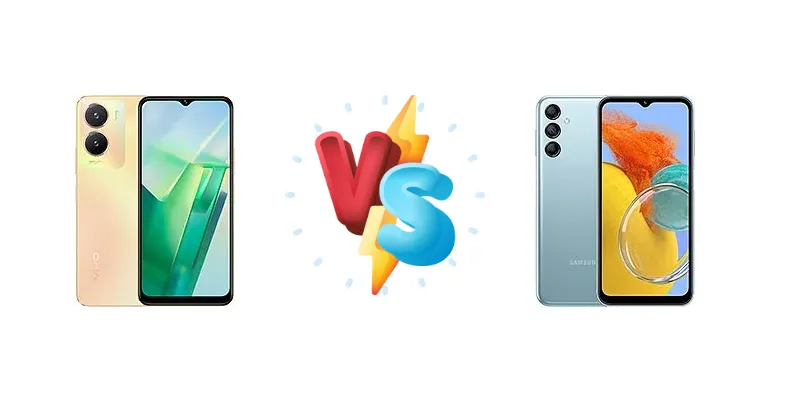
The budget smartphone market is fiercely competitive, and the vivo T2x and Samsung Galaxy M14 are two strong contenders. Both offer compelling features at an attractive price point, but which one reigns supreme? This detailed comparison will help you decide which phone best suits your needs.
🏆 Quick Verdict
The Samsung Galaxy M14 edges out the vivo T2x thanks to its superior chipset (Exynos 1330), potentially better camera performance, and faster charging (in India). While the T2x offers a competitive price, the M14 provides a more well-rounded experience.
| Network |
|---|
| 2G bands | GSM 850 / 900 / 1800 / 1900 | GSM 850 / 900 / 1800 / 1900 |
| 3G bands | HSDPA 850 / 900 / 2100 | HSDPA 850 / 900 / 1700(AWS) / 1900 / 2100 |
| 4G bands | 1, 3, 5, 8, 38, 40, 41 | 1, 2, 3, 4, 5, 7, 8, 12, 17, 20, 26, 28, 38, 40, 41, 66 |
| 5G bands | 1, 3, 8, 28, 77, 78 SA/NSA | 1, 3, 5, 7, 8, 20, 28, 38, 40, 41, 66, 77, 78 SA/NSA |
| Speed | HSPA, LTE, 5G | HSPA, LTE, 5G |
| Technology | GSM / HSPA / LTE / 5G | GSM / HSPA / LTE / 5G |
| Launch |
|---|
| Announced | 2023, April 11 | 2023, March 08 |
| Status | Available. Released 2023, April 21 | Available. Released 2023, March 08 |
| Body |
|---|
| Build | Glass front, plastic frame, plastic back | Glass front (Gorilla Glass 5), plastic back, plastic frame |
| Dimensions | 164.1 x 75.6 x 8.2 mm (6.46 x 2.98 x 0.32 in) | 166.8 x 77.2 x 9.4 mm (6.57 x 3.04 x 0.37 in) |
| SIM | Nano-SIM + Nano-SIM | · Nano-SIM· Nano-SIM + Nano-SIM |
| Weight | 184 g (6.49 oz) | 206 g (7.27 oz) |
| Display |
|---|
| Protection | - | Corning Gorilla Glass 5 |
| Resolution | 1080 x 2408 pixels, 20:9 ratio (~401 ppi density) | 1080 x 2408 pixels, 20:9 ratio (~400 ppi density) |
| Size | 6.58 inches, 104.3 cm2 (~84.1% screen-to-body ratio) | 6.6 inches, 104.9 cm2 (~81.5% screen-to-body ratio) |
| Type | IPS LCD | PLS LCD, 90Hz |
| Platform |
|---|
| CPU | Octa-core (2x2.2 GHz Cortex-A76 & 6x2.0 GHz Cortex-A55) | Octa-core (2x2.4 GHz Cortex-A78 & 6x2.0 GHz Cortex-A55) |
| Chipset | Mediatek Dimensity 6020 (7 nm) | Exynos 1330 (5 nm) |
| GPU | Mali-G57 MC2 | Mali-G68 MP2 |
| OS | Android 13, Funtouch 13 | Android 13, One UI core 5.1 |
| Memory |
|---|
| Card slot | microSDXC (uses shared SIM slot) | microSDHC (dedicated slot) |
| Internal | 128GB 4GB RAM, 128GB 6GB RAM, 128GB 8GB RAM | 64GB 4GB RAM, 128GB 4GB RAM, 128GB 6GB RAM |
| Main Camera |
|---|
| Dual | 50 MP, f/1.8, 0.64µm, (wide), PDAF
2 MP (macro) | - |
| Features | LED flash, HDR, panorama | LED flash, panorama, HDR |
| Single | - | 13 MP, f/2.0, (wide) |
| Triple | - | 50 MP, f/1.8, (wide), PDAF
2 MP (macro)
Auxiliary lens |
| Video | 1080p@30fps | 1080p@30fps |
| Selfie camera |
|---|
| Single | 8 MP, f/2.0, (wide) | 13 MP, f/2.0, (wide) |
| Video | Yes | 1080p@30fps |
| Sound |
|---|
| 3.5mm jack | Yes | Yes |
| 35mm jack | Yes | Yes |
| Loudspeaker | Yes | Yes |
| Comms |
|---|
| Bluetooth | 5.1, A2DP, LE | 5.2, A2DP, LE |
| NFC | No | Yes |
| Positioning | GPS, GLONASS, GALILEO, BDS, QZSS | GPS, GLONASS, GALILEO, BDS, QZSS, NavIC |
| Radio | FM radio | Unspecified |
| USB | USB Type-C 2.0, OTG | USB Type-C 2.0 |
| WLAN | Wi-Fi 802.11 a/b/g/n/ac, dual-band | Wi-Fi 802.11 a/b/g/n/ac, dual-band, Wi-Fi Direct |
| Features |
|---|
| Sensors | Fingerprint (side-mounted), accelerometer, proximity, compass | Fingerprint (side-mounted), accelerometer, gyro, proximity, compass |
| Battery |
|---|
| Charging | 18W wired | 15W wired - international
25W wired - India |
| Type | 5000 mAh | Li-Po 6000 mAh |
| Misc |
|---|
| Colors | Glimmer Black, Aurora Gold, Marine Blue | Navy Blue, Light Blue, Silver |
| Models | V2253 | SM-M146B, SM-M146B/DS, SM-M146B/DSN |
| Price | About 150 EUR | ₹ 10,990 |
| SAR EU | - | 0.48 W/kg (head) 1.53 W/kg (body) |
vivo T2x (India)
- Competitive Price
- Clean Software Experience
- Decent Performance for Basic Tasks
- Less Powerful Chipset
- Slower Charging
- Potentially Inferior Camera
Samsung Galaxy M14
- Superior Chipset (Exynos 1330)
- Potentially Better Camera
- Excellent Battery Life
- Faster Charging (India)
- Samsung's One UI can be bloated
- Design may be less appealing to some
Display Comparison
Both phones feature large 6.6-inch displays, likely with FHD+ resolution. The Galaxy M14 might offer slightly better color accuracy and brightness due to Samsung's display technology, but both should provide a decent viewing experience for everyday use. Expect LCD panels on both.
Camera Comparison
While specific camera specs are needed, the Galaxy M14 is generally expected to have a more capable camera system. Samsung's image processing is typically strong, and the Exynos 1330's ISP (Image Signal Processor) is likely superior. The T2x will likely offer a decent camera for casual photography.
Performance
The Samsung Galaxy M14's Exynos 1330 (5nm) holds a significant advantage over the vivo T2x's Dimensity 6020 (7nm). The Exynos 1330's Cortex-A78 cores offer noticeably better performance for demanding tasks and gaming. The T2x will handle basic tasks adequately, but may struggle with heavier applications.
Battery Life
The Galaxy M14 boasts a large 6000mAh battery, providing excellent battery life. The vivo T2x likely has a smaller battery, but still offers respectable endurance. The M14's 25W charging (in India) is faster than the T2x's 18W charging.
Buying Guide
Who should buy the vivo T2x (India)? Users prioritizing a very budget-friendly option and a clean software experience. Who should buy the Samsung Galaxy M14? Those seeking better performance, a potentially improved camera, and faster charging (especially in India).
Frequently Asked Questions
❓ Which phone is better for gaming?
The Samsung Galaxy M14 is significantly better for gaming due to its more powerful Exynos 1330 chipset.
❓ Does the Galaxy M14 support 5G?
Yes, the Samsung Galaxy M14 supports 5G connectivity.
❓ What is the software experience like on each phone?
The vivo T2x typically offers a cleaner, more streamlined software experience. The Galaxy M14 runs Samsung's One UI, which can be more feature-rich but also more bloated.