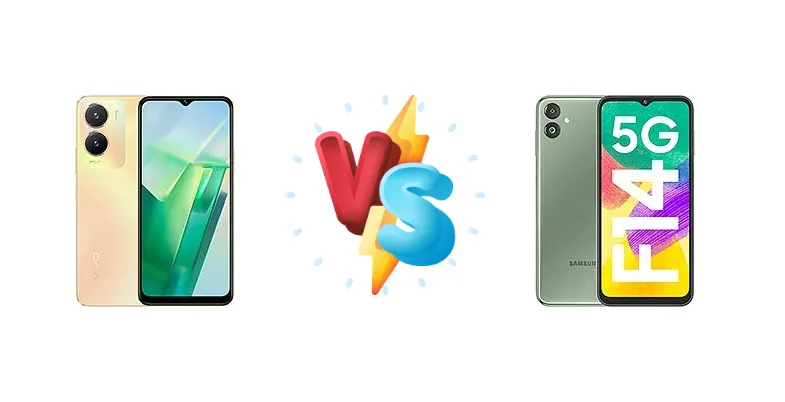
The budget smartphone market is fiercely competitive, and the vivo T2x and Samsung Galaxy F14 are two strong contenders. Both offer compelling features at an affordable price, but which one reigns supreme? This comprehensive comparison will help you decide which phone best suits your needs.
🏆 Quick Verdict
The Samsung Galaxy F14 edges out the vivo T2x thanks to its superior chipset (Exynos 1330), faster charging (25W vs 18W), and generally more polished software experience. While the T2x is a decent option, the F14 provides better overall value.
| Network |
|---|
| 2G bands | GSM 850 / 900 / 1800 / 1900 | GSM 850 / 900 / 1800 / 1900 |
| 3G bands | HSDPA 850 / 900 / 2100 | HSDPA 850 / 900 / 1700(AWS) / 1900 / 2100 |
| 4G bands | 1, 3, 5, 8, 38, 40, 41 | 1, 2, 3, 4, 5, 7, 8, 12, 17, 20, 26, 28, 38, 40, 41, 66 |
| 5G bands | 1, 3, 8, 28, 77, 78 SA/NSA | 1, 3, 5, 7, 8, 20, 28, 38, 40, 41, 66, 77, 78 SA/NSA/Sub6 |
| Speed | HSPA, LTE, 5G | HSPA, LTE-А, 5G |
| Technology | GSM / HSPA / LTE / 5G | GSM / HSPA / LTE / 5G |
| Launch |
|---|
| Announced | 2023, April 11 | 2023, March 24 |
| Status | Available. Released 2023, April 21 | Available. Released 2023, March 30 |
| Body |
|---|
| Build | Glass front, plastic frame, plastic back | Glass front (Gorilla Glass 5), plastic back, plastic frame |
| Dimensions | 164.1 x 75.6 x 8.2 mm (6.46 x 2.98 x 0.32 in) | 166.8 x 77.2 x 9.4 mm (6.57 x 3.04 x 0.37 in) |
| SIM | Nano-SIM + Nano-SIM | Nano-SIM + Nano-SIM |
| Weight | 184 g (6.49 oz) | 206 g (7.27 oz) |
| Display |
|---|
| Protection | - | Corning Gorilla Glass 5 |
| Resolution | 1080 x 2408 pixels, 20:9 ratio (~401 ppi density) | 1080 x 2408 pixels, 20:9 ratio (~400 ppi density) |
| Size | 6.58 inches, 104.3 cm2 (~84.1% screen-to-body ratio) | 6.6 inches, 104.9 cm2 (~81.5% screen-to-body ratio) |
| Type | IPS LCD | PLS LCD, 90Hz |
| Platform |
|---|
| CPU | Octa-core (2x2.2 GHz Cortex-A76 & 6x2.0 GHz Cortex-A55) | Octa-core (2x2.4 GHz Cortex-A78 & 6x2.0 GHz Cortex-A55) |
| Chipset | Mediatek Dimensity 6020 (7 nm) | Exynos 1330 (5 nm) |
| GPU | Mali-G57 MC2 | Mali-G68 MP2 |
| OS | Android 13, Funtouch 13 | Android 13, One UI Core 5.1 |
| Memory |
|---|
| Card slot | microSDXC (uses shared SIM slot) | microSDXC (dedicated slot) |
| Internal | 128GB 4GB RAM, 128GB 6GB RAM, 128GB 8GB RAM | 64GB 4GB RAM, 128GB 4GB RAM, 128GB 6GB RAM |
| Main Camera |
|---|
| Dual | 50 MP, f/1.8, 0.64µm, (wide), PDAF
2 MP (macro) | 50 MP, f/1.8, (wide), PDAF
2 MP (macro) |
| Features | LED flash, HDR, panorama | LED flash, panorama, HDR |
| Video | 1080p@30fps | 1080p@30fps |
| Selfie camera |
|---|
| Single | 8 MP, f/2.0, (wide) | 13 MP, f/2.0, (wide) |
| Video | Yes | 1080p@30fps |
| Sound |
|---|
| 3.5mm jack | Yes | Yes |
| 35mm jack | Yes | Yes |
| Loudspeaker | Yes | Yes |
| Comms |
|---|
| Bluetooth | 5.1, A2DP, LE | 5.2, A2DP, LE |
| NFC | No | No |
| Positioning | GPS, GLONASS, GALILEO, BDS, QZSS | GPS, GLONASS, GALILEO, BDS, QZSS, NavIC |
| Radio | FM radio | FM radio, recording |
| USB | USB Type-C 2.0, OTG | USB Type-C 2.0 |
| WLAN | Wi-Fi 802.11 a/b/g/n/ac, dual-band | Wi-Fi 802.11 a/b/g/n/ac, dual-band, Wi-Fi Direct |
| Features |
|---|
| Sensors | Fingerprint (side-mounted), accelerometer, proximity, compass | Fingerprint (side-mounted), accelerometer, gyro, proximity, compass |
| Battery |
|---|
| Charging | 18W wired | 25W wired |
| Type | 5000 mAh | Li-Po 6000 mAh |
| Misc |
|---|
| Colors | Glimmer Black, Aurora Gold, Marine Blue | Black, Green, Purple |
| Models | V2253 | SM-E146B, SM-E146B/DS |
| Price | About 150 EUR | About 150 EUR |
| SAR | - | 0.69 W/kg (head) |
vivo T2x (India)
- Potentially more affordable
- Compact design (likely)
- Decent battery life
- Weaker chipset
- Slower charging
- Less versatile camera
Samsung Galaxy F14
- Superior performance (Exynos 1330)
- Faster charging (25W)
- Better camera system
- Samsung's software support
- Potentially slightly more expensive
- Larger size
Display Comparison
Both phones feature a 6.6-inch FHD+ display, likely with a 90Hz refresh rate on the F14 and potentially a standard 60Hz on the T2x. The Samsung likely has slightly better color accuracy and brightness due to Samsung's display technology, though both offer a decent viewing experience for the price.
Camera Comparison
The Galaxy F14 is expected to have a more versatile camera system, likely featuring a 50MP main sensor with OIS, an ultrawide lens, and a macro lens. The vivo T2x likely has a simpler camera setup, potentially a 50MP main sensor and a depth sensor. Image quality and low-light performance will likely favor the F14.
Performance
The Exynos 1330 in the Galaxy F14 is significantly more powerful than the Dimensity 6020 in the vivo T2x. The 5nm process and Cortex-A78 cores give the F14 a noticeable advantage in gaming and multitasking. Expect smoother performance and less lag on the F14.
Battery Life
Both phones likely have a 6000mAh battery, offering excellent battery life. However, the Galaxy F14's 25W charging is faster than the vivo T2x's 18W charging, allowing for quicker top-ups.
Buying Guide
Who should buy the vivo T2x (India)? Users prioritizing a slightly more compact design and potentially a lower price point (depending on retailer deals) might find the T2x appealing. Who should buy the Samsung Galaxy F14? Those seeking better performance, faster charging, and the reliability of the Samsung brand should opt for the Galaxy F14.
Frequently Asked Questions
❓ Is the vivo T2x good for gaming?
The vivo T2x can handle basic games, but demanding titles will likely suffer from lag and reduced frame rates due to its less powerful chipset.
❓ Which phone has better software support?
Samsung generally provides longer software update support than vivo, making the Galaxy F14 a more future-proof choice.