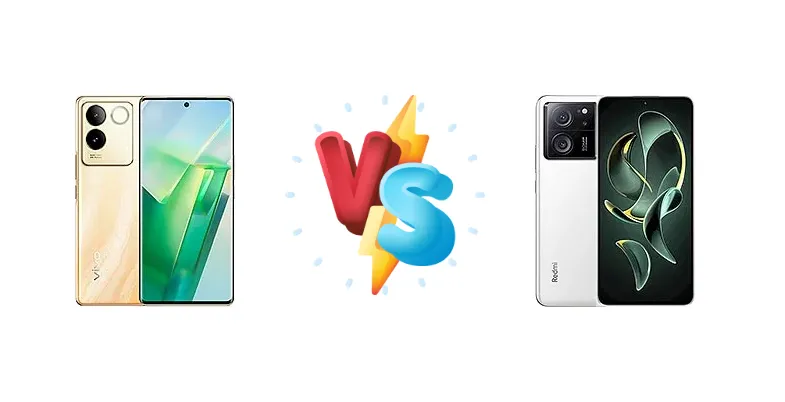
The Xiaomi Redmi K60 Ultra and vivo T2 Pro represent compelling options in the increasingly competitive mid-range smartphone market. Both leverage MediaTek's Dimensity series, but with significant differences in chipset choice and charging capabilities. This comparison dissects those differences, helping you determine which device best suits your needs.
🏆 Quick Verdict
For the average user prioritizing raw performance and rapid charging, the Xiaomi Redmi K60 Ultra is the clear winner. Its Dimensity 9200+ chipset delivers a noticeable performance uplift over the vivo T2 Pro’s Dimensity 7200, and the 120W charging significantly reduces downtime. However, the T2 Pro remains a strong contender for those seeking a balanced experience.
| Network |
|---|
| 2G bands | GSM 850 / 900 / 1800 / 1900 | GSM 850 / 900 / 1800 / 1900 |
| 3G bands | HSDPA 850 / 900 / 1900 / 2100 | HSDPA 800 / 850 / 900 / 1700(AWS) / 2100 |
| 4G bands | 1, 3, 4, 5, 8, 28, 34, 38, 39, 40, 41 | 1, 3, 4, 5, 8, 18, 19, 26, 34, 38, 39, 40, 41, 42, 66 |
| 5G bands | 1, 3, 5, 8, 28, 38, 40, 41, 77, 78 SA/NSA | 1, 3, 5, 8, 28, 38, 41, 66, 77, 78 SA/NSA |
| Speed | HSPA, LTE, 5G | HSPA, LTE, 5G |
| Technology | GSM / HSPA / LTE / 5G | GSM / CDMA / HSPA / CDMA2000 / LTE / 5G |
| Launch |
|---|
| Announced | 2023, September 22 | 2023, August 15 |
| Status | Available. Released 2023, September 29 | Available. Released 2023, August 15 |
| Body |
|---|
| Build | Glass front, plastic frame, glass back | - |
| Dimensions | 164.1 x 74.8 x 7.4 mm (6.46 x 2.94 x 0.29 in) | 162.2 x 75.7 x 8.5 mm (6.39 x 2.98 x 0.33 in) |
| SIM | Nano-SIM + Nano-SIM | Nano-SIM + Nano-SIM |
| Weight | 175 g (6.17 oz) | 204 g (7.20 oz) |
| Display |
|---|
| Protection | - | Unspecified |
| Resolution | 1080 x 2400 pixels, 20:9 ratio (~388 ppi density) | 1220 x 2712 pixels, 20:9 ratio (~446 ppi density) |
| Size | 6.78 inches, 111.0 cm2 (~90.4% screen-to-body ratio) | 6.67 inches, 107.4 cm2 (~87.5% screen-to-body ratio) |
| Type | AMOLED, 1B colors, 120Hz, HDR10+, 1300 nits (peak) | OLED, 68B colors, 144Hz, Dolby Vision, HDR10+, 2600 nits (peak) |
| Platform |
|---|
| CPU | Octa-core (2x2.8 GHz Cortex-A715 & 6x2.0 Cortex-A510) | Octa-core (1x3.35 GHz Cortex-X3 & 3x3.0 GHz Cortex-A715 & 4x2.0 GHz Cortex-A510) |
| Chipset | Mediatek Dimensity 7200 (4 nm) | Mediatek Dimensity 9200+ (4 nm) |
| GPU | Mali-G610 MC4 | Immortalis-G715 MC11 |
| OS | Android 13, Funtouch 13 | Android 13, MIUI 14 |
| Memory |
|---|
| Card slot | No | No |
| Internal | 128GB 8GB RAM, 256GB 8GB RAM | 256GB 12GB RAM, 256GB 16GB RAM, 512GB 16GB RAM, 1TB 16GB RAM, 1TB 24GB RAM |
| Main Camera |
|---|
| Dual | 64 MP, f/1.8, 26mm (wide), PDAF, OIS
Auxiliary lens | - |
| Features | Ring-LED flash, panorama, HDR | Color spectrum sensor, Dual-LED dual-tone flash, HDR, panorama |
| Triple | - | 50 MP, f/1.7, (wide), 1/1.49", 1.0µm, PDAF, OIS
8 MP, 119˚ (ultrawide), 1/4.0", 1.12µm
2 MP (macro) |
| Video | 4K@30fps, 1080p@30fps, gyro-EIS | 8K@24fps, 4K@30/60fps, 1080p@30/60/120/240/960fps, gyro-EIS, HDR10+, 10-bit |
| Selfie camera |
|---|
| Features | - | HDR |
| Single | 16 MP, f/2.5, (wide) | 20 MP, (wide), 1/2.0", 0.8µm |
| Video | 1080p@30fps | 1080p@30/120fps |
| Sound |
|---|
| 35mm jack | No | No |
| Loudspeaker | Yes | Yes, with stereo speakers |
| Comms |
|---|
| Bluetooth | 5.3, A2DP, LE | 5.4, A2DP, LE |
| Infrared port | - | Yes |
| NFC | No | Yes |
| Positioning | GPS, GLONASS, GALILEO, BDS, QZSS | GPS (L1+L5), GLONASS (G1), BDS (B1I+B1C+B2a+B2b), GALILEO (E1+E5a), QZSS (L1+L5), NavIC |
| Radio | Unspecified | Unspecified |
| USB | USB Type-C 2.0, OTG | USB Type-C, OTG |
| WLAN | Wi-Fi 802.11 a/b/g/n/ac, dual-band | Wi-Fi 802.11 a/b/g/n/ac/6e, dual-band, Wi-Fi Direct |
| Features |
|---|
| Sensors | Fingerprint (under display, optical), accelerometer, gyro, proximity, compass | Fingerprint (under display, optical), accelerometer, gyro, proximity, compass |
| Battery |
|---|
| Charging | 66W wired, 50% in 22 min | 120W wired, PD3.0, 100% in 19 min |
| Type | Li-Ion 4600 mAh | Li-Po 5000 mAh |
| Misc |
|---|
| Colors | Moon Black, Dune Gold | Black, White, Green |
| Models | - | 23078RKD5C |
| Price | About 250 EUR | About 330 EUR |
vivo T2 Pro
- Faster 66W charging offers convenience.
- Potentially more efficient Dimensity 7200 chipset.
- Likely a more streamlined software experience.
- Significantly less powerful Dimensity 7200 chipset.
- Slower charging compared to the K60 Ultra.
Xiaomi Redmi K60 Ultra
- Superior performance with the Dimensity 9200+.
- Ultra-fast 120W charging for minimal downtime.
- More advanced ISP for potentially better image processing.
- MIUI software can be feature-rich but complex.
- Potentially higher power consumption due to the more powerful chipset.
Display Comparison
While both devices likely feature high-refresh-rate AMOLED displays (data not provided), the core difference lies in the processing power driving them. The Redmi K60 Ultra, benefiting from the more powerful chipset, will likely handle graphically intensive tasks and high-refresh-rate gaming with greater ease. Without specific display specs, it's difficult to assess color accuracy or peak brightness, but the K60 Ultra’s superior processing power suggests a smoother overall visual experience.
Camera Comparison
Without detailed camera specifications, a direct comparison is limited. However, the chipset’s image signal processor (ISP) plays a crucial role. The Dimensity 9200+ in the K60 Ultra features a more advanced ISP, potentially leading to better image processing, noise reduction, and dynamic range. While both phones likely offer capable camera systems, the K60 Ultra’s superior processing power gives it an advantage in computational photography.
Performance
The performance gap is the most significant differentiator. The Xiaomi Redmi K60 Ultra’s Dimensity 9200+ boasts a prime Cortex-X3 core clocked at 3.35 GHz, a substantial upgrade over the vivo T2 Pro’s Dimensity 7200, which uses Cortex-A715 cores at 2.8 GHz. This translates to a noticeable advantage in CPU-intensive tasks like video editing and demanding games. The K60 Ultra’s GPU will also outperform the T2 Pro’s, offering higher frame rates and better graphics settings. Both utilize a 4nm process, but the architectural improvements in the 9200+ provide a clear edge.
Battery Life
The Redmi K60 Ultra’s 120W charging is a game-changer, achieving a full charge in just 19 minutes. The vivo T2 Pro’s 66W charging, while respectable, takes approximately 22 minutes to reach 50% and significantly longer for a full charge. This difference in charging speed is a major convenience factor for users who frequently need to top up their battery. While battery capacity isn’t specified, the faster charging of the K60 Ultra effectively mitigates any potential disadvantage from a slightly smaller battery.
Buying Guide
Buy the vivo T2 Pro if you prioritize a balanced experience with respectable performance and efficient charging, and are looking for a slightly more streamlined software experience. Buy the Xiaomi Redmi K60 Ultra if you demand the highest possible performance within this price bracket, need the fastest possible charging speeds, and don't mind a more feature-rich (and potentially complex) MIUI software experience.
Frequently Asked Questions
❓ Does the Xiaomi Redmi K60 Ultra’s Dimensity 9200+ chipset generate excessive heat during prolonged gaming sessions?
The Dimensity 9200+ is known for its performance, but thermal management is crucial. Xiaomi typically employs robust cooling solutions in their ‘Ultra’ series, including vapor chamber cooling. While some heat generation is inevitable during intense gaming, the K60 Ultra is expected to manage temperatures effectively to prevent significant throttling, offering sustained performance.
❓ Is the 66W charging on the vivo T2 Pro sufficient for daily use, or is the 120W on the K60 Ultra a necessity?
66W charging is still quite fast and will adequately charge the phone overnight. However, the 120W charging on the K60 Ultra is a significant convenience boost, allowing for a full charge in under 20 minutes. If you frequently find yourself needing to quickly top up your battery throughout the day, the 120W charging is a worthwhile advantage.
❓ How does the software experience differ between the vivo T2 Pro and the Xiaomi Redmi K60 Ultra?
The vivo T2 Pro likely runs Funtouch OS, known for being relatively clean and streamlined. The Redmi K60 Ultra runs MIUI, which is highly customizable and feature-rich, but can also be more complex and include pre-installed bloatware. The choice depends on your preference for software simplicity versus extensive customization options.