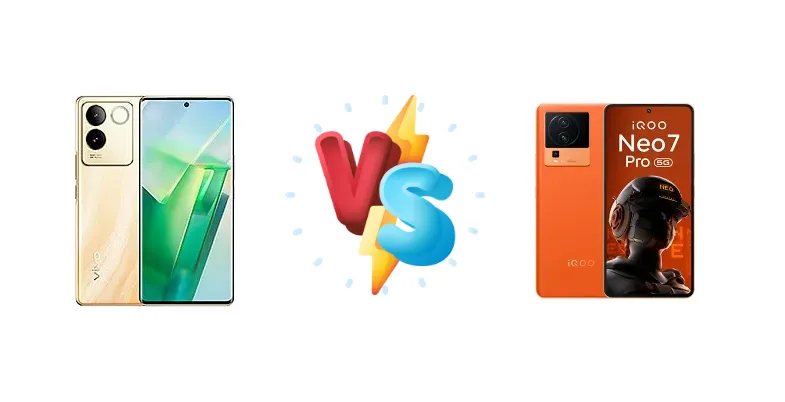
vivo's sub-brands, iQOO and the standard vivo line, often overlap in the mid-range segment. The iQOO Neo 7 Pro and vivo T2 Pro represent distinct approaches: the iQOO prioritizes raw performance with a flagship-tier chipset, while the T2 Pro aims for a balance of efficiency and features. This comparison dissects their key differences to determine which phone best suits your needs.
🏆 Quick Verdict
For users prioritizing gaming and demanding tasks, the vivo iQOO Neo 7 Pro is the clear winner thanks to its Snapdragon 8+ Gen 1. However, the vivo T2 Pro offers a compelling alternative for everyday use with its efficient Dimensity 7200 and respectable charging speeds, making it a strong contender for budget-conscious buyers.
| Network |
|---|
| 2G bands | GSM 850 / 900 / 1800 / 1900 | GSM 850 / 900 / 1800 / 1900 |
| 3G bands | HSDPA 850 / 900 / 1900 / 2100 | HSDPA 800 / 850 / 900 / 1700(AWS) / 1900 / 2100 |
| 4G bands | 1, 3, 4, 5, 8, 28, 34, 38, 39, 40, 41 | 1, 2, 3, 4, 5, 8, 28, 34, 38, 39, 40, 41 |
| 5G bands | 1, 3, 5, 8, 28, 38, 40, 41, 77, 78 SA/NSA | 1, 3, 5, 8, 28, 40, 77, 78 SA/NSA |
| Speed | HSPA, LTE, 5G | HSPA, LTE, 5G |
| Technology | GSM / HSPA / LTE / 5G | GSM / HSPA / LTE / 5G |
| Launch |
|---|
| Announced | 2023, September 22 | 2023, July 04 |
| Status | Available. Released 2023, September 29 | Available. Released 2023, July 15 |
| Body |
|---|
| Build | Glass front, plastic frame, glass back | Glass front, plastic frame, glass or leather back |
| Dimensions | 164.1 x 74.8 x 7.4 mm (6.46 x 2.94 x 0.29 in) | 164.8 x 76.9 x 8.5 mm or 8.9 mm |
| SIM | Nano-SIM + Nano-SIM | Nano-SIM + Nano-SIM |
| Weight | 175 g (6.17 oz) | 197 g or 202 g (6.95 oz) |
| Display |
|---|
| Resolution | 1080 x 2400 pixels, 20:9 ratio (~388 ppi density) | 1080 x 2400 pixels, 20:9 ratio (~388 ppi density) |
| Size | 6.78 inches, 111.0 cm2 (~90.4% screen-to-body ratio) | 6.78 inches, 111.0 cm2 (~87.6% screen-to-body ratio) |
| Type | AMOLED, 1B colors, 120Hz, HDR10+, 1300 nits (peak) | AMOLED, 1B colors, 120Hz, HDR10+, 1300 nits (peak) |
| Platform |
|---|
| CPU | Octa-core (2x2.8 GHz Cortex-A715 & 6x2.0 Cortex-A510) | Octa-core (1x3.19 GHz Cortex-X2 & 3x2.75 GHz Cortex-A710 & 4x2.0 GHz Cortex-A510) |
| Chipset | Mediatek Dimensity 7200 (4 nm) | Qualcomm SM8475 Snapdragon 8+ Gen 1 (4 nm) |
| GPU | Mali-G610 MC4 | Adreno 730 |
| OS | Android 13, Funtouch 13 | Android 13, Funtouch 13 |
| Memory |
|---|
| Card slot | No | No |
| Internal | 128GB 8GB RAM, 256GB 8GB RAM | 128GB 8GB RAM, 256GB 12GB RAM |
| Main Camera |
|---|
| Dual | 64 MP, f/1.8, 26mm (wide), PDAF, OIS
Auxiliary lens | - |
| Features | Ring-LED flash, panorama, HDR | LED flash, HDR, panorama |
| Triple | - | 50 MP, f/1.9, 24mm (wide), 1/1.57", 1.0µm, PDAF, OIS
8 MP, f/2.2, 16mm (ultrawide), 1/4.0", 1.12µm
2 MP (macro) |
| Video | 4K@30fps, 1080p@30fps, gyro-EIS | 4K@30fps, 1080p@30fps |
| Selfie camera |
|---|
| Features | - | HDR |
| Single | 16 MP, f/2.5, (wide) | 16 MP, f/2.5, (wide), 1/3.1", 1.0µm |
| Video | 1080p@30fps | 1080p@30fps |
| Sound |
|---|
| 35mm jack | No | No |
| Loudspeaker | Yes | Yes, with stereo speakers |
| Comms |
|---|
| Bluetooth | 5.3, A2DP, LE | 5.3, A2DP, LE, aptX HD, aptX Adaptive |
| Infrared port | - | Yes |
| NFC | No | No |
| Positioning | GPS, GLONASS, GALILEO, BDS, QZSS | GPS, GLONASS, GALILEO, BDS, QZSS, NavIC |
| Radio | Unspecified | No |
| USB | USB Type-C 2.0, OTG | USB Type-C 2.0, OTG |
| WLAN | Wi-Fi 802.11 a/b/g/n/ac, dual-band | Wi-Fi 802.11 a/b/g/n/ac/6, dual-band, Wi-Fi Direct |
| Features |
|---|
| Sensors | Fingerprint (under display, optical), accelerometer, gyro, proximity, compass | Fingerprint (under display, optical), accelerometer, gyro, proximity, compass |
| Battery |
|---|
| Charging | 66W wired, 50% in 22 min | 120W wired, 50% in 8 min |
| Type | Li-Ion 4600 mAh | 5000 mAh |
| Misc |
|---|
| Colors | Moon Black, Dune Gold | Fearless Flame, Dark Storm |
| Models | - | I2217 |
| Price | About 250 EUR | About 380 EUR |
vivo T2 Pro
- Faster Snapdragon 8+ Gen 1 processor
- Significantly faster 120W charging
- Potentially superior camera performance
- Potentially shorter battery life due to power-hungry chipset
- May run hotter under sustained load
vivo iQOO Neo 7 Pro
- More efficient Dimensity 7200 processor
- Good balance of performance and battery life
- Competitive 66W charging
- Lower peak performance compared to Snapdragon 8+ Gen 1
- May struggle with demanding games at high settings
Display Comparison
While both phones likely feature AMOLED panels (based on brand standards), specific details like peak brightness and refresh rates are missing. However, the core difference lies in the processing power driving them. The Snapdragon 8+ Gen 1 in the iQOO Neo 7 Pro will handle graphically intensive games and high refresh rates with greater ease, potentially offering a smoother visual experience. The T2 Pro's Dimensity 7200 is capable, but will be more constrained in demanding scenarios.
Camera Comparison
Without detailed camera specs, it's difficult to make a definitive judgment. However, iQOO phones often prioritize camera performance, and the Neo 7 Pro is likely to feature a more sophisticated camera system. The Snapdragon 8+ Gen 1’s ISP (Image Signal Processor) is more advanced, enabling faster image processing and potentially better low-light performance. The T2 Pro’s Dimensity 7200 ISP is capable, but will likely lag behind in complex scenarios. Expect the iQOO Neo 7 Pro to offer more features like 4K video recording at higher frame rates and potentially better dynamic range.
Performance
The iQOO Neo 7 Pro’s Qualcomm Snapdragon 8+ Gen 1 (4nm) is a significant step up from the vivo T2 Pro’s MediaTek Dimensity 7200 (4nm). The Snapdragon 8+ Gen 1 boasts a prime Cortex-X2 core clocked at 3.19 GHz, alongside three Cortex-A710 cores at 2.75 GHz, offering superior single-core and multi-core performance. The T2 Pro’s configuration of 2x Cortex-A715 at 2.8 GHz and 6x Cortex-A510 at 2.0 GHz is more focused on efficiency. This translates to faster app loading, smoother multitasking, and higher frame rates in games on the iQOO Neo 7 Pro. Both chips are built on a 4nm process, but the architectural advantages of the Snapdragon 8+ Gen 1 provide a clear performance edge. The iQOO Neo 7 Pro will also benefit from potentially faster LPDDR5x RAM configurations, further boosting performance.
Battery Life
The iQOO Neo 7 Pro’s 120W wired charging is a game-changer, achieving 50% charge in just 8 minutes. This is significantly faster than the vivo T2 Pro’s 66W charging, which takes 22 minutes for the same level. While battery capacity isn't specified, the faster charging of the iQOO Neo 7 Pro mitigates any potential disadvantage from a slightly smaller battery. The Snapdragon 8+ Gen 1 is known to be more power-hungry than the Dimensity 7200, so the iQOO Neo 7 Pro may require more frequent charging despite the faster speeds.
Buying Guide
Buy the vivo T2 Pro if you need a reliable daily driver with good battery life and fast charging, and don't plan on pushing the phone with intensive gaming or video editing. Buy the vivo iQOO Neo 7 Pro if you prioritize maximum performance for gaming, multitasking, and future-proofing, and are willing to accept potentially shorter battery life and more aggressive thermal management.
Frequently Asked Questions
❓ Will the Snapdragon 8+ Gen 1 in the iQOO Neo 7 Pro overheat during prolonged gaming sessions?
The Snapdragon 8+ Gen 1 is known to generate heat under sustained load. However, iQOO typically implements robust cooling solutions, including vapor chamber cooling, to mitigate thermal throttling. Expect some performance reduction after extended gaming, but it should remain playable. The T2 Pro's Dimensity 7200 will likely run cooler, but at the cost of peak performance.
❓ Is the 66W charging on the vivo T2 Pro slow compared to the iQOO Neo 7 Pro's 120W?
While 120W is significantly faster, 66W is still a respectable charging speed. It will still top up the battery quickly enough for most users. The difference is most noticeable when you need a very rapid charge – going from near empty to 50% in under 10 minutes with the iQOO Neo 7 Pro is a substantial convenience.
❓ Does the Dimensity 7200 in the vivo T2 Pro support high frame rates in popular games like PUBG Mobile?
The Dimensity 7200 can handle PUBG Mobile at high frame rates (60fps) with optimized settings. However, achieving consistently smooth 90fps gameplay may require lowering graphics settings. The iQOO Neo 7 Pro's Snapdragon 8+ Gen 1 will provide a more consistent and higher frame rate experience.