
vivo T2 Pro vs Nothing Phone (2): A Detailed Performance and Value Showdown
| Phones Images | |||||
|---|---|---|---|---|---|
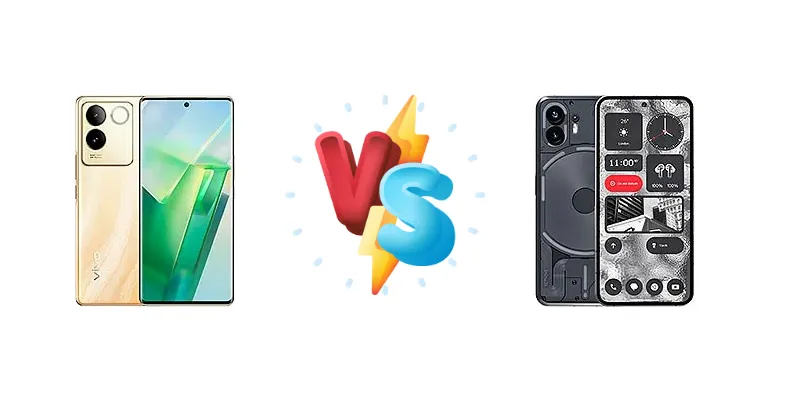
|
🏆 Quick Verdict
For most users, the Nothing Phone (2) emerges as the stronger overall package. Its Snapdragon 8+ Gen 1 chipset delivers significantly superior performance, and its longer battery life, coupled with wireless charging, provides a more versatile experience. However, the vivo T2 Pro offers a compelling alternative for budget-conscious users prioritizing raw charging speed.
| PHONES | ||
|---|---|---|
| Phone Names | vivo T2 Pro | Nothing Phone (2) |
| Network | ||
|---|---|---|
| 2G bands | GSM 850 / 900 / 1800 / 1900 | GSM 850 / 900 / 1800 / 1900 |
| 3G bands | HSDPA 850 / 900 / 1900 / 2100 | HSDPA 800 / 850 / 900 / 1700(AWS) / 1900 / 2100 |
| 4G bands | 1, 3, 4, 5, 8, 28, 34, 38, 39, 40, 41 | 1, 2, 3, 4, 5, 7, 8, 12, 17, 18, 19, 20, 25, 26, 28, 30, 32, 34, 38, 39, 40, 41, 42, 48, 66, 71 |
| 5G bands | 1, 3, 5, 8, 28, 38, 40, 41, 77, 78 SA/NSA | 1, 2, 3, 5, 7, 8, 12, 20, 25, 28, 30, 38, 40, 41, 66, 71, 75, 77, 78 SA/NSA |
| Speed | HSPA, LTE, 5G | HSPA, LTE, 5G |
| Technology | GSM / HSPA / LTE / 5G | GSM / HSPA / LTE / 5G |
| Launch | ||
|---|---|---|
| Announced | 2023, September 22 | 2023, July 11 |
| Status | Available. Released 2023, September 29 | Available. Released 2023, July 17 |
| Body | ||
|---|---|---|
| Build | Glass front, plastic frame, glass back | Glass front (Gorilla Glass 5), glass back (Gorilla Glass 5), aluminum frame |
| Dimensions | 164.1 x 74.8 x 7.4 mm (6.46 x 2.94 x 0.29 in) | 162.1 x 76.4 x 8.6 mm (6.38 x 3.01 x 0.34 in) |
| SIM | Nano-SIM + Nano-SIM | Nano-SIM + Nano-SIM |
| Weight | 175 g (6.17 oz) | 201.2 g (7.09 oz) |
| Display | ||
|---|---|---|
| Protection | - | Corning Gorilla Glass 5 |
| Resolution | 1080 x 2400 pixels, 20:9 ratio (~388 ppi density) | 1080 x 2412 pixels, 20:9 ratio (~394 ppi density) |
| Size | 6.78 inches, 111.0 cm2 (~90.4% screen-to-body ratio) | 6.7 inches, 108.0 cm2 (~87.2% screen-to-body ratio) |
| Type | AMOLED, 1B colors, 120Hz, HDR10+, 1300 nits (peak) | LTPO OLED, 1B colors, 120Hz, 1920Hz PWM, HDR10+, 1600 nits (HBM), 1600 nits (peak) |
| Platform | ||
|---|---|---|
| CPU | Octa-core (2x2.8 GHz Cortex-A715 & 6x2.0 Cortex-A510) | Octa-core (1x3.0 GHz Cortex-X2 & 3x2.5 GHz Cortex-A710 & 4x1.80 GHz Cortex-A510) |
| Chipset | Mediatek Dimensity 7200 (4 nm) | Qualcomm SM8475 Snapdragon 8+ Gen 1 (4 nm) |
| GPU | Mali-G610 MC4 | Adreno 730 |
| OS | Android 13, Funtouch 13 | Android 13, upgradable to Android 15, up to 3 major Android upgrades, Nothing OS 3.0 |
| Memory | ||
|---|---|---|
| Card slot | No | No |
| Internal | 128GB 8GB RAM, 256GB 8GB RAM | 128GB 8GB RAM, 256GB 12GB RAM, 512GB 12GB RAM |
| Main Camera | ||
|---|---|---|
| Dual | 64 MP, f/1.8, 26mm (wide), PDAF, OIS Auxiliary lens | 50 MP, f/1.9, 24mm (wide), 1/1.56", 1.0µm, PDAF, OIS 50 MP, f/2.2, 114˚ (ultrawide), 1/2.76", 0.64µm, AF |
| Features | Ring-LED flash, panorama, HDR | LED flash, panorama, HDR |
| Video | 4K@30fps, 1080p@30fps, gyro-EIS | 4K@30/60fps, 1080p@30/60fps, gyro-EIS, live HDR, OIS |
| Selfie camera | ||
|---|---|---|
| Features | - | HDR |
| Single | 16 MP, f/2.5, (wide) | 32 MP, f/2.5, (wide), 1/2.74", 0.8µm |
| Video | 1080p@30fps | 1080p@30fps |
| Sound | ||
|---|---|---|
| 35mm jack | No | No |
| Loudspeaker | Yes | Yes, with stereo speakers |
| Comms | ||
|---|---|---|
| Bluetooth | 5.3, A2DP, LE | 5.3, A2DP, LE, aptX HD, aptX Adaptive |
| NFC | No | Yes |
| Positioning | GPS, GLONASS, GALILEO, BDS, QZSS | GPS (L1+L5), GLONASS (L1), BDS (B1I+B1c), GALILEO (E1), QZSS (L1), NavIC |
| Radio | Unspecified | No |
| USB | USB Type-C 2.0, OTG | USB Type-C 2.0, OTG |
| WLAN | Wi-Fi 802.11 a/b/g/n/ac, dual-band | Wi-Fi 802.11 a/b/g/n/ac/6, dual-band, Wi-Fi Direct |
| Features | ||
|---|---|---|
| Sensors | Fingerprint (under display, optical), accelerometer, gyro, proximity, compass | Fingerprint (under display, optical), accelerometer, proximity, gyro, compass |
| Battery | ||
|---|---|---|
| Charging | 66W wired, 50% in 22 min | 45W wired, PD3.0, PPS, QC4, 100% in 55 min 15W wireless, 100% in 130 min 5W reverse wireless |
| Type | Li-Ion 4600 mAh | Li-Ion 4700 mAh |
| Misc | ||
|---|---|---|
| Colors | Moon Black, Dune Gold | White, Dark Gray |
| Models | - | A065 |
| Price | About 250 EUR | $ 379.99 / £ 370.00 |
vivo T2 Pro
- Extremely fast 66W wired charging
- Potentially more affordable price point
- Capable Dimensity 7200 chipset for everyday tasks
- Missing detailed camera specifications
- Likely lower performance compared to Snapdragon 8+ Gen 1
- No wireless charging support
Nothing Phone (2)
- Powerful Snapdragon 8+ Gen 1 processor
- Excellent battery life (14:21h active use)
- Wireless and reverse wireless charging
- Slower 45W wired charging compared to vivo T2 Pro
- Higher price tag
- Glyph Interface may not appeal to all users
Display Comparison
The Nothing Phone (2) boasts a brighter display, reaching a measured peak of 998 nits, which translates to better visibility outdoors compared to the unspecified brightness of the vivo T2 Pro. While both utilize 4nm chipsets, display technology details for the T2 Pro are missing; however, the Nothing Phone (2)'s panel is known for its accurate color reproduction and smooth scrolling. The absence of LTPO on either device suggests neither offers adaptive refresh rate for maximum power efficiency.
Camera Comparison
Detailed camera specs for the vivo T2 Pro are unavailable, making a direct comparison challenging. However, the Nothing Phone (2) is equipped with a dual 50MP camera system, likely featuring Optical Image Stabilization (OIS) on the main sensor. The Snapdragon 8+ Gen 1’s image signal processor (ISP) offers advanced computational photography capabilities, resulting in improved image quality, especially in low-light conditions. Without knowing the sensor sizes and apertures of the T2 Pro’s cameras, it’s difficult to assess its photographic capabilities, but the Nothing Phone (2) likely holds an edge in overall image quality and video recording.
Performance
The core difference lies in the chipsets. The Nothing Phone (2) is powered by the Qualcomm Snapdragon 8+ Gen 1 (4nm), featuring a Cortex-X2 prime core clocked at 3.0 GHz, while the vivo T2 Pro utilizes the MediaTek Dimensity 7200 (4nm) with a Cortex-A715 prime core at 2.8 GHz. The Snapdragon 8+ Gen 1’s architecture, with its more powerful Cortex-X2 core and superior GPU, provides a substantial performance advantage in demanding applications and gaming. The Dimensity 7200 is still a capable chip, but it’s positioned a tier below. Both phones utilize an octa-core configuration, but the Snapdragon’s core arrangement is optimized for peak performance.
Battery Life
The Nothing Phone (2) excels in battery endurance, achieving an active use score of 14:21 hours and an endurance rating of 103 hours. While the vivo T2 Pro’s battery capacity is unknown, its 66W wired charging is significantly faster than the Nothing Phone (2)’s 45W charging (taking 55 minutes for a full charge). The Nothing Phone (2) also offers 15W wireless charging and 5W reverse wireless charging, features absent on the T2 Pro. The faster charging of the T2 Pro is beneficial for quick top-ups, but the Nothing Phone (2) provides longer runtimes between charges and added convenience with wireless charging.
Buying Guide
Buy the vivo T2 Pro if you need the absolute fastest wired charging available and prioritize value above all else. It’s ideal for users who frequently find themselves needing a quick power boost. Buy the Nothing Phone (2) if you prefer a more premium experience with a powerful processor for demanding tasks, longer battery life, and the convenience of wireless charging, even if it comes at a higher price point.