
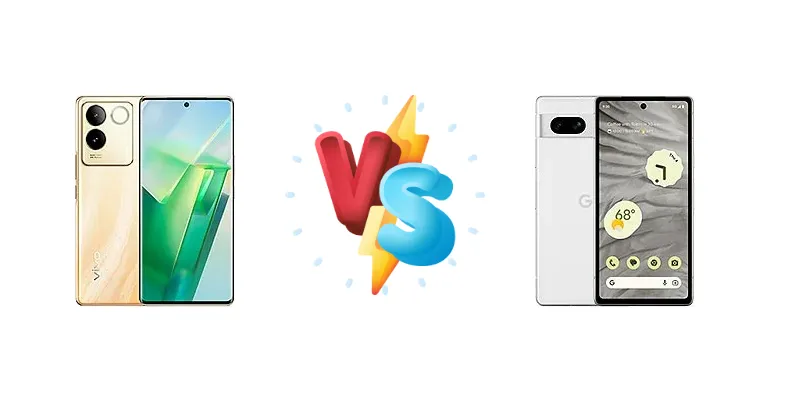
vivo T2 Pro vs. Google Pixel 7a: Which Mid-Range Champion Reigns Supreme?
| Phones Images | |||||
|---|---|---|---|---|---|
|
🏆 Quick Verdict
For users prioritizing raw processing power and faster charging, the vivo T2 Pro is the better choice. However, the Google Pixel 7a excels in camera capabilities and offers a more refined software experience, making it ideal for photography enthusiasts and those deeply integrated into the Google ecosystem.
| PHONES | ||
|---|---|---|
| Phone Names | vivo T2 Pro | Google Pixel 7a |
| Network | ||
|---|---|---|
| 2G bands | GSM 850 / 900 / 1800 / 1900 | GSM 850 / 900 / 1800 / 1900 |
| 3G bands | HSDPA 850 / 900 / 1900 / 2100 | HSDPA 800 / 850 / 900 / 1700(AWS) / 1900 / 2100 |
| 4G bands | 1, 3, 4, 5, 8, 28, 34, 38, 39, 40, 41 | 1, 2, 3, 4, 5, 7, 8, 12, 13, 14, 17, 20, 25, 26, 28, 29, 30, 38, 40, 41, 48, 66, 71 - GWKK3, G0DZQ |
| 5G bands | 1, 3, 5, 8, 28, 38, 40, 41, 77, 78 SA/NSA | 1, 2, 3, 5, 7, 8, 12, 14, 20, 25, 28, 30, 38, 41, 48, 66, 71, 77, 78 SA/NSA/Sub6 - GWKK3 |
| Speed | HSPA, LTE, 5G | HSPA, LTE, 5G |
| Technology | GSM / HSPA / LTE / 5G | GSM / HSPA / LTE / 5G |
| - | 1, 2, 3, 5, 7, 8, 12, 20, 25, 28, 38, 40, 41, 66, 75, 76, 77, 78, 79 SA/NSA/Sub6 - GHL1X, G82U8 | |
| Launch | ||
|---|---|---|
| Announced | 2023, September 22 | 2023, May 10 |
| Status | Available. Released 2023, September 29 | Available. Released 2023, May 10 |
| Body | ||
|---|---|---|
| Build | Glass front, plastic frame, glass back | Glass front (Gorilla Glass 3), aluminum frame, plastic back |
| Dimensions | 164.1 x 74.8 x 7.4 mm (6.46 x 2.94 x 0.29 in) | 152 x 72.9 x 9 mm (5.98 x 2.87 x 0.35 in) |
| SIM | Nano-SIM + Nano-SIM | Nano-SIM + eSIM |
| Weight | 175 g (6.17 oz) | 193.5 g (6.84 oz) |
| - | IP67 dust/water resistant (up to 1m for 30 min) | |
| Display | ||
|---|---|---|
| Protection | - | Corning Gorilla Glass 3 |
| Resolution | 1080 x 2400 pixels, 20:9 ratio (~388 ppi density) | 1080 x 2400 pixels, 20:9 ratio (~429 ppi density) |
| Size | 6.78 inches, 111.0 cm2 (~90.4% screen-to-body ratio) | 6.1 inches, 90.7 cm2 (~81.8% screen-to-body ratio) |
| Type | AMOLED, 1B colors, 120Hz, HDR10+, 1300 nits (peak) | OLED, HDR, 90Hz |
| - | Always-on display | |
| Platform | ||
|---|---|---|
| CPU | Octa-core (2x2.8 GHz Cortex-A715 & 6x2.0 Cortex-A510) | Octa-core (2x2.85 GHz Cortex-X1 & 2x2.35 GHz Cortex-A78 & 4x1.80 GHz Cortex-A55) |
| Chipset | Mediatek Dimensity 7200 (4 nm) | Google Tensor G2 (5 nm) |
| GPU | Mali-G610 MC4 | Mali-G710 MP7 |
| OS | Android 13, Funtouch 13 | Android 13, upgradable to Android 15, up to 5 major Android upgrades |
| Memory | ||
|---|---|---|
| Card slot | No | No |
| Internal | 128GB 8GB RAM, 256GB 8GB RAM | 128GB 8GB RAM |
| - | UFS 3.1 | |
| Main Camera | ||
|---|---|---|
| Dual | 64 MP, f/1.8, 26mm (wide), PDAF, OIS Auxiliary lens | 64 MP, f/1.9, 26mm (wide), 1/1.73", 0.8µm, dual pixel PDAF, OIS 13 MP, f/2.2, 120˚ (ultrawide), 1.12µm |
| Features | Ring-LED flash, panorama, HDR | Dual-LED flash, Pixel Shift, Auto-HDR, panorama |
| Video | 4K@30fps, 1080p@30fps, gyro-EIS | 4K@30/60fps, 1080p@30/60/120/240fps, OIS |
| Selfie camera | ||
|---|---|---|
| Features | - | HDR, panorama |
| Single | 16 MP, f/2.5, (wide) | 13 MP, f/2.2, 20mm (ultrawide), 1.12µm |
| Video | 1080p@30fps | 4K@30fps, 1080p@30fps |
| Sound | ||
|---|---|---|
| 3.5mm jack | - | No |
| 35mm jack | No | No |
| Loudspeaker | Yes | Yes, with stereo speakers |
| Comms | ||
|---|---|---|
| Bluetooth | 5.3, A2DP, LE | 5.3, A2DP, LE |
| NFC | No | Yes |
| Positioning | GPS, GLONASS, GALILEO, BDS, QZSS | GPS, GLONASS, GALILEO, BDS, QZSS, NavIC |
| Radio | Unspecified | No |
| USB | USB Type-C 2.0, OTG | USB Type-C 3.2 |
| WLAN | Wi-Fi 802.11 a/b/g/n/ac, dual-band | Wi-Fi 802.11 a/b/g/n/ac/6e, tri-band |
| Features | ||
|---|---|---|
| Sensors | Fingerprint (under display, optical), accelerometer, gyro, proximity, compass | Fingerprint (under display, optical), accelerometer, gyro, proximity, compass, barometer |
| Battery | ||
|---|---|---|
| Charging | 66W wired, 50% in 22 min | 18W wired, PD3.0 7.5W wireless |
| Type | Li-Ion 4600 mAh | Li-Po 4385 mAh |
| Misc | ||
|---|---|---|
| Colors | Moon Black, Dune Gold | Charcoal, Snow, Sea, Coral |
| Models | - | GWKK3, GHL1X, G0DZQ, G82U8 |
| Price | About 250 EUR | € 179.90 / $ 150.00 / £ 170.00 / ₹ 25,980 |
vivo T2 Pro
- Faster 66W wired charging
- Potentially better multi-core performance with Dimensity 7200
- Likely more affordable price point
- No wireless charging
- Camera likely inferior to Pixel 7a
- Software updates may be less frequent
Google Pixel 7a
- Exceptional camera quality and image processing
- Clean Android experience with guaranteed updates
- Wireless charging support
- Slower 18W wired charging
- Tensor G2 may throttle under sustained load
- Generally higher price
Display Comparison
The Pixel 7a boasts a measured peak brightness of 1070 nits, providing excellent visibility in direct sunlight. While the vivo T2 Pro’s display specifications aren’t provided, it’s likely to be slightly dimmer. The Pixel 7a’s display technology is optimized for color accuracy and clarity, crucial for photo and video consumption. The absence of LTPO on either device means refresh rates are likely fixed, impacting battery efficiency during dynamic content viewing. Bezels appear comparable based on available imagery, but the Pixel 7a’s smaller overall size may offer a slightly more immersive experience.
Camera Comparison
The Pixel 7a is renowned for its computational photography prowess, leveraging Google’s image processing algorithms to deliver stunning results, even in challenging lighting conditions. While specific sensor details for the T2 Pro are missing, the Pixel 7a’s camera system is likely to outperform it in dynamic range and low-light performance. The Pixel 7a’s video capabilities are also exceptional, with excellent stabilization and dynamic range. The T2 Pro may offer competitive hardware, but it lacks the software advantage of the Pixel 7a. Ignoring the likely-low-resolution macro sensors on both devices, the main sensor and image processing are the key differentiators here.
Performance
The core difference lies in the chipsets. The vivo T2 Pro’s Mediatek Dimensity 7200 (4nm) utilizes a dual-cluster architecture with 2x Cortex-A715 cores clocked at 2.8 GHz for peak performance and 6x Cortex-A510 cores for efficiency. The Pixel 7a’s Google Tensor G2 (5nm) employs a tri-cluster setup: 2x Cortex-X1 (2.85 GHz), 2x Cortex-A78 (2.35 GHz), and 4x Cortex-A55 (1.80 GHz). The Tensor G2’s Cortex-X1 cores offer higher single-core performance, beneficial for tasks like app loading and UI responsiveness. However, the Dimensity 7200’s newer architecture and 4nm process potentially offer better multi-core performance and thermal efficiency, especially during sustained workloads. The Pixel 7a benefits from Google’s software optimizations tailored to the Tensor G2, but the T2 Pro’s raw horsepower may shine in graphically intensive games.
Battery Life
The Pixel 7a boasts an endurance rating of 76 hours, suggesting excellent battery life despite a potentially smaller capacity. The vivo T2 Pro compensates with significantly faster 66W wired charging, achieving 50% charge in just 22 minutes. The Pixel 7a’s 18W charging is comparatively slow, taking considerably longer for a full charge. While the Pixel 7a’s efficiency may offset the slower charging for some users, the T2 Pro’s rapid charging is a significant convenience factor. The lack of wireless charging on the T2 Pro is a drawback compared to the Pixel 7a’s 7.5W wireless charging support.
Buying Guide
Buy the vivo T2 Pro if you need a phone for demanding tasks like mobile gaming or video editing, and value rapid 66W charging. Buy the Google Pixel 7a if you prioritize exceptional camera quality, a clean Android experience with guaranteed updates, and seamless integration with Google services. The Pixel 7a is the better choice for everyday users who value simplicity and photographic prowess.