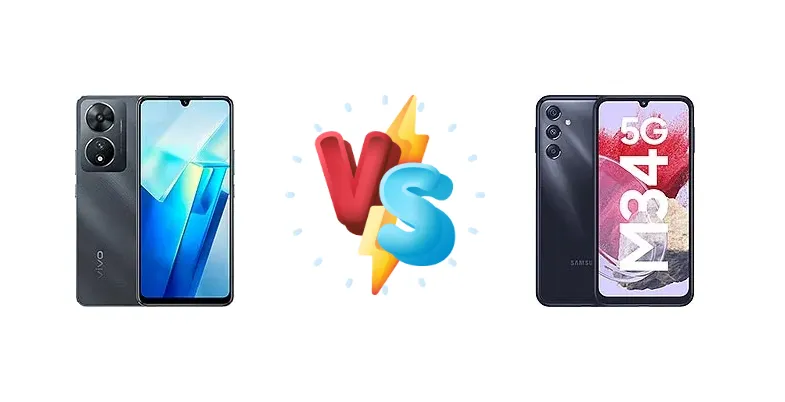
The sub-₹20,000 (approximately $240 USD) Indian smartphone market is fiercely competitive. The vivo T2 and Samsung Galaxy M34 5G both aim for the sweet spot of affordability and features, but take distinctly different approaches. The vivo T2 leverages Qualcomm’s Snapdragon 695 5G, while Samsung opts for its in-house Exynos 1280. This comparison dissects these choices, revealing which phone delivers the best experience for your money.
🏆 Quick Verdict
For most users, the Samsung Galaxy M34 5G emerges as the stronger contender. Its Exynos 1280 chipset, built on a more efficient 5nm process, provides a noticeable performance advantage in demanding tasks and offers better long-term stability. While the vivo T2’s 44W charging is faster, the M34’s overall package is more compelling.
| Network |
|---|
| 2G bands | GSM 850 / 900 / 1800 / 1900 | GSM 850 / 900 / 1800 / 1900 |
| 3G bands | HSDPA 850 / 900 / 2100 | HSDPA 850 / 900 / 1700(AWS) / 1900 / 2100 |
| 4G bands | 1, 3, 5, 8, 38, 40, 41 | 1, 2, 3, 4, 5, 7, 8, 12, 17, 20, 26, 28, 38, 40, 41, 66 |
| 5G bands | 1, 3, 8, 28, 77, 78 SA/NSA | 1, 3, 5, 7, 8, 28, 38, 40, 41, 66, 78 SA/NSA/Sub6 |
| Speed | HSPA, LTE, 5G | HSPA, LTE, 5G |
| Technology | GSM / HSPA / LTE / 5G | GSM / HSPA / LTE / 5G |
| Launch |
|---|
| Announced | 2023, April 11 | 2023, July 03 |
| Status | Available. Released 2023, April 18 | Available. Released 2023, July 15 |
| Body |
|---|
| Build | Glass front, plastic frame, plastic back | - |
| Dimensions | 158.9 x 73.5 x 7.8 mm (6.26 x 2.89 x 0.31 in) | 161.7 x 77.2 x 8.8 mm (6.37 x 3.04 x 0.35 in) |
| SIM | Nano-SIM + Nano-SIM | Nano-SIM + Nano-SIM |
| Weight | 172 g (6.07 oz) | 208 g (7.34 oz) |
| Display |
|---|
| Protection | - | Corning Gorilla Glass 5 |
| Resolution | 1080 x 2400 pixels, 20:9 ratio (~413 ppi density) | 1080 x 2340 pixels, 19.5:9 ratio (~396 ppi density) |
| Size | 6.38 inches, 98.3 cm2 (~84.1% screen-to-body ratio) | 6.5 inches, 103.7 cm2 (~83.1% screen-to-body ratio) |
| Type | AMOLED, 90Hz, 1300 nits (peak) | Super AMOLED, 120Hz, 1000 nits (peak) |
| Platform |
|---|
| CPU | Octa-core (2x2.2 GHz Kryo 660 Gold & 6x1.7 GHz Kryo 660 Silver) | Octa-core (2x2.4 GHz Cortex-A78 & 6x2.0 GHz Cortex-A55) |
| Chipset | Qualcomm SM6375 Snapdragon 695 5G (6 nm) | Exynos 1280 (5 nm) |
| GPU | Adreno 619 | Mali-G68 |
| OS | Android 13, Funtouch 13 | Android 13, upgradable to Android 16, One UI 8 |
| Memory |
|---|
| Card slot | microSDXC (uses shared SIM slot) | microSDXC (uses shared SIM slot) |
| Internal | 128GB 6GB RAM, 128GB 8GB RAM | 128GB 6GB RAM, 128GB 8GB RAM, 256GB 8GB RAM |
| Main Camera |
|---|
| Dual | 64 MP, f/1.8, (wide), 0.7µm, PDAF, OIS
Auxiliary lens | - |
| Features | LED flash, HDR, panorama | LED flash, panorama, HDR |
| Triple | - | 50 MP, f/1.8, (wide), PDAF, OIS
8 MP, f/2.2, 120˚ (ultrawide)
2 MP, f/2.4 |
| Video | 1080p@30fps | 4K@30fps, 1080p@30fps |
| Selfie camera |
|---|
| Single | 16 MP, f/2.0, (wide) | 13 MP, f/2.2, (wide) |
| Video | 1080p@30fps | 1080p@30fps |
| Sound |
|---|
| 3.5mm jack | Yes | - |
| 35mm jack | Yes | Yes |
| Loudspeaker | Yes | Yes |
| Comms |
|---|
| Bluetooth | 5.1, A2DP, LE | 5.3, A2DP, LE |
| NFC | No | Yes |
| Positioning | GPS, GLONASS, BDS, GALILEO, QZSS | GPS, GLONASS, GALILEO, BDS |
| Radio | No | FM radio |
| USB | USB Type-C 2.0, OTG | USB Type-C 2.0, OTG |
| WLAN | Wi-Fi 802.11 a/b/g/n/ac, dual-band | Wi-Fi 802.11 a/b/g/n/ac, dual-band, Wi-Fi Direct |
| Features |
|---|
| Sensors | Fingerprint (under display, optical), accelerometer, gyro, proximity, compass | Fingerprint (side-mounted), accelerometer, gyro, compass |
| Battery |
|---|
| Charging | 44W wired, 50% in 25 min | 25W wired |
| Type | 4500 mAh | Li-Po 6000 mAh |
| Misc |
|---|
| Colors | Nitro Blaze, Velocity Wave | Midnight Blue, Prism Silver, Waterfall Blue |
| Models | V2240, V2222 | SM-M346B, SM-M346B/DS, SM-M346B1, SM-M346B1/DS |
| Price | About 210 EUR | About 190 EUR |
| SAR | - | 0.89 W/kg (head) |
vivo T2 (India)
- Faster 44W charging
- Potentially lighter design (based on brand history)
- Competitive price point
- Less powerful Snapdragon 695 chipset
- 6nm process may lead to more thermal throttling
- Image processing likely inferior to Samsung
Samsung Galaxy M34 5G
- More powerful Exynos 1280 chipset
- 5nm process for better efficiency and sustained performance
- Potentially better camera image processing
- Slower 25W charging
- May be slightly heavier than the vivo T2
- Samsung’s One UI can be resource intensive
Display Comparison
Neither device boasts a standout display. Both likely utilize IPS LCD panels, a common choice in this price bracket. However, the lack of detailed display specs (resolution, peak brightness, color gamut) necessitates relying on brand tendencies. Samsung generally offers slightly more color-accurate displays, but the vivo T2’s potential for a higher refresh rate (not specified in the data) could be a differentiating factor. Bezels are likely comparable, and neither is expected to feature LTPO technology.
Camera Comparison
Without detailed camera specs beyond the presence of a chipset, a direct comparison is limited. However, Samsung’s image processing algorithms are generally more refined, potentially leading to more pleasing photos in various conditions. The absence of information regarding sensor sizes is critical; a larger sensor generally captures more light and detail. The inclusion of a 2MP macro camera on both devices is largely a marketing tactic, offering minimal practical benefit due to its low resolution and fixed focus. The Exynos 1280’s ISP (Image Signal Processor) is likely more capable, allowing for better noise reduction and dynamic range.
Performance
The core difference lies in the chipsets. The Samsung Galaxy M34 5G’s Exynos 1280 (5nm) has a clear architectural advantage over the vivo T2’s Snapdragon 695 5G (6nm). The Exynos utilizes two Cortex-A78 cores clocked at 2.4GHz, offering significantly higher single-core performance than the Snapdragon’s Kryo 660 Gold cores at 2.2GHz. This translates to snappier app launches and smoother multitasking. The 5nm fabrication process of the Exynos also contributes to better thermal efficiency, reducing the likelihood of throttling during extended gaming sessions. While both are octa-core CPUs, the Exynos’ core configuration and process node give it a substantial edge.
Battery Life
The vivo T2’s 44W wired charging is a significant advantage over the Samsung Galaxy M34 5G’s 25W charging. This means the T2 can replenish its battery much faster, reaching 50% charge in a claimed 25 minutes. While battery capacity isn’t specified, the faster charging is a tangible benefit for users who frequently need to top up their phones. However, the Exynos 1280’s superior power efficiency could offset the difference in battery capacity, potentially resulting in comparable real-world battery life despite the slower charging speed.
Buying Guide
Buy the vivo T2 (India) if you prioritize faster charging speeds and a lighter overall weight. It’s a good choice for users who primarily browse social media, make calls, and occasionally play less demanding games. Buy the Samsung Galaxy M34 5G if you value sustained performance for gaming, multitasking, and future-proofing, and are willing to trade off slightly slower charging for a more powerful processor.
Frequently Asked Questions
❓ Does the Exynos 1280 in the Galaxy M34 5G tend to overheat during prolonged gaming sessions?
While the Exynos 1280 isn't known for extreme overheating, sustained gaming will generate heat. However, its 5nm fabrication process is more efficient than the Snapdragon 695’s 6nm process, meaning it’s less prone to thermal throttling and will maintain higher performance for longer periods. Samsung also incorporates thermal management solutions within the device.
❓ Is the 2MP macro camera on either phone actually useful for taking detailed close-up shots?
Unfortunately, the 2MP macro cameras on both the vivo T2 and Galaxy M34 5G are largely marketing features. Their low resolution and fixed focus result in images that lack detail and sharpness. They are unlikely to provide a significant improvement over using the main camera in close-up mode.
❓ Can the Samsung Galaxy M34 5G reliably achieve 60fps in popular games like PUBG Mobile or Call of Duty Mobile?
The Exynos 1280 is capable of running PUBG Mobile and Call of Duty Mobile at 60fps, but achieving consistently smooth frame rates will depend on the graphics settings selected. High graphics settings may require reducing the frame rate to maintain stability. Expect a playable experience at medium to high settings with 60fps.
❓ How long does it realistically take to fully charge the vivo T2 (India) from 0% to 100% with the 44W charger?
While vivo claims 50% charge in 25 minutes, a full 0-100% charge with the 44W charger will likely take around 50-60 minutes. Charging speed slows down as the battery approaches full capacity to protect battery health.