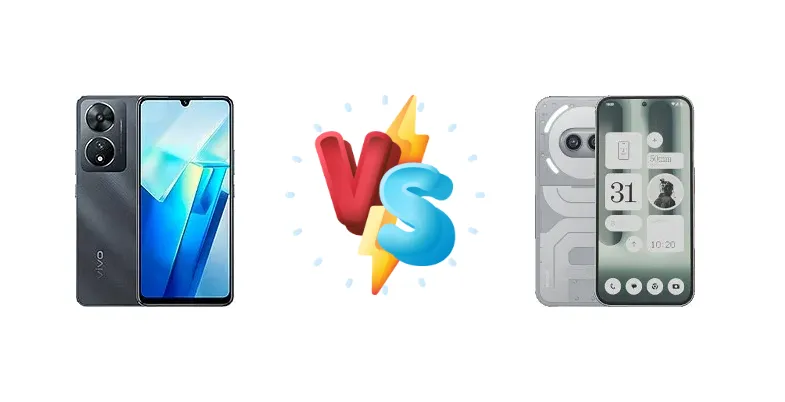
The mid-range smartphone market is fiercely competitive, and the vivo T2 (India) and Nothing Phone (2a) Plus represent compelling options. The T2 focuses on established brand recognition and a streamlined experience, while the Nothing Phone (2a) Plus aims to disrupt with a unique design and a more powerful chipset. This comparison dissects their key differences to help you choose the right device.
🏆 Quick Verdict
For most users, the Nothing Phone (2a) Plus emerges as the stronger contender. Its Mediatek Dimensity 7350 Pro chipset delivers significantly improved performance over the Snapdragon 695 in the vivo T2, and the superior display brightness enhances usability. While the vivo T2 offers a slightly faster initial charge, the Nothing Phone (2a) Plus’s overall package is more compelling.
| Network |
|---|
| 2G bands | GSM 850 / 900 / 1800 / 1900 | GSM 850 / 900 / 1800 / 1900 |
| 3G bands | HSDPA 850 / 900 / 2100 | HSDPA 800 / 850 / 900 / 1700(AWS) / 1900 / 2100 |
| 4G bands | 1, 3, 5, 8, 38, 40, 41 | 1, 3, 4, 5, 7, 8, 18, 19, 20, 26, 28, 38, 39, 40, 41, 42, 66 |
| 5G bands | 1, 3, 8, 28, 77, 78 SA/NSA | 1, 3, 5, 7, 8, 20, 28, 38, 40, 41, 66, 77, 78 SA/NSA |
| Speed | HSPA, LTE, 5G | HSPA, LTE, 5G |
| Technology | GSM / HSPA / LTE / 5G | GSM / HSPA / LTE / 5G |
| Launch |
|---|
| Announced | 2023, April 11 | 2024, July 31 |
| Status | Available. Released 2023, April 18 | Available. Released 2024, August 03 |
| Body |
|---|
| Build | Glass front, plastic frame, plastic back | Glass front (Gorilla Glass 5), plastic frame, plastic back |
| Dimensions | 158.9 x 73.5 x 7.8 mm (6.26 x 2.89 x 0.31 in) | 161.7 x 76.3 x 8.5 mm (6.37 x 3.00 x 0.33 in) |
| SIM | Nano-SIM + Nano-SIM | Nano-SIM + Nano-SIM |
| Weight | 172 g (6.07 oz) | 190 g (6.70 oz) |
| Display |
|---|
| Protection | - | Corning Gorilla Glass 5 |
| Resolution | 1080 x 2400 pixels, 20:9 ratio (~413 ppi density) | 1080 x 2412 pixels, 20:9 ratio (~395 ppi density) |
| Size | 6.38 inches, 98.3 cm2 (~84.1% screen-to-body ratio) | 6.7 inches, 107.5 cm2 (~87.1% screen-to-body ratio) |
| Type | AMOLED, 90Hz, 1300 nits (peak) | AMOLED, 1B colors, 120Hz, 2160Hz PWM, HDR10+, 700 nits (typ), 1100 nits (HBM), 1300 nits (peak) |
| Platform |
|---|
| CPU | Octa-core (2x2.2 GHz Kryo 660 Gold & 6x1.7 GHz Kryo 660 Silver) | Octa-core (2x3.0 GHz Cortex-A715 & 6x 2.0 GHz Cortex-A510) |
| Chipset | Qualcomm SM6375 Snapdragon 695 5G (6 nm) | Mediatek Dimensity 7350 Pro (4 nm) |
| GPU | Adreno 619 | Mali-G610 MC4 |
| OS | Android 13, Funtouch 13 | Android 14, up to 3 major Android upgrades, Nothing OS 3.0 |
| Memory |
|---|
| Card slot | microSDXC (uses shared SIM slot) | No |
| Internal | 128GB 6GB RAM, 128GB 8GB RAM | 256GB 8GB RAM, 256GB 12GB RAM |
| Main Camera |
|---|
| Dual | 64 MP, f/1.8, (wide), 0.7µm, PDAF, OIS
Auxiliary lens | 50 MP, f/1.9, 24mm (wide), 1/1.57", 1.0µm, PDAF, OIS
50 MP, f/2.2, 114˚ (ultrawide), 1/2.76", 0.64µm |
| Features | LED flash, HDR, panorama | LED flash, panorama, HDR |
| Video | 1080p@30fps | 4K@30fps, 1080p@60/120fps, gyro-EIS |
| Selfie camera |
|---|
| Features | - | HDR |
| Single | 16 MP, f/2.0, (wide) | 50 MP, f/2.2, (wide), 1/2.76" |
| Video | 1080p@30fps | 4K@30fps |
| Sound |
|---|
| 3.5mm jack | Yes | - |
| 35mm jack | Yes | No |
| Loudspeaker | Yes | Yes, with stereo speakers |
| Comms |
|---|
| Bluetooth | 5.1, A2DP, LE | 5.3, A2DP, LE |
| NFC | No | Yes, 360˚ |
| Positioning | GPS, GLONASS, BDS, GALILEO, QZSS | GPS, GALILEO, GLONASS, BDS, QZSS |
| Radio | No | No |
| USB | USB Type-C 2.0, OTG | USB Type-C 2.0, OTG |
| WLAN | Wi-Fi 802.11 a/b/g/n/ac, dual-band | Wi-Fi 802.11 a/b/g/n/ac/6, dual-band, Wi-Fi Direct |
| Features |
|---|
| Sensors | Fingerprint (under display, optical), accelerometer, gyro, proximity, compass | Fingerprint (under display, optical), accelerometer, gyro, proximity, compass |
| Battery |
|---|
| Charging | 44W wired, 50% in 25 min | 50W wired, 50% in 21 min, 100% in 56 min |
| Type | 4500 mAh | 5000 mAh |
| Misc |
|---|
| Colors | Nitro Blaze, Velocity Wave | Black, Grey |
| Models | V2240, V2222 | A142P |
| Price | About 210 EUR | € 269.90 / ₹ 22,599 |
vivo T2 (India)
- Potentially lower price point
- Familiar Android experience
- Faster initial charging (to 50%)
- Significantly weaker processor
- Likely inferior display brightness
- Potentially shorter battery life
Nothing Phone (2a) Plus
- Superior processor performance
- Brighter and more vibrant display
- Longer battery life (16:34h active use)
- Potentially higher price
- Unique design may not appeal to everyone
- Slightly slower full charge time compared to initial 50%
Display Comparison
The Nothing Phone (2a) Plus boasts a significant advantage in display quality, achieving a measured peak brightness of 1097 nits. This is crucial for outdoor visibility, a scenario where the vivo T2’s unspecified brightness will likely struggle. While both likely utilize AMOLED panels, the Nothing Phone (2a) Plus’s higher peak brightness translates to a more dynamic and enjoyable viewing experience. The absence of LTPO technology on either device suggests both will rely on adaptive refresh rates to conserve battery, but the superior brightness of the Nothing Phone (2a) Plus provides a more versatile display.
Camera Comparison
Without detailed camera specifications for the vivo T2, a direct comparison is limited. However, given its price point, it likely features a standard camera setup. The Nothing Phone (2a) Plus, while details are missing, benefits from the Dimensity 7350 Pro’s enhanced image signal processor (ISP). This ISP allows for faster image processing and improved noise reduction, potentially resulting in better low-light performance. The focus should be on the main sensor resolution and aperture; a larger sensor with a wider aperture will capture more light and produce better images. Ignoring the typical 2MP macro lenses found on both devices, the primary camera capabilities will be the deciding factor.
Performance
The core difference lies in the chipsets: the vivo T2 utilizes the Qualcomm Snapdragon 695 5G (6nm), while the Nothing Phone (2a) Plus is powered by the Mediatek Dimensity 7350 Pro (4nm). The Dimensity 7350 Pro, with its Cortex-A715 cores clocked at 3.0 GHz, represents a substantial leap in CPU performance compared to the Snapdragon 695’s Kryo 660 Gold cores at 2.2 GHz. The 4nm process node of the Dimensity 7350 Pro also contributes to improved thermal efficiency, meaning sustained performance will be higher. This translates to smoother multitasking, faster app loading times, and a more responsive gaming experience on the Nothing Phone (2a) Plus.
Battery Life
The Nothing Phone (2a) Plus demonstrates superior battery performance with an active use score of 16:34 hours. While the vivo T2’s battery capacity is unknown, the Nothing Phone (2a) Plus’s efficiency, coupled with the 4nm Dimensity 7350 Pro, provides a clear advantage. Charging speeds are competitive: 44W for the vivo T2 (50% in 25 minutes) versus 50W for the Nothing Phone (2a) Plus (50% in 21 minutes, 100% in 56 minutes). The Nothing Phone (2a) Plus offers a faster full charge, and its overall battery life is demonstrably longer.
Buying Guide
Buy the vivo T2 (India) if you prioritize a familiar Android experience, a slightly quicker initial charging speed, and are operating on a very tight budget. Buy the Nothing Phone (2a) Plus if you value performance for gaming and demanding apps, a brighter and more vibrant display, and a longer-lasting battery life, even if it means spending a bit more.
Frequently Asked Questions
❓ Does the Mediatek Dimensity 7350 Pro in the Nothing Phone (2a) Plus tend to overheat during prolonged gaming sessions?
The Dimensity 7350 Pro, built on a 4nm process, is generally efficient and manages thermals well. While some heat generation is inevitable during intensive gaming, the Nothing Phone (2a) Plus’s thermal design should prevent significant throttling, allowing for sustained performance. The 4nm node is a key advantage over the 6nm Snapdragon 695 in the vivo T2, which is more prone to throttling.
❓ How does the 50W charging on the Nothing Phone (2a) Plus compare to the 44W charging on the vivo T2 in real-world usage?
While the vivo T2 charges to 50% slightly faster (25 minutes vs. 21 minutes), the Nothing Phone (2a) Plus completes a full charge in 56 minutes, which is faster than the unspecified full charge time of the vivo T2. The difference in full charge time is more significant for users who frequently need a complete top-up.
❓ Is the Nothing Phone (2a) Plus’s software experience significantly different from standard Android, and is it a positive change?
The Nothing Phone (2a) Plus runs Nothing OS, a near-stock Android experience with a unique visual design and a focus on simplicity. It offers a cleaner interface and fewer pre-installed apps compared to many other Android phones, including those from vivo. This is generally considered a positive change for users who prefer a minimalist and bloatware-free experience.