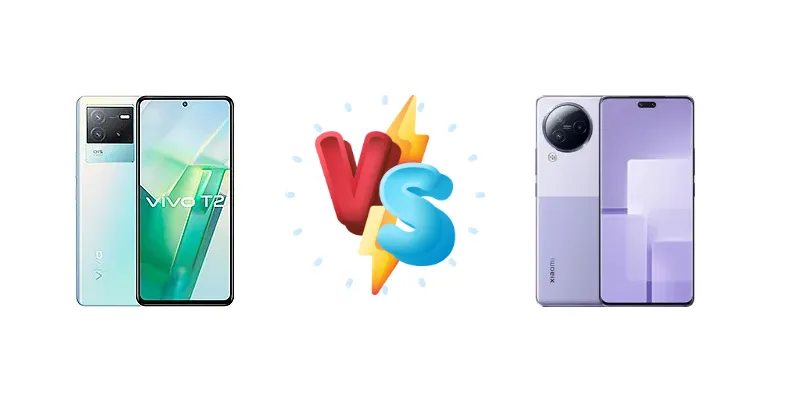
The vivo T2 (China) and Xiaomi Civi 3 represent compelling options in the increasingly competitive mid-range smartphone market. The T2 leverages the proven Snapdragon 870, while the Civi 3 debuts with the newer, more efficient Dimensity 8200-Ultra. This comparison dissects these key differences, focusing on performance, charging speed, and overall user experience to determine which device offers the best value.
🏆 Quick Verdict
For most users, the Xiaomi Civi 3 emerges as the stronger choice. The Dimensity 8200-Ultra’s 4nm process provides a noticeable efficiency advantage, translating to better sustained performance and potentially longer battery life, despite the slightly slower 67W charging compared to the vivo T2’s 80W.
| Network |
|---|
| 2G bands | GSM 850 / 900 / 1800 / 1900 | GSM 850 / 900 / 1800 / 1900 |
| 3G bands | HSDPA 850 / 900 / 1700(AWS) / 2100 | HSDPA 800 / 850 / 900 / 1700(AWS) / 1900 / 2100 |
| 4G bands | 1, 3, 4, 5, 8, 28, 34, 38, 39, 40, 41 | 1, 3, 4, 5, 8, 18, 19, 26, 34, 38, 39, 40, 41, 42 |
| 5G bands | 1, 5, 8, 28, 41, 77, 78 SA/NSA | 1, 3, 5, 8, 28, 38, 41, 77, 78 SA/NSA |
| Speed | HSPA, LTE, 5G | HSPA, LTE, 5G |
| Technology | GSM / CDMA / HSPA / CDMA2000 / LTE / 5G | GSM / CDMA / HSPA / CDMA2000 / LTE / 5G |
| Launch |
|---|
| Announced | 2022, May 23 | 2023, May 25 |
| Status | Cancelled | Available. Released 2023, May 25 |
| Body |
|---|
| Build | - | Glass front (Gorilla Glass 5), glass back, aluminum frame |
| Dimensions | 163 x 76.2 x 8.5 mm (6.42 x 3.00 x 0.33 in) | 158.7 x 71.7 x 7.6 mm (6.25 x 2.82 x 0.30 in) |
| SIM | Nano-SIM + Nano-SIM | Nano-SIM + Nano-SIM |
| Weight | 190 g (6.70 oz) | 174 g (6.14 oz) |
| Display |
|---|
| Protection | - | Corning Gorilla Glass 5 |
| Resolution | 1080 x 2400 pixels, 20:9 ratio (~398 ppi density) | 1080 x 2400 pixels, 20:9 ratio (~402 ppi density) |
| Size | 6.62 inches, 105.8 cm2 (~85.2% screen-to-body ratio) | 6.55 inches, 103.6 cm2 (~91.0% screen-to-body ratio) |
| Type | AMOLED, 120Hz, HDR10+, 1300 nits (peak) | AMOLED, 68B colors, 120Hz, Dolby Vision, HDR10+, 1500 nits (peak) |
| Platform |
|---|
| CPU | Octa-core (1x3.2 GHz Kryo 585 & 3x2.42 GHz Kryo 585 & 4x1.80 GHz Kryo 585) | Octa-core (1x3.1 GHz Cortex-A78 & 3x3.0 GHz Cortex-A78 & 4x2.0 GHz Cortex-A55) |
| Chipset | Qualcomm SM8250-AC Snapdragon 870 5G (7 nm) | Mediatek Dimensity 8200 Ultra (4 nm) |
| GPU | Adreno 650 | Mali-G610 MC6 |
| OS | Android 12, OriginOS Ocean | Android 13, MIUI 14 |
| Memory |
|---|
| Card slot | No | No |
| Internal | 128GB 8GB RAM, 256GB 8GB RAM, 256GB 12GB RAM | 256GB 12GB RAM, 512GB 12GB RAM, 1TB 16GB RAM |
| Main Camera |
|---|
| Features | LED flash, HDR, panorama | Color spectrum sensor, Quad-LED dual-tone flash, HDR, panorama |
| Triple | 64 MP, f/1.9, (wide), PDAF, OIS
8 MP, f/2.2, 116˚ (ultrawide)
2 MP (macro) | 50 MP, f/1.8, (wide), 1/1.49", 1.0µm, PDAF, OIS
8 MP, f/2.2, 115˚ (ultrawide), 1.12µm
2 MP (macro) |
| Video | 4K@30fps, 1080p@30fps | 4K@30fps, 1080p@30/60/120fps, 720p@960fps; gyro-EIS |
| Selfie camera |
|---|
| Dual | - | 32 MP, f/2.0, 26mm (wide), 1/2.8", 0.8µm, AF
32 MP, f/2.4, 100˚ (ultrawide), 1/2.8", 0.8µm |
| Features | HDR | 2 Dual-LED dual-tone flash, HDR, panorama |
| Single | 16 MP, f/2.0, (wide) | - |
| Video | 1080p@30fps | 4K@30fps, 1080p@30/60fps; gyro-EIS |
| Sound |
|---|
| 35mm jack | Yes | No |
| Loudspeaker | Yes, with dual speakers | Yes, with stereo speakers |
| Comms |
|---|
| Bluetooth | 5.2, A2DP, LE, aptX HD, aptX Adaptive | 5.3, A2DP, LE |
| Infrared port | Yes | Yes |
| NFC | Yes | Yes |
| Positioning | GPS, GLONASS, GALILEO, BDS, QZSS | GPS (L1), GLONASS (G1), BDS (B1I+B1c), GALILEO (E1), QZSS (L1) |
| Radio | No | No |
| USB | USB Type-C 2.0, OTG | USB Type-C 2.0, OTG |
| WLAN | Wi-Fi 802.11 a/b/g/n/ac, dual-band, Wi-Fi Direct | Wi-Fi 802.11 a/b/g/n/ac/6, dual-band, Wi-Fi Direct |
| Features |
|---|
| Sensors | Fingerprint (under display, optical), accelerometer, gyro, proximity, compass | Fingerprint (under display, optical), accelerometer, gyro, proximity, compass |
| Battery |
|---|
| Charging | 80W wired | 67W wired, PD3.0, 100% in 38 minutes |
| Type | 4700 mAh | Li-Po 4500 mAh |
| Misc |
|---|
| Colors | Black, Mint | Purple, Mint, Gold, Gray |
| Models | V2199GA | 23046PNC9C |
| Price | - | About 330 EUR |
vivo T2 (China)
- Faster 80W wired charging
- Proven Snapdragon 870 performance
- Potentially lower price (depending on market)
- Older 7nm manufacturing process
- Potentially less efficient power consumption
- May lack the latest features found in the Civi 3
Xiaomi Civi 3
- More efficient Dimensity 8200-Ultra (4nm)
- Potentially better sustained performance
- Modern chipset architecture
- Slower 67W wired charging
- May be slightly more expensive
- Performance gains may not be noticeable in all scenarios
Display Comparison
Neither device’s display specifications are provided, so a direct comparison is limited. However, given the Civi 3’s positioning, it likely features an AMOLED panel with a high refresh rate, common in its price bracket. The T2, while potentially also AMOLED, may prioritize cost savings. The key difference will likely be in peak brightness and color accuracy, with the Civi 3 potentially offering a more vibrant and color-accurate display. Bezels are expected to be minimal on both, reflecting current design trends.
Camera Comparison
Without detailed camera specifications, a precise comparison is difficult. However, the Xiaomi Civi 3, given its marketing focus, likely prioritizes selfie camera quality. Both phones will likely feature multi-camera setups, but the sensor size of the main camera will be a critical differentiator. A larger sensor generally captures more light, resulting in better low-light performance. Image processing algorithms will also play a significant role, with Xiaomi typically favoring vibrant, social media-ready images, while vivo often aims for more natural color reproduction. We can assume both will have standard wide and ultrawide lenses, but details on OIS (Optical Image Stabilization) are unknown.
Performance
The core battleground is the chipset. The Xiaomi Civi 3’s Mediatek Dimensity 8200-Ultra, built on a 4nm process, represents a significant architectural leap over the vivo T2’s Snapdragon 870 (7nm). While the Snapdragon 870 remains a capable performer, the Dimensity 8200-Ultra’s newer Cortex-A78 cores and more efficient manufacturing process deliver superior sustained performance and thermal management. The Snapdragon 870’s octa-core configuration (1x3.2 GHz Kryo 585, 3x2.42 GHz Kryo 585, 4x1.80 GHz Kryo 585) is a proven design, but the Dimensity 8200-Ultra (1x3.1 GHz Cortex-A78, 3x3.0 GHz Cortex-A78, 4x2.0 GHz Cortex-A55) benefits from newer core designs. The 4nm node allows for higher transistor density and lower power consumption, reducing throttling during demanding tasks like gaming.
Battery Life
The vivo T2 boasts 80W wired charging, promising significantly faster top-up times than the Xiaomi Civi 3’s 67W charging. Xiaomi claims a 100% charge in 38 minutes, while the T2’s charging time is not specified but will likely be faster. However, battery life is not solely determined by charging speed. The Dimensity 8200-Ultra’s 4nm efficiency could offset the T2’s faster charging, resulting in comparable or even better real-world battery endurance. The actual mAh capacity of each device is crucial, but without that information, we can only speculate on overall battery life.
Buying Guide
Buy the vivo T2 (China) if you prioritize the absolute fastest charging speeds and are comfortable with a slightly older, though still potent, chipset. It’s ideal for users who frequently top up their phones and demand quick power boosts. Buy the Xiaomi Civi 3 if you value a more modern, efficient processor, potentially better thermal management during extended use, and a refined user experience, even if it means sacrificing a bit of charging speed.
Frequently Asked Questions
❓ Will the Snapdragon 870 in the vivo T2 struggle with demanding games like Genshin Impact?
The Snapdragon 870 is still a capable gaming chip, but it may require lower graphics settings in very demanding titles like Genshin Impact to maintain stable frame rates and prevent overheating. The Dimensity 8200-Ultra in the Civi 3 will likely offer a smoother experience with higher settings due to its more efficient architecture.
❓ How much faster is the 80W charging on the vivo T2 compared to the 67W charging on the Xiaomi Civi 3 in real-world use?
While the T2’s 80W charging is faster, the difference in practical terms may not be massive. The Civi 3’s 67W charging still delivers a full charge in a respectable 38 minutes. The T2 will likely shave off 10-15 minutes, but the efficiency of the Dimensity 8200-Ultra could mean you don't need to charge as frequently.
❓ Does the Dimensity 8200-Ultra in the Xiaomi Civi 3 get hot during prolonged gaming sessions?
The Dimensity 8200-Ultra’s 4nm process is designed to minimize heat generation. While some heat is inevitable during intense gaming, it’s expected to be better managed than the Snapdragon 870, reducing the likelihood of significant performance throttling.