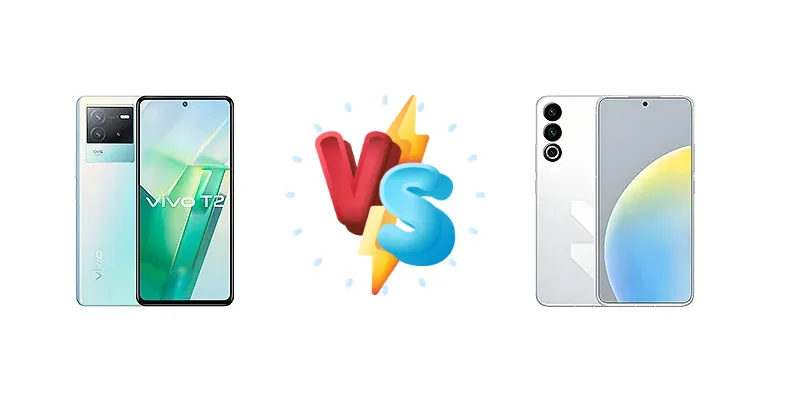
The Meizu 20 Classic and vivo T2 (China) represent distinct approaches to the competitive smartphone market. The Meizu aims for a premium experience with the latest Snapdragon 8 Gen 2, while the vivo T2 leverages the still-capable Snapdragon 870 to deliver strong performance at a potentially lower price point. This comparison dissects the key differences to determine which device offers the best value for your money.
🏆 Quick Verdict
For most users, the Meizu 20 Classic is the superior choice. The Snapdragon 8 Gen 2 provides a significant performance uplift and improved efficiency over the Snapdragon 870 in the vivo T2, justifying the likely price premium. However, the vivo T2 remains a compelling option for budget-conscious gamers who prioritize raw power over all else.
| Network |
|---|
| 2G bands | GSM 850 / 900 / 1800 / 1900 | GSM 850 / 900 / 1800 / 1900 |
| 3G bands | HSDPA 850 / 900 / 1700(AWS) / 2100 | HSDPA 800 / 850 / 900 / 1900 / 2100 |
| 4G bands | 1, 3, 4, 5, 8, 28, 34, 38, 39, 40, 41 | 1, 2, 3, 4, 5, 7, 8, 12, 28, 34, 38, 39, 40, 41 |
| 5G bands | 1, 5, 8, 28, 41, 77, 78 SA/NSA | 1, 3, 5, 8, 28, 38, 41, 77, 78 SA/NSA |
| Speed | HSPA, LTE, 5G | HSPA, LTE, 5G |
| Technology | GSM / CDMA / HSPA / CDMA2000 / LTE / 5G | GSM / HSPA / LTE / 5G |
| Launch |
|---|
| Announced | 2022, May 23 | 2023, October 19 |
| Status | Cancelled | Available. Released 2023, October 31 |
| Body |
|---|
| Dimensions | 163 x 76.2 x 8.5 mm (6.42 x 3.00 x 0.33 in) | 157.9 x 73.5 x 8 mm (6.22 x 2.89 x 0.31 in) |
| SIM | Nano-SIM + Nano-SIM | Nano-SIM + Nano-SIM |
| Weight | 190 g (6.70 oz) | 190 g (6.70 oz) |
| Display |
|---|
| Resolution | 1080 x 2400 pixels, 20:9 ratio (~398 ppi density) | 1080 x 2400 pixels, 20:9 ratio (~402 ppi density) |
| Size | 6.62 inches, 105.8 cm2 (~85.2% screen-to-body ratio) | 6.55 inches, 103.6 cm2 (~89.2% screen-to-body ratio) |
| Type | AMOLED, 120Hz, HDR10+, 1300 nits (peak) | OLED, 1B colors, 144Hz, 500 nits (typ), 800 nits (HBM) |
| Platform |
|---|
| CPU | Octa-core (1x3.2 GHz Kryo 585 & 3x2.42 GHz Kryo 585 & 4x1.80 GHz Kryo 585) | Octa-core (1x3.2 GHz Cortex-X3 & 2x2.8 GHz Cortex-A715 & 2x2.8 GHz Cortex-A710 & 3x2.0 GHz Cortex-A510) |
| Chipset | Qualcomm SM8250-AC Snapdragon 870 5G (7 nm) | Qualcomm SM8550-AB Snapdragon 8 Gen 2 (4 nm) |
| GPU | Adreno 650 | Adreno 740 |
| OS | Android 12, OriginOS Ocean | Android 13, Flyme 10 |
| Memory |
|---|
| Card slot | No | No |
| Internal | 128GB 8GB RAM, 256GB 8GB RAM, 256GB 12GB RAM | 256GB 16GB RAM, 512GB 16GB RAM |
| Main Camera |
|---|
| Features | LED flash, HDR, panorama | Ring-LED flash, panorama, HDR |
| Triple | 64 MP, f/1.9, (wide), PDAF, OIS
8 MP, f/2.2, 116˚ (ultrawide)
2 MP (macro) | 50 MP, f/1.9, 24mm (wide), 1/1.56", PDAF, OIS
16 MP, f/2.4, 16mm, 122˚ (ultrawide)
5 MP, f/2.4 |
| Video | 4K@30fps, 1080p@30fps | 8K, 4K, 1080p; gyro-EIS |
| Selfie camera |
|---|
| Features | HDR | HDR |
| Single | 16 MP, f/2.0, (wide) | 32 MP, f/2.5, (wide) |
| Video | 1080p@30fps | Yes |
| Sound |
|---|
| 35mm jack | Yes | No |
| Loudspeaker | Yes, with dual speakers | Yes, with stereo speakers |
| Comms |
|---|
| Bluetooth | 5.2, A2DP, LE, aptX HD, aptX Adaptive | 5.3, A2DP, LE |
| Infrared port | Yes | - |
| NFC | Yes | Yes |
| Positioning | GPS, GLONASS, GALILEO, BDS, QZSS | GPS (L1+L5), GLONASS, BDS (B1I+B1c+B2a), GALILEO, QZSS |
| Radio | No | No |
| USB | USB Type-C 2.0, OTG | USB Type-C, OTG |
| WLAN | Wi-Fi 802.11 a/b/g/n/ac, dual-band, Wi-Fi Direct | Wi-Fi 802.11 а/b/g/n/ac/6e/7, dual-band |
| Features |
|---|
| Sensors | Fingerprint (under display, optical), accelerometer, gyro, proximity, compass | Fingerprint (under display, ultrasonic), accelerometer, gyro, proximity, compass |
| Battery |
|---|
| Charging | 80W wired | 67W wired, PD3 PPS, QC4+ |
| Type | 4700 mAh | Li-Po 4700 mAh |
| Misc |
|---|
| Colors | Black, Mint | Gray, Silver, Green |
| Models | V2199GA | - |
| Price | - | About 400 EUR |
vivo T2 (China)
- Faster processor with Snapdragon 870
- 80W fast charging
- Potentially more affordable price
- Older 7nm process node leads to lower efficiency
- Less powerful GPU compared to the 8 Gen 2
- Potentially more thermal throttling
Meizu 20 Classic
- Flagship-level performance with Snapdragon 8 Gen 2
- Superior thermal efficiency due to 4nm process
- Advanced charging standards (PD3 PPS, QC4+)
- Likely higher price point
- Slightly slower wired charging (67W)
Display Comparison
While display specifications are missing for the vivo T2, the Meizu 20 Classic is expected to feature a high-quality AMOLED panel. The core difference lies in the processing power driving the display. The Snapdragon 8 Gen 2’s integrated display engine offers superior image processing capabilities, potentially resulting in more vibrant colors and smoother animations. The Meizu 20 Classic also supports advanced charging protocols like PD3 PPS and QC4+, which are not present in the vivo T2.
Camera Comparison
Without detailed camera specs for either device, it’s difficult to make a definitive judgment. However, the processing capabilities of the Snapdragon 8 Gen 2 in the Meizu 20 Classic will likely result in superior image processing, including better noise reduction, dynamic range, and detail preservation. The 8 Gen 2’s ISP (Image Signal Processor) is significantly more advanced than the 870’s, allowing for faster and more efficient image capture and processing. The Meizu 20 Classic is likely to offer more sophisticated computational photography features.
Performance
The performance gap is the most significant differentiator. The Meizu 20 Classic’s Snapdragon 8 Gen 2 (4nm) boasts a newer CPU architecture – Cortex-X3, A715, and A710 cores – compared to the vivo T2’s Snapdragon 870 (7nm). This translates to a substantial increase in both single-core and multi-core performance. The 4nm process node of the 8 Gen 2 also provides superior thermal efficiency, meaning the Meizu 20 Classic is less likely to throttle under sustained load, crucial for demanding games and applications. The Snapdragon 870 remains capable, but the 8 Gen 2 offers a generational leap in processing power.
Battery Life
The vivo T2 features 80W wired charging, potentially offering faster 0-100% times than the Meizu 20 Classic’s 67W charging. However, the Snapdragon 8 Gen 2’s improved efficiency means the Meizu 20 Classic will likely consume less power during typical usage, potentially offsetting the charging speed difference. The Meizu 20 Classic’s support for PD3 PPS and QC4+ also ensures compatibility with a wider range of chargers and optimized charging profiles.
Buying Guide
Buy the vivo T2 (China) if you need a powerful gaming phone on a tighter budget and are willing to accept slightly lower efficiency and potentially more thermal throttling during extended sessions. Buy the Meizu 20 Classic if you prefer a more refined, efficient experience with flagship-level performance, faster charging standards, and a more modern chipset architecture for future-proofing.
Frequently Asked Questions
❓ Will the Snapdragon 870 in the vivo T2 struggle with demanding games like Genshin Impact?
While the Snapdragon 870 is capable, it may exhibit more noticeable frame drops and thermal throttling during extended Genshin Impact sessions compared to the Snapdragon 8 Gen 2 in the Meizu 20 Classic. Lowering graphics settings can mitigate this, but the 8 Gen 2 offers a smoother, more consistent experience.
❓ Does the Meizu 20 Classic's 67W charging feel significantly slower than the vivo T2's 80W?
In practice, the difference between 67W and 80W charging isn't always dramatic. The Meizu 20 Classic's more efficient chipset means it may require less overall charging time, partially offsetting the wattage difference. Both phones should still offer reasonably fast charging speeds.
❓ Is the Snapdragon 870 still a viable option for long-term software support?
The Snapdragon 870 is a well-supported chipset, but the Snapdragon 8 Gen 2 will likely receive updates for a longer period. Meizu will likely provide more extensive software support for the 20 Classic due to its newer processor.